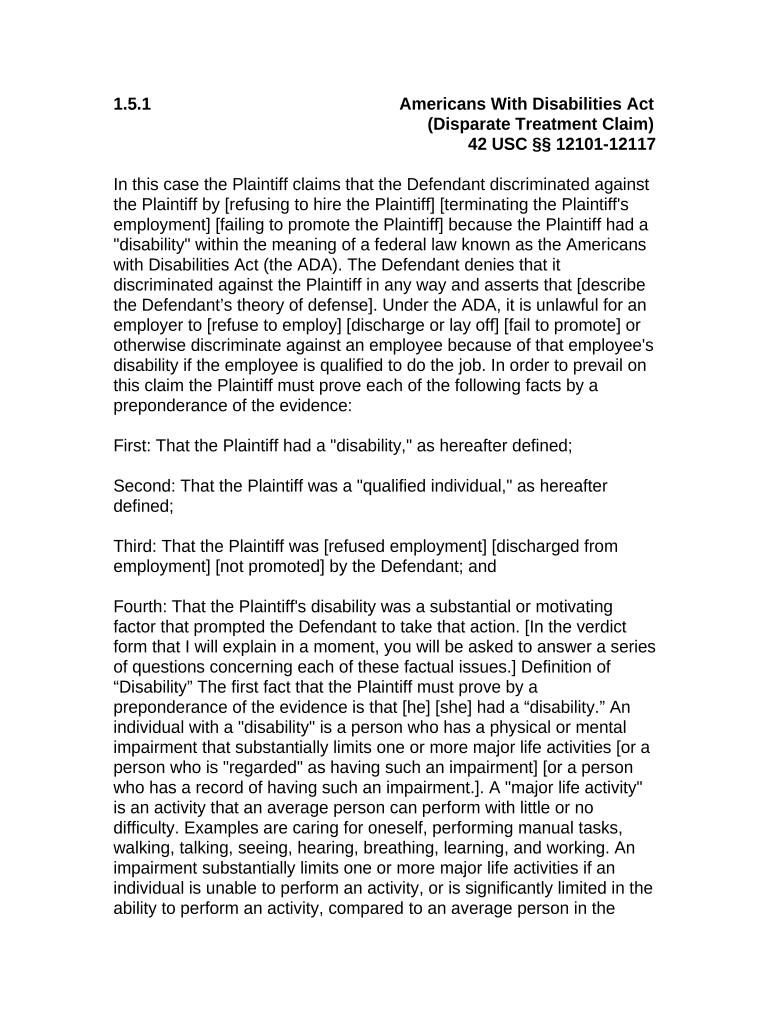
Jury Instruction - 1.5.1 Americans With Disabilities Act 42 USC Sect. 12101 - 12117 Disparate Treatment Claim 2026

Get Form
Jury Instruction - 1.5.1 Americans With Disabilities Act 42 USC Sect. 12101 - 12117 Disparate Treatment Claim Preview on Page 1

Here's how it works

01. Edit your form online
Type text, add images, blackout confidential details, add comments, highlights and more.
02. Sign it in a few clicks
Draw your signature, type it, upload its image, or use your mobile device as a signature pad.
03. Share your form with others
Send it via email, link, or fax. You can also download it, export it or print it out.

The best way to edit Jury Instruction - 1.5.1 Americans With Disabilities Act 42 USC Sect. 12101 - 12117 Disparate Treatment Claim in PDF format online

Form edit decoration
9.5
Ease of Setup
DocHub User Ratings on G2
9.0
Ease of Use
DocHub User Ratings on G2

Adjusting documents with our extensive and intuitive PDF editor is easy. Adhere to the instructions below to complete Jury Instruction - 1.5.1 Americans With Disabilities Act 42 USC Sect. 12101 - 12117 Disparate Treatment Claim online quickly and easily:

  1. Sign in to your account. Sign up with your credentials or create a free account to try the service prior to upgrading the subscription.
  2. Import a form. Drag and drop the file from your device or add it from other services, like Google Drive, OneDrive, Dropbox, or an external link.
  3. Edit Jury Instruction - 1.5.1 Americans With Disabilities Act 42 USC Sect. 12101 - 12117 Disparate Treatment Claim. Effortlessly add and highlight text, insert images, checkmarks, and icons, drop new fillable areas, and rearrange or delete pages from your paperwork.
  4. Get the Jury Instruction - 1.5.1 Americans With Disabilities Act 42 USC Sect. 12101 - 12117 Disparate Treatment Claim completed. Download your adjusted document, export it to the cloud, print it from the editor, or share it with other participants via a Shareable link or as an email attachment.

Take advantage of DocHub, one of the most easy-to-use editors to rapidly handle your documentation online!

be ready to get more

Complete this form in 5 minutes or less

Get form

Got questions?

We have answers to the most popular questions from our customers. If you can't find an answer to your question, please contact us.
Contact us
42 USC 12132. Subject to the provisions of this title, no qualified individual with a disability shall, by reason of such disability, be excluded from participation in or be denied the benefits of the services, programs, or activities of a public entity, or be subjected to discrimination by any such entity.
Disparate treatment refers to intentional discrimination, where people in a protected class are deliberately treated differently. This is the most common type of discrimination. An example of this would be an employer giving a certain test to applicants with disabilities but not to applicants without disabilities.
The Americans with Disabilities Act (ADA) became law in 1990. The ADA is a civil rights law that prohibits discrimination against individuals with disabilities in all areas of public life, including jobs, schools, transportation, and all public and private places that are open to the general public.
The ADA prohibits discrimination on the basis of disability in employment, State and local government, public accommodations, commercial facilities, transportation, and telecommunications.
(1) DisabilityThe term disability means, with respect to an individual (A) a physical or mental impairment that substantially limits one or more major life activities of such individual; (B) a record of such an impairment; or.

Security and compliance

At DocHub, your data security is our priority. We follow HIPAA, SOC2, GDPR, and other standards, so you can work on your documents with confidence.

Learn more
ccpa2
pci-dss
gdpr-compliance
hipaa
soc-compliance
be ready to get more

Complete this form in 5 minutes or less

Get form

People also ask

(A) An individual meets the requirement of being regarded as having such an impair- ment if the individual establishes that he or she has been subjected to an action pro- hibited under this chapter because of an ac- tual or perceived physical or mental impair- ment whether or not the impairment limits or is
Youre disabled under the Equality Act 2010 if you have a physical or mental impairment that has a substantial and long-term negative effect on your ability to do normal daily activities. The Equality Act 2010 does not apply to Northern Ireland.
The ADA states, [i]t is the purpose of this [Act] (1) to provide a clear and comprehensive national mandate for the elimination of discrimination against individuals with disabilities; [and] (2) to provide clear, strong, consistent, enforceable standards addressing discrimination against individuals with disabilities[

Related links