Jury instruction damages 2026

Get Form
jury instruction damages Preview on Page 1

Here's how it works

01. Edit your form online
Type text, add images, blackout confidential details, add comments, highlights and more.
02. Sign it in a few clicks
Draw your signature, type it, upload its image, or use your mobile device as a signature pad.
03. Share your form with others
Send it via email, link, or fax. You can also download it, export it or print it out.

How to use or fill out jury instruction damages with our platform

Form edit decoration
9.5
Ease of Setup
DocHub User Ratings on G2
9.0
Ease of Use
DocHub User Ratings on G2
  1. Click ‘Get Form’ to open the jury instruction damages document in the editor.
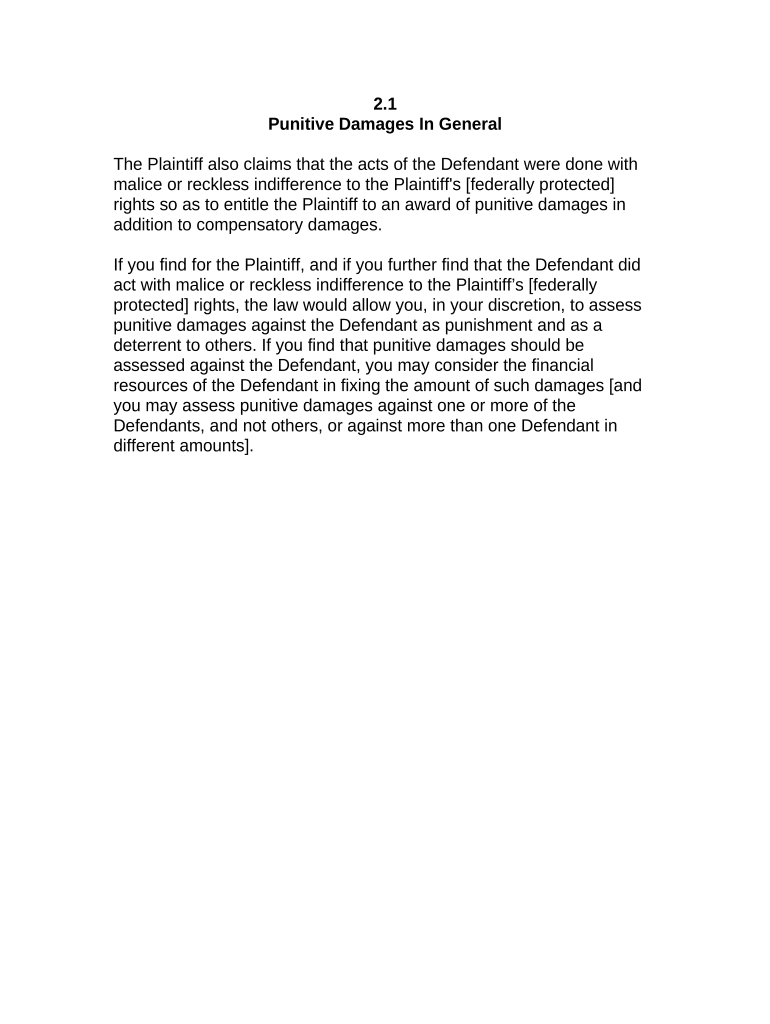
  2. Begin by reviewing the section on punitive damages. Understand that this part addresses the criteria for awarding punitive damages based on the Defendant's actions.
  3. Locate the field where you can indicate whether you find for the Plaintiff. This is crucial as it sets the foundation for any potential award of punitive damages.
  4. Next, assess if you believe the Defendant acted with malice or reckless indifference. Use the provided checkboxes or text fields to clearly express your findings.
  5. If applicable, enter any considerations regarding the financial resources of the Defendant when determining punitive damage amounts. This ensures a fair assessment.
  6. Finally, review all entries for accuracy and completeness before saving or exporting your filled form.

Start using our platform today to easily fill out your jury instruction damages form online, for free!

be ready to get more

Complete this form in 5 minutes or less

Get form

Got questions?

We have answers to the most popular questions from our customers. If you can't find an answer to your question, please contact us.
Contact us
Model, standard, and pattern instructions are not binding, so a trial court may modify them as necessary to fit the circumstances of the case. A court will often reject parties proposed jury instructions if there are model instructions available on the topic, in an effort to avoid bias or manipulation.
Dont talk about the case, or issues raised by the case with anyone, including other jurors, while the trial is going on, and dont let others talk about the case in your presence, even family members. If someone insists on talking to you or another juror about the case, please report the matter to a court employee.
The type and amount of damages paid will be determined by the civil court in charge of the case. In a jury trial, the jury will determine the award. The plaintiff can also opt for a judge-only trial (also called a bench trial). In a bench trial, the judge makes the final determination on damages.
Juries are left to make their decisions, based on the evidence presented to them, and how the evidence is presented. Some types of evidence about your injuries and your damages are easy to value: injuries or damages that are countable, are easy for a jury to calculate.
The jury is then responsible for determining what amount of damages, if any, will be awarded to the plaintiff. When they do this, they will be awarding a verdict as opposed to a settlement.

Security and compliance

At DocHub, your data security is our priority. We follow HIPAA, SOC2, GDPR, and other standards, so you can work on your documents with confidence.

Learn more
ccpa2
pci-dss
gdpr-compliance
hipaa
soc-compliance

People also ask

Damages are imposed if the court finds that a party breached a duty under contract or violated some right. The sum of money included in the damages can be compensatory damages that are calculated based on the harmed partys actual loses, or punitive damages intended to punish the wrongdoer.
Judicial Council of California Civil Jury Instructions (2025 edition) The parties must persuade you, by the evidence presented in court, that. what they are required to prove is more likely to be true than not true. This is referred to as the burden of proof.
Jury instructions are given to the jury by the judge, who usually reads them aloud to the jury. The judge issues a judges charge to inform the jury how to act in deciding a case.

Related links