
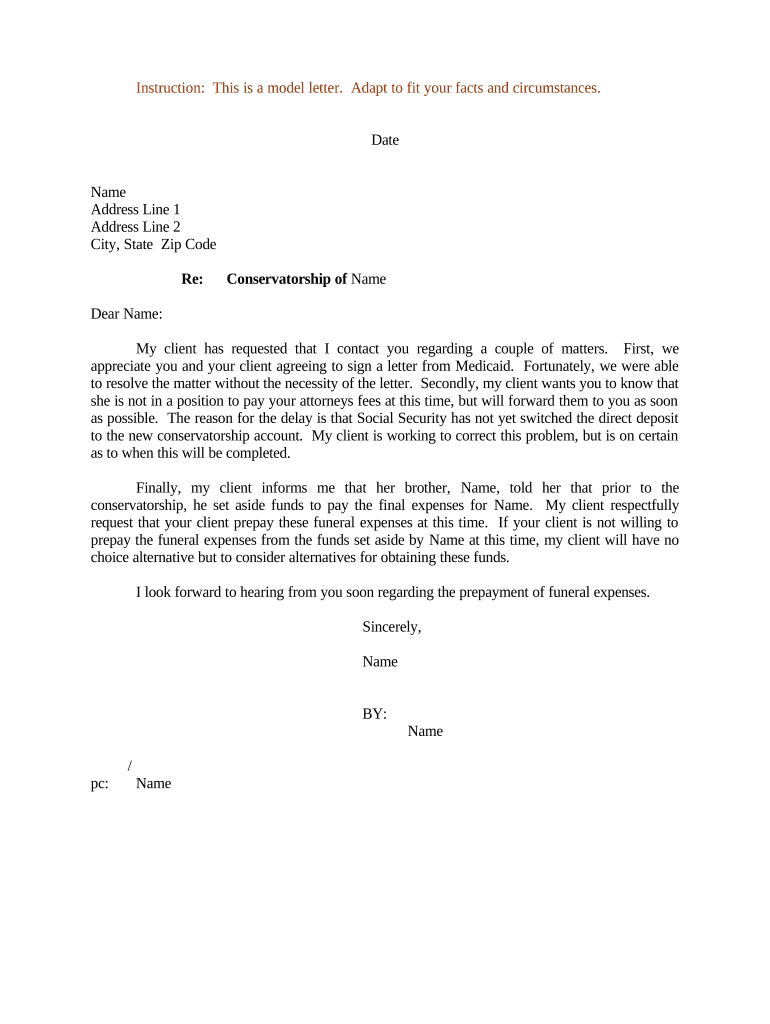







Understanding Conservatorship Letters
A sample letter conservatorship serves as a useful tool for individuals navigating the complexities of legal guardianship, particularly when dealing with issues concerning the care and management of another individual's affairs. This letter typically outlines the relevant parties involved, addresses financial arrangements, and specifies the needs and decisions concerning the individual under conservatorship.
Elements of a Conservatorship Letter
A conservatorship letter should incorporate several essential elements to ensure clarity and compliance with legal standards. These components include:
-
Identification of Parties: Clearly identify the conservator and the person under conservatorship, including full names and relationship to one another.
-
Purpose of Conservatorship: State the reason for the conservatorship, detailing the needs of the individual that warrant a conservatorship arrangement.
-
Authority Granted: Specify the powers and responsibilities bestowed upon the conservator, such as managing financial resources, making health care decisions, or overseeing daily activities.
-
Duration of Conservatorship: Indicate whether the conservatorship is temporary or indefinite, outlining any review or renewal processes.
-
Legal Compliance: Emphasize adherence to state laws regarding the establishment and maintenance of conservatorships, including required documentation and court involvement.
Sample Template for a Conservatorship Letter
Creating an effective conservatorship letter can simplify the communication process among involved parties. Below is a sample template illustrating how to structure such a letter:
[Your Name]
[Your Address]
[City, State, ZIP Code]
[Email Address]
[Phone Number]
[Date]
[Recipient's Name]
[Recipient's Address]
[City, State, ZIP Code]
Subject: Conservatorship Arrangement for [Ward’s Name]
Dear [Recipient's Name],
I am writing to confirm the establishment of a conservatorship for my [relation], [Ward’s Name], due to [reason for conservatorship, such as inability to manage financial or personal affairs].
As the conservator, I will undertake the following responsibilities:
- Manage [Ward’s Name]’s finances, including budgeting and bill payment.
- Make health care decisions as necessary.
- Ensure [Ward’s Name] receives appropriate support and care concerning daily living activities.
This conservatorship is intended to remain in effect until [duration or condition for review].
Thank you for your cooperation and understanding during this time.
Sincerely,
[Your Name]
Importance of Clear Communication
Maintaining transparent communication between all parties involved in a conservatorship is vital for effective management and care. The letter should serve as an official document that reinforces the roles and expectations of the designated conservator, aiding in the coordination of services and financial obligations. Utilizing clear language while avoiding legal jargon can enhance understanding and compliance among clients, family members, and service providers.
Legal Considerations Regarding Conservatorships
Understanding the legal ramifications of conservatorships is critical. Different states may have specific laws governing how conservatorships are established and enforced:
-
Court Approval: Many jurisdictions require formal court approval before a conservatorship can be implemented. This often involves submitting a petition to the court and providing evidence supporting the necessity for conservatorship.
-
Rights of the Conservatee: Individuals placed under conservatorship retain certain rights, such as the right to legal representation and the right to request a review of the conservatorship.
-
Certification of Competency: In various states, a medical professional's assessment of the individual's competency is necessary to validate the need for a conservatorship, ensuring that their rights are safeguarded.
Procedure for Establishing a Conservatorship Letter
Following a systematic process when creating a conservatorship letter is crucial:
-
Gather Documentation: Compile necessary documentation, including identification of the conservatee and any medical records that attest to their condition.
-
Consult Legal Counsel: It is advisable to seek guidance from a legal professional familiar with family law to ensure that the letter complies with all applicable laws and standards.
-
Draft the Letter: Utilize the provided template, customizing it to reflect the specifics of the situation and clarifying roles and responsibilities.
-
Review for Clarity: Ensure the letter is free from ambiguity, as a clear statement of intent will reduce confusion among involved parties.
-
Distribute the Letter: Deliver the finalized letter to all parties concerned, including family members, healthcare providers, and legal representatives, ensuring that everyone is informed of the conservatorship arrangement.
Conclusion
A sample letter conservatorship provides pivotal support in the management and care of individuals unable to manage their affairs. By understanding the essential elements, structure, and legal considerations surrounding conservatorships, guardianship can be effectively established.




