Should be agreement 2026

Get Form
should be agreement Preview on Page 1

Here's how it works

01. Edit your form online
Type text, add images, blackout confidential details, add comments, highlights and more.
02. Sign it in a few clicks
Draw your signature, type it, upload its image, or use your mobile device as a signature pad.
03. Share your form with others
Send it via email, link, or fax. You can also download it, export it or print it out.

How to Use or Fill Out the Should Be Agreement

Form edit decoration
9.5
Ease of Setup
DocHub User Ratings on G2
9.0
Ease of Use
DocHub User Ratings on G2
  1. Click ‘Get Form’ to open it in the editor.
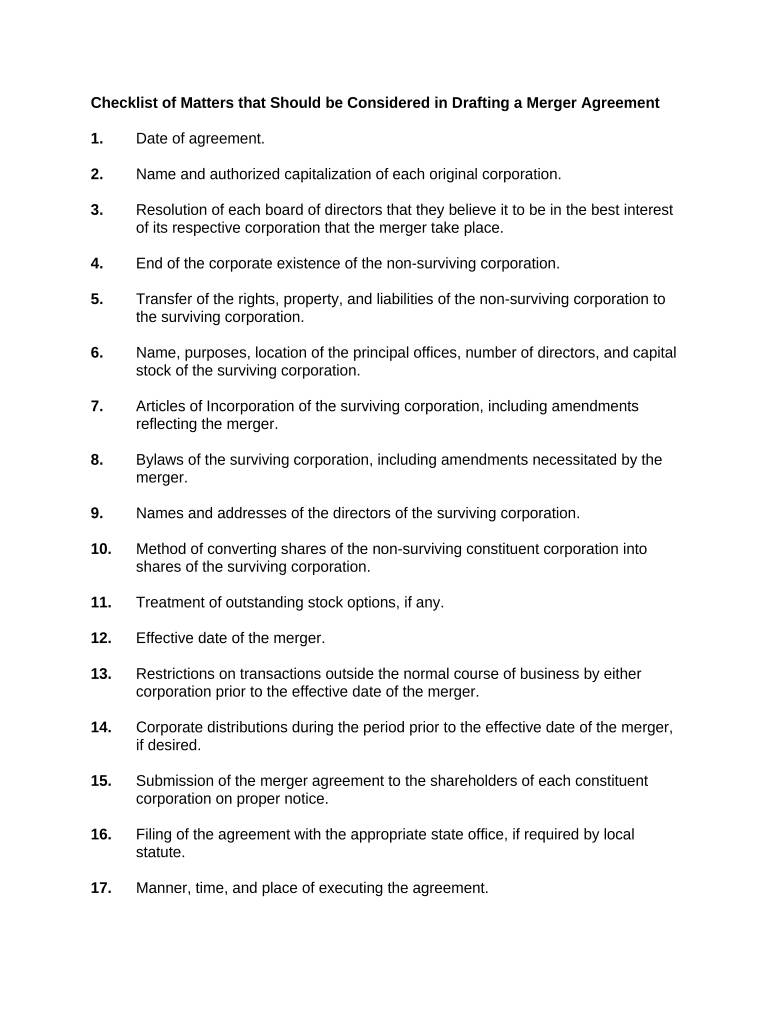
  2. Begin by entering the date of the agreement at the top of the form. This establishes when the merger will be recognized legally.
  3. Fill in the names and authorized capitalization of each original corporation involved in the merger. Ensure accuracy to avoid legal complications.
  4. Include resolutions from each board of directors, affirming that they believe the merger is in their corporation's best interest.
  5. Document the end of corporate existence for the non-surviving corporation, ensuring clarity on which entity will continue post-merger.
  6. Specify how rights, property, and liabilities will transfer from the non-surviving corporation to the surviving one.
  7. Detail information about the surviving corporation, including its name, purposes, principal office location, number of directors, and capital stock.
  8. Attach articles of incorporation and bylaws for the surviving corporation, noting any amendments due to the merger.
  9. List names and addresses of directors for easy reference and compliance with corporate governance requirements.
  10. Outline how shares from the non-surviving corporation will convert into shares of the surviving corporation.
  11. Address any outstanding stock options that may need special treatment during this transition.
  12. Indicate an effective date for when the merger will take place.
  13. Set restrictions on transactions outside normal business operations prior to this effective date to protect both corporations' interests.
  14. If applicable, note any corporate distributions planned before finalizing the merger.
  15. Ensure proper notice is given for submitting this agreement to shareholders for approval.
  16. Confirm if filing with a state office is necessary according to local statutes and prepare accordingly.
  17. Finally, specify how and when this agreement will be executed by all parties involved.

Start using our platform today to streamline your document editing process for free!

be ready to get more

Complete this form in 5 minutes or less

Get form

Got questions?

We have answers to the most popular questions from our customers. If you can't find an answer to your question, please contact us.
Contact us
How to ask for a contract to be signed: 6 easy steps Identify decision makers. Clearly understand the clients goals. Set a firm timeline and deadline. Deliver on promises. Follow up. Review your message and contract language.
In simplest terms, should is something you ought to do. Shall is something you must do.
Should means an expected course of action or policy that is to be followed unless inappropriate for a particular circumstance.
Key components of a contract include clear identification of parties, deliverables, payment terms, and termination conditions. Using contract templates can streamline the drafting process. docHub offers a convenient way to create, sign, and manage contracts efficiently.
Shall and should are two distinct words that hold different meanings and usage. Shall is employed to indicate a definite intention or action in the future, while should expresses uncertainty, advice, or suggestion.

Security and compliance

At DocHub, your data security is our priority. We follow HIPAA, SOC2, GDPR, and other standards, so you can work on your documents with confidence.

Learn more
ccpa2
pci-dss
gdpr-compliance
hipaa
soc-compliance

People also ask

Use should for non-mandatory goals or guidance. These are not contractually enforceable but still communicate important design intentions or preferences.
While both agreements and contracts can be legally binding, contracts generally have more legal weight and enforceability. Contracts offer stronger legal protections because they involve more formalities, clear terms, and consideration between parties.

Related links