Patent 2026

Get Form
patent Preview on Page 1

Here's how it works

01. Edit your form online
Type text, add images, blackout confidential details, add comments, highlights and more.
02. Sign it in a few clicks
Draw your signature, type it, upload its image, or use your mobile device as a signature pad.
03. Share your form with others
Send it via email, link, or fax. You can also download it, export it or print it out.

How to Use or Fill Out Patent with Our Platform

Form edit decoration
9.5
Ease of Setup
DocHub User Ratings on G2
9.0
Ease of Use
DocHub User Ratings on G2
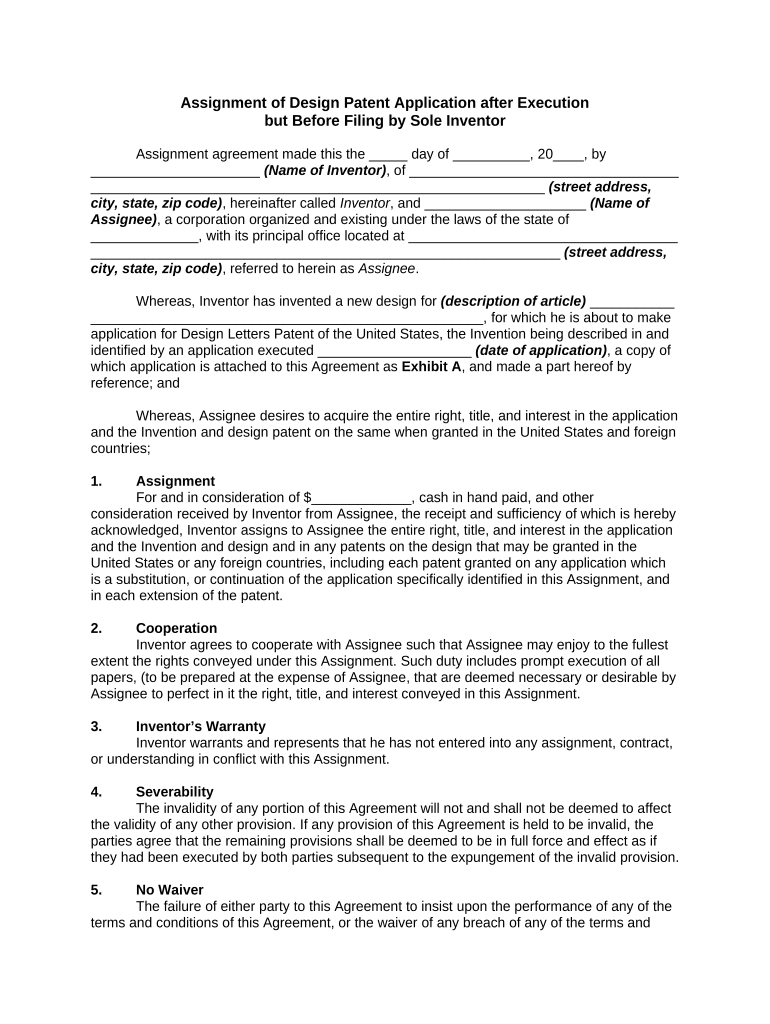
  1. Click ‘Get Form’ to open the patent assignment document in the editor.
  2. Begin by filling in the date and your name as the Inventor at the top of the form. Ensure that your address is complete and accurate.
  3. Next, enter the name of the Assignee and their corporate details, including their address. This section establishes who will receive rights to the patent.
  4. In the 'Description of Article' field, provide a clear description of your invention. This is crucial for identifying your design patent.
  5. Fill in the consideration amount you are receiving for this assignment. This should reflect any agreed-upon payment between you and the Assignee.
  6. Review sections on cooperation, warranties, and governing law to ensure you understand your obligations and rights under this agreement.
  7. Finally, sign and date the document where indicated. If required, have it notarized to validate your agreement legally.

Start using our platform today to streamline your patent assignment process for free!

be ready to get more

Complete this form in 5 minutes or less

Get form

Got questions?

We have answers to the most popular questions from our customers. If you can't find an answer to your question, please contact us.
Contact us
The five primary requirements for patentability are: (1) patentable subject matter; (2) utility; (3) novelty; (4) non-obviousness; and (5) enablement. Like trademarks, patents are territorial, meaning they are enforceable in a specific geographic area.
A patent is the granting of a property right by a sovereign authority to an inventor. A patent provides the inventor exclusive rights to the patented process, design, or invention for a certain period in exchange for a complete disclosure of the invention.
Patent is an anatomical term that means open or unobstructed. It might be used anywhere there a. In medical terminology, gross usually means large.
Simply put, airway patency is the ability of a person to breathe, with airflow passing to and from the respiratory system through the oral and nasal passages. Airway patency may be impacted by anatomical or physiologic changes that impede airflow or even by a foreign object, such as a tracheostomy tube.
A patent application often includes the following primary sections: Invention Title. The titles objective is to provide a clear understanding of the invention or idea. Prior Art: Context and Novelty. Invention Summary. Drawings and Descriptions. Detailed Description. Claims. Scope. Characteristics. How To Write a Patent | Columbia Law School columbia.edu writing-a-patent columbia.edu writing-a-patent

Security and compliance

At DocHub, your data security is our priority. We follow HIPAA, SOC2, GDPR, and other standards, so you can work on your documents with confidence.

Learn more
ccpa2
pci-dss
gdpr-compliance
hipaa
soc-compliance
be ready to get more

Complete this form in 5 minutes or less

Get form

People also ask

Step 1: Get ready to apply. Contact Patents. Step 2: File your application. Filing a patent application on your own. Step 3: Application prosecution. Filing a patent application on your own. Step 4: Receive your patent. Inventors Assistance Center. Step 5: Maintain legal protection for your invention. Pay your maintenance fees. Patent process overview - USPTO uspto.gov patents basics patent-process uspto.gov patents basics patent-process
A patent is an intellectual property right to protect inventions, granted by a countrys government as a territorial right for a limited period.

Related links