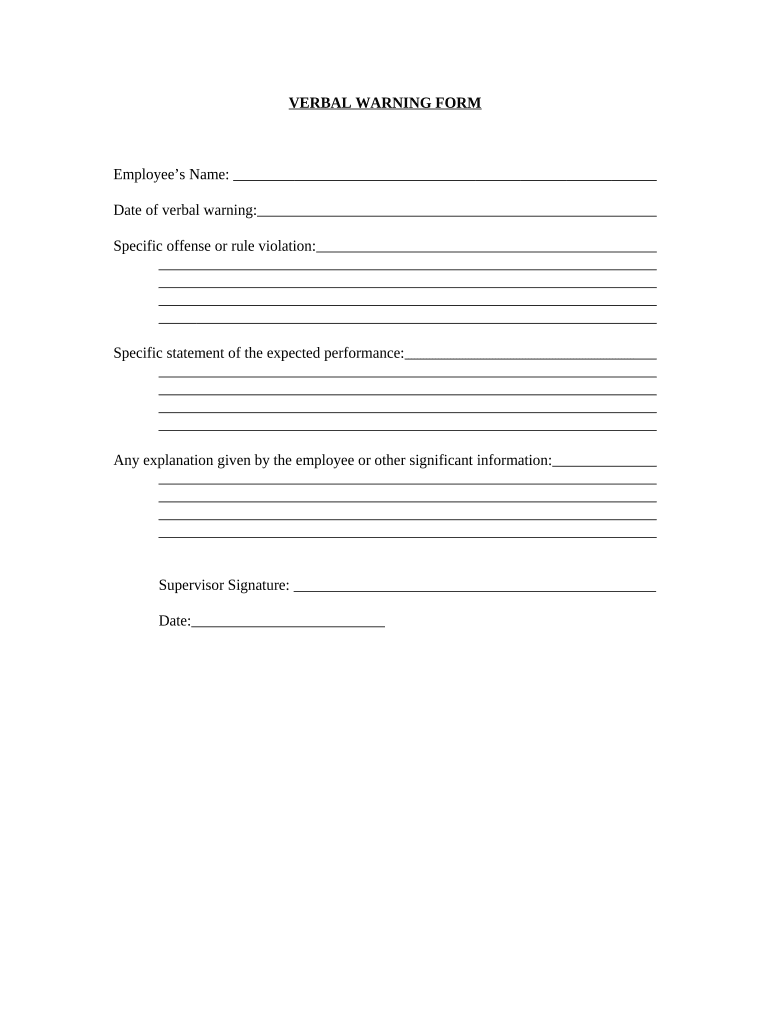







Definition and Purpose of the Verbal Warning Form
A verbal warning form serves as an official record documenting an employee's infraction of workplace policies or performance standards. This form is crucial for both managers and employees to ensure transparency and accountability in the workplace. Its primary function is to create a written account of any verbal discussions concerning disciplinary actions taken against an employee, thereby avoiding ambiguity in future evaluations or decisions. The verbal warning form typically includes:
- Employee Information: Name, position, and department of the employee receiving the warning.
- Details of the Violation: Description of the specific incident or behavior that prompted the warning.
- Discussion Points: Summary of the conversation between the supervisor and the employee regarding the violation.
- Expected Standards: Clear guidelines on the expected performance or behavior moving forward.
- Consequences of Repeated Violations: Explanation that further infractions may result in more severe disciplinary actions.
Steps to Complete a Verbal Warning Form
Completing a verbal warning form involves several definitive steps to capture all necessary information effectively. These steps help to ensure that the process is thorough and consistent for each situation.
-
Gather Information:
- Collect details about the employee, including their name, role, and department.
- Note the date of the warning and the date of the discussed violation.
-
Clarify the Offense:
- Document the specific rules or policies that were violated, including direct quotes from employee guidelines if applicable.
- Provide a factual and objective account of the incident, including names of any witnesses if relevant.
-
Conduct a Meeting:
- Arrange a private meeting with the employee to discuss the violation.
- During the meeting, explain the reason for the verbal warning and allow the employee to share their perspective. This dialogue should be collaborative and focused.
-
Complete the Form:
- Fill out the verbal warning form with the collected information, ensuring clarity in wording.
- Include both the supervisor's observations and the employee's comments for a comprehensive record.
-
Review and Sign:
- Present the completed form to the employee for their review. Encourage them to ask questions and understand what is being documented.
- Obtain signatures from both the supervisor and the employee, indicating acknowledgment of the discussion without necessarily agreeing with its content.
-
Distribute Copies:
- Provide copies of the signed form to the employee and retain a copy in the employee's personnel file.
- Consistently using this process helps establish a clear protocol for handling future violations.
Key Elements of the Verbal Warning Form
Understanding the key elements that comprise a verbal warning form can enhance its effectiveness as a disciplinary tool. These elements are designed to address various aspects of the warning process and document necessary information comprehensively.
-
Employee Identification: Essential for associating the warning with the correct individual. This section should include full name, employee number, position, and department.
-
Incident Description: A detailed account of the behavior or actions leading to the warning, ensuring that the context is clear and specific.
-
Date of Warning: Important for record-keeping and potential future reference, marking the timeline of disciplinary actions taken.
-
Expected Improvement: Clear articulation of what constitutes acceptable behavior going forward, enabling the employee to understand expectations clearly.
-
Supervisor's Comments: Any additional remarks from the supervisor that provide context or clarification concerning the incident or the warning itself.
-
Acknowledgment of Receipt: Section for the employee to sign, indicating receipt of the warning and the discussion that took place without requiring agreement on the content.
Legal Use of the Verbal Warning Form
Implementing a verbal warning form necessitates attention to legal considerations, ensuring that it complies with labor laws and organizational policies. Here are key legal aspects to consider:
-
Documentation: A well-maintained verbal warning form serves as a protective measure for employers, demonstrating that appropriate disciplinary procedures were followed should a dispute arise.
-
Anti-discrimination Laws: Employers must ensure that warnings are issued fairly and consistently across all employees to avoid claims of discrimination. Documentation should reflect a consistent application of policies.
-
Privacy and Confidentiality: Records that contain personal employee information must be handled with discretion, ensuring compliance with privacy regulations and corporate policies.
-
Potential for Escalation: Verbal warnings often serve as a precursor to more severe disciplinary actions, such as written warnings or termination. The form should outline the possible consequences of repeated violations to maintain clarity.
-
Legal Compliance: Incorporating HR policies and local labor laws into the verbal warning process ensures that the document remains compliant with relevant regulations, minimizing the risk of legal repercussions.
Examples of Using the Verbal Warning Form
Incorporating practical examples can illustrate how a verbal warning form operates in different scenarios. Here are a few common situations:
-
Attendance Issues: An employee frequently arrives late to work, affecting team productivity. A verbal warning form documents the discussion addressing the importance of punctuality and outlines expectations moving forward.
-
Performance Decline: An employee’s job performance has noticeably declined. The supervisor schedules a meeting, using the verbal warning form to document specific performance metrics that need improvement and timelines for expected recovery.
-
Policy Violations: If an employee engages in inappropriate behavior, such as using offensive language in the workplace, the supervisor discusses the violation, using the verbal warning form to highlight the violation and reiterate company policies.
These examples reinforce the importance of open communication and proper documentation in maintaining workplace standards while ensuring employees understand their responsibilities.
Who Typically Uses the Verbal Warning Form
The verbal warning form is utilized primarily by managers, supervisors, and human resources personnel within an organization. Here are the primary users and their roles:
-
Supervisors and Managers: They are typically responsible for enforcing workplace policies and addressing performance issues. They utilize the verbal warning form as a key part of the corrective action process.
-
Human Resources Professionals: HR plays a crucial role in advising managers on compliance with company policies and labor laws. They may help draft the form and oversee its implementation.
-
Compliance Officers: In organizations with strict regulatory requirements, compliance officers may review the form to ensure adherence to legal standards and internal policies.
-
Employees: While the form is created and maintained by management, employees are also the end recipients of the process, as their acknowledgment and understanding are vital to the warning's intent and function.
Through their distinct roles, these users contribute to creating a constructive feedback mechanism that maintains organizational standards and fosters a culture of accountability.