Seller's Information for Appraiser provided to Buyer - South Carolina 2026

Get Form
Seller's Information for Appraiser provided to Buyer - South Carolina Preview on Page 1

Here's how it works

01. Edit your form online
Type text, add images, blackout confidential details, add comments, highlights and more.
02. Sign it in a few clicks
Draw your signature, type it, upload its image, or use your mobile device as a signature pad.
03. Share your form with others
Send it via email, link, or fax. You can also download it, export it or print it out.

How to use or fill out Seller's Information for Appraiser provided to Buyer - South Carolina with our platform

Form edit decoration
9.5
Ease of Setup
DocHub User Ratings on G2
9.0
Ease of Use
DocHub User Ratings on G2
  1. Click ‘Get Form’ to open it in the editor.
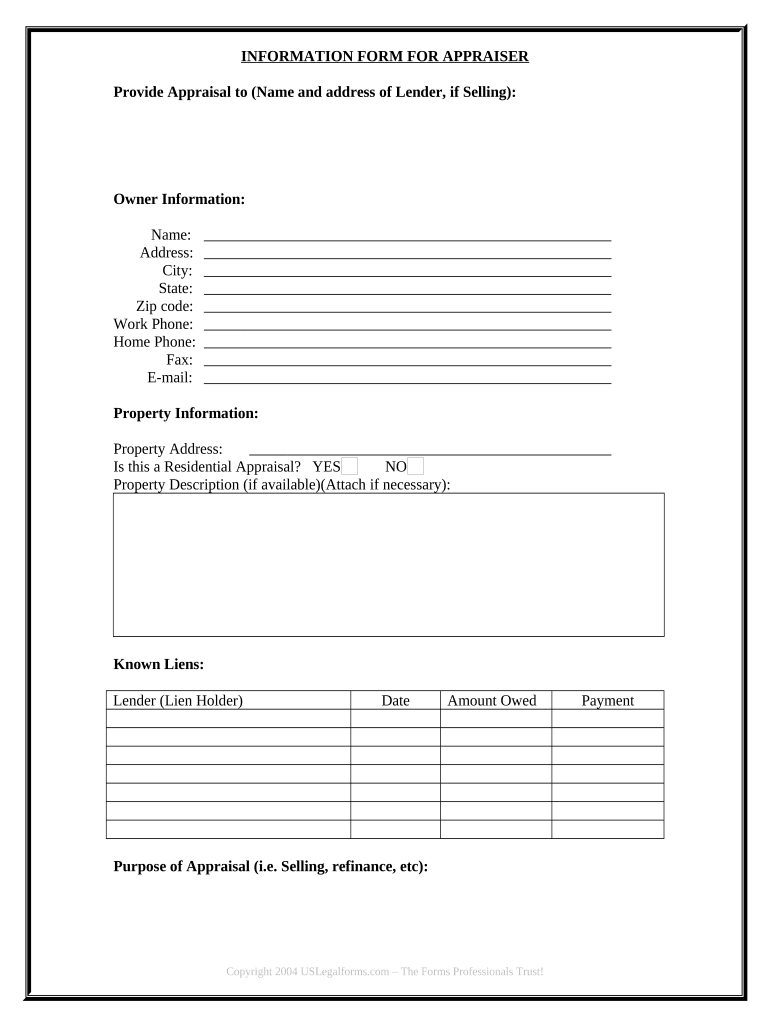
  2. Begin by entering the Owner Information. Fill in your Name, Address, City, State, Zip code, Work Phone, Home Phone, Fax, and E-mail. Ensure all details are accurate for effective communication.
  3. Next, provide the Property Information. Enter the Property Address and indicate whether this is a Residential Appraisal by selecting YES or NO.
  4. If available, include a brief Property Description. You can attach additional documents if necessary for clarity.
  5. List any Known Liens by providing the Lender (Lien Holder), Date, and Amount Owed. This information is crucial for the appraisal process.
  6. Finally, specify the Purpose of Appraisal (e.g., Selling, refinance) to guide the appraiser on your intentions.

Start using our platform today to streamline your document editing and ensure a smooth completion of your Seller's Information for Appraiser!

be ready to get more

Complete this form in 5 minutes or less

Get form

Got questions?

We have answers to the most popular questions from our customers. If you can't find an answer to your question, please contact us.
Contact us
An appraisal contingency is a condition in a typical real estate contract that allows the potential buyer of the property to back out of the transaction if the property does not appraise at the purchase price.
The bottom line The bottom line is that it is ok for the home owner/seller to be present during the appraisal inspection because they can provide valuable information, however it is even more helpful for the agent to be present if that is possible.
Most homeowners, when they interact with an appraiser, its because theyre either buying or selling a property or perhaps refinancing their mortgage. If youre a seller, you almost never see the appraisal, unless the buyer wants to show it to you.
While the lender is technically the owner of the appraisal, as a home buyer you still have certain rights: You have the right to obtain your own appraisal, even if you are paying cash for a property. You have the right to know what type of valuation service is being ordered for your loan.
Yes, a buyer can back out after an appraisal, but whether they can do so without repercussions depends on the specific terms of the purchase agreement and the circumstances surrounding the appraisal. Here are a few scenarios to consider: Contingency Clauses: Many purchase agreements include an appraisal contingency.

Security and compliance

At DocHub, your data security is our priority. We follow HIPAA, SOC2, GDPR, and other standards, so you can work on your documents with confidence.

Learn more
ccpa2
pci-dss
gdpr-compliance
hipaa
soc-compliance

People also ask

A lender uses an appraisal not only to assess the value of the property, but also to determine such things as your interest rate, required down payment, and whether you will be approved for the loan.

Related links