






Definition and Meaning
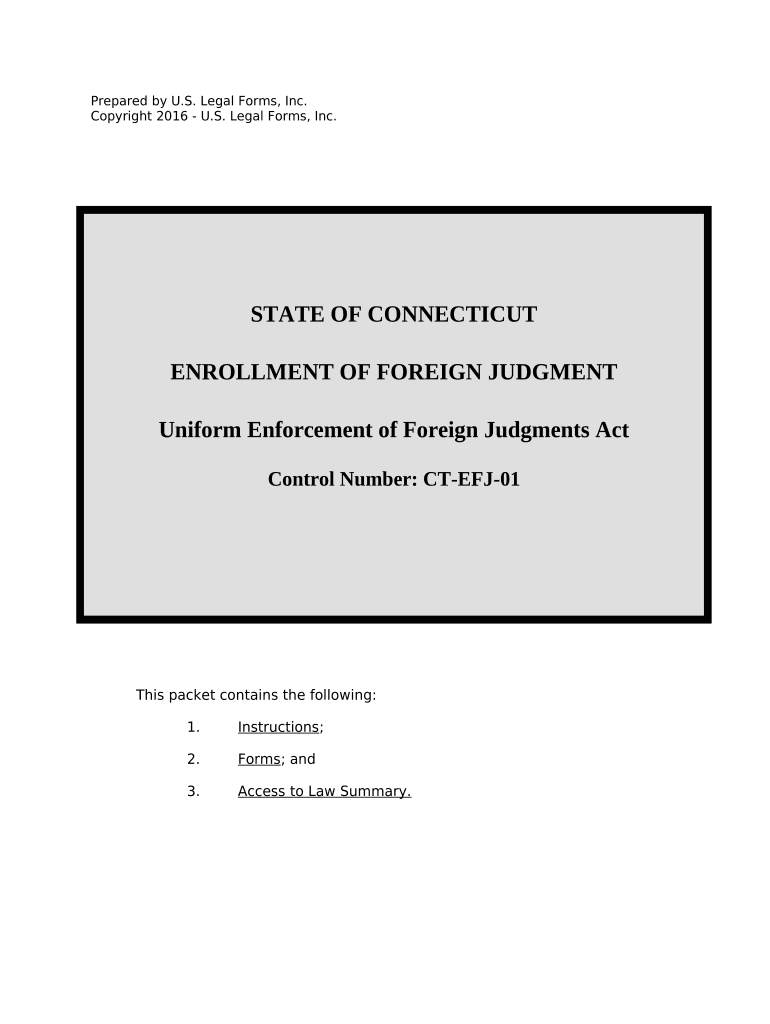
The CT Judgment Form, often referred to in legal circles as part of the process under the Uniform Enforcement of Foreign Judgments Act (UEFJA), is an essential legal document used for the enrollment of foreign judgments in the state of Connecticut. It facilitates the enforcement of judgments rendered in other jurisdictions within Connecticut, ensuring that a judgment creditor can exercise their rights and seek remedies across state lines. This form is integral in streamlining the process of recognizing and executing judgments from various jurisdictions, thereby enhancing judicial efficiency and cross-jurisdictional cooperation.
How to Use the CT Judgment Form
To effectively utilize the CT Judgment Form, understanding its role in the judicial process is crucial. The primary function of the form is to officially record and register a foreign judgment with Connecticut’s judicial system. This involves:
-
Certification: Ensure the judgment from the original jurisdiction is certified and authenticated as required.
-
Filing: The form, along with the certified judgment, is filed with the clerk of the Superior Court in Connecticut.
-
Notification: Upon filing, the judgment debtor must be notified, allowing them a chance to dispute or acknowledge the judgment.
-
Enforcement: Once all procedural steps are completed, the judgment can be enforced in the same manner as any judgment originally issued by a Connecticut court.
Using the form involves preparing and organizing documentation that aligns with the specific legal requirements of the state.
How to Obtain the CT Judgment Form
Acquiring the CT Judgment Form can be accomplished through several methods, ensuring access and compliance with the appropriate procedure:
-
Judicial Branch Websites: Visit the official website of the Connecticut Judicial Branch, where many legal forms are available for download.
-
Court Clerks: Contact the clerk's office of any Superior Court in Connecticut, where forms and further guidance on the documentation process can be obtained.
-
Legal Service Providers: Companies like U.S. Legal Forms, Inc., offer prepared packets that include the necessary forms and instructions.
Access through these channels guarantees that you're using the most current and official version of the form.
Steps to Complete the CT Judgment Form
Completing the CT Judgment Form requires careful attention to detail and adherence to procedural guidelines:
-
Initial Information: Fill out the basic information, including the names of the judgment creditor and debtor, and case numbers.
-
Attach Certified Judgment: Include a certified copy of the judgment you wish to enforce, ensuring it meets Connecticut’s certification standards.
-
Supporting Documents: Gather and attach any additional documentation required by the state, such as proof of notification to the debtor.
-
Review: Carefully review all entered information for accuracy and completeness.
-
Submission: File the completed form and attached documents with the appropriate Superior Court.
By meticulously following these steps, the chances of successful form completion and subsequent enforcement are significantly increased.
Who Typically Uses the CT Judgment Form
The CT Judgment Form is predominantly used by judgment creditors looking to enforce a judgment from another state within Connecticut. Typical users include:
- Attorneys: Legal professionals acting on behalf of clients to enforce judgments.
- Businesses: Companies seeking to collect debts or enforce decisions from courts in other jurisdictions.
- Individuals: Private citizens with judgments in their favor from out-of-state courts.
This form is critical in allowing these parties to apply foreign judgments, ensuring their legal and financial interests are protected.


Legal Use of the CT Judgment Form
The CT Judgment Form is governed by legal standards that ensure its proper use within the judicial system. Specifically, it serves to:
-
Authorize: It legally permits the enforcement of out-of-state judgments within Connecticut, subject to specific statutory requirements.
-
Validate: Confirms the legitimacy and authenticity of judgments filed in the state to prevent fraudulent or erroneous claims.
-
Facilitate Due Process: Guarantees that judgment debtors are notified and given the opportunity to contest any claims made against them.
These functions highlight the form’s importance in maintaining judicial integrity and ensuring fair enforcement processes.
Key Elements of the CT Judgment Form
Understanding the core components of the CT Judgment Form is vital for its correct completion:
-
Judgment Details: Precise information about the original judgment, including date, amount, and issuing court.
-
Parties Involved: Clear identification of involved parties, ensuring there is no ambiguity in the enforcement process.
-
Certification: Proof of the original judgment’s certification, ensuring its legal standing.
These elements must be accurately documented to facilitate the straightforward enforcement of foreign judgments.
State-Specific Rules for the CT Judgment Form
Connecticut has specific rules and procedures governing the use and acceptance of the CT Judgment Form:
-
Certification Requirements: The judgment from the original jurisdiction must be certified according to Connecticut’s stipulated guidelines.
-
Filing Procedures: Determine the appropriate court for filing; typically, the filing is done at a court location relevant to the judgment debtor’s residence or business.
-
Deadline for Notification: Connecticut law requires timely notification of the judgment debtor following the filing.
Understanding and adhering to these state-specific nuances are crucial for the successful registration and enforcement of a foreign judgment in Connecticut.