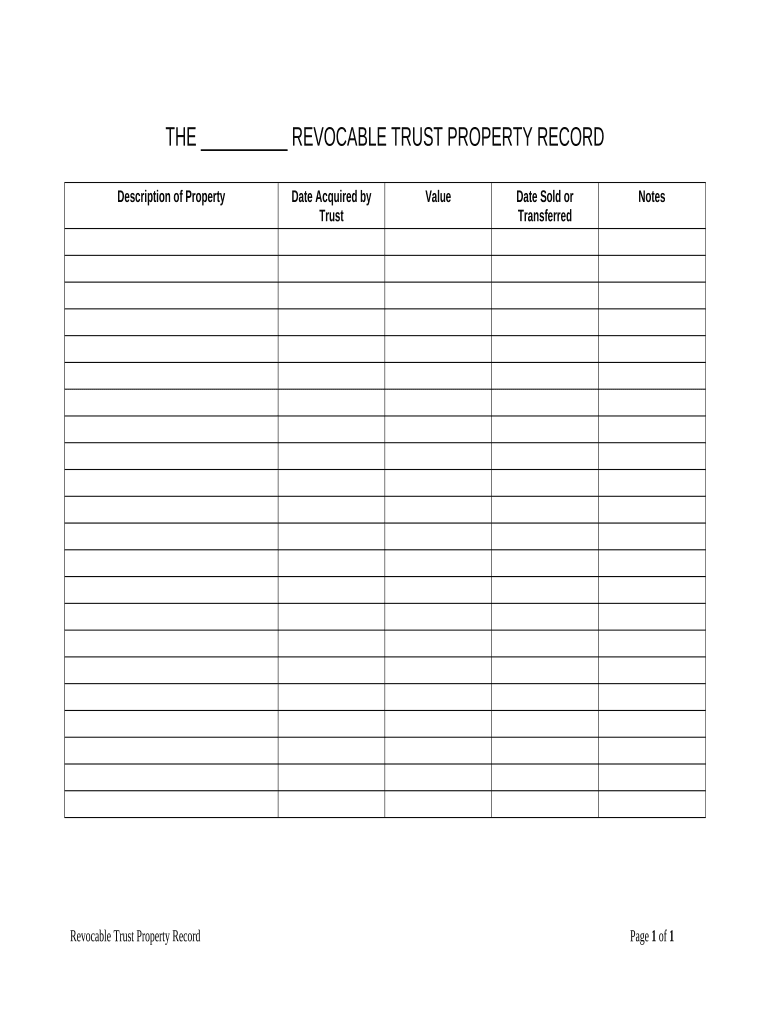
Living Trust Property Record - Connecticut 2026

Get Form
Living Trust Property Record - Connecticut Preview on Page 1

Here's how it works

01. Edit your form online
Type text, add images, blackout confidential details, add comments, highlights and more.
02. Sign it in a few clicks
Draw your signature, type it, upload its image, or use your mobile device as a signature pad.
03. Share your form with others
Send it via email, link, or fax. You can also download it, export it or print it out.

How to use or fill out Living Trust Property Record - Connecticut with our platform

Form edit decoration
9.5
Ease of Setup
DocHub User Ratings on G2
9.0
Ease of Use
DocHub User Ratings on G2
  1. Click ‘Get Form’ to open the Living Trust Property Record in the editor.
  2. Begin by entering the name of the trust in the designated field at the top of the form. This identifies which trust is being recorded.
  3. In the 'Description of Property' section, provide a detailed description of each property held in the trust. Be specific to ensure clarity.
  4. Fill in the 'Date Acquired by Trust' field with the date when each property was transferred into the trust. This is crucial for legal records.
  5. Next, indicate the 'Value' of each property at the time it was acquired. This helps establish an accurate financial overview of the trust's assets.
  6. If applicable, enter any relevant information in the 'Date Sold or Transferred' field to document any changes in ownership.
  7. Finally, use the 'Notes' section for any additional comments or details that may be important for future reference regarding each property.

Start using our platform today to easily complete your Living Trust Property Record online and for free!

be ready to get more

Complete this form in 5 minutes or less

Get form

Got questions?

We have answers to the most popular questions from our customers. If you can't find an answer to your question, please contact us.
Contact us
The Public Use and Benefit Land Registry (Land Registry) pilot portal allows users to browse state lands, determine property ownership, and research, view, and download copies of parcel information, including deeds, surveys, and land management plans.
A trustee is a person or entity responsible for and with the authority for managing and administering your trust according to your instructions and in accordance with state law.
The trust is the legal owner. The trustee holds the title and manages it, but always for the benefit of the beneficiaries. The trustor decides the terms, and beneficiaries enjoy the property or its benefits according to those terms.
The trustee holds title to the property in the trust on behalf of the beneficiaries. It is the trustees duty to manage the property according to the rules outlined in the trust document. They must do so in the best interests of the beneficiaries.
The trustee is the person (or people) who holds legal title to the property that is in the trust. The trustees job is to manage the property in the trust for the benefit of the beneficiaries in the way the settlor has asked.

Security and compliance

At DocHub, your data security is our priority. We follow HIPAA, SOC2, GDPR, and other standards, so you can work on your documents with confidence.

Learn more
ccpa2
pci-dss
gdpr-compliance
hipaa
soc-compliance

People also ask

What Are the Disadvantages of a Trust? Loss of Control. Setting up the trust necessitates you giving up some amount of control of the assets you place within the trust. Loss of Asset Access. Cost. Recordkeeping Complexity. High Need for Competency.
WILL A LIVING TRUST AVOID PROBATE? Yes, but under current Connecticut law, not entirely. If assets are properly placed in trust before death, the living trust bypasses probate as no proceedings are now necessary to pass title on death.

Related links