Non-Marital Cohabitation Living Together Agreement - Connecticut 2026

Get Form
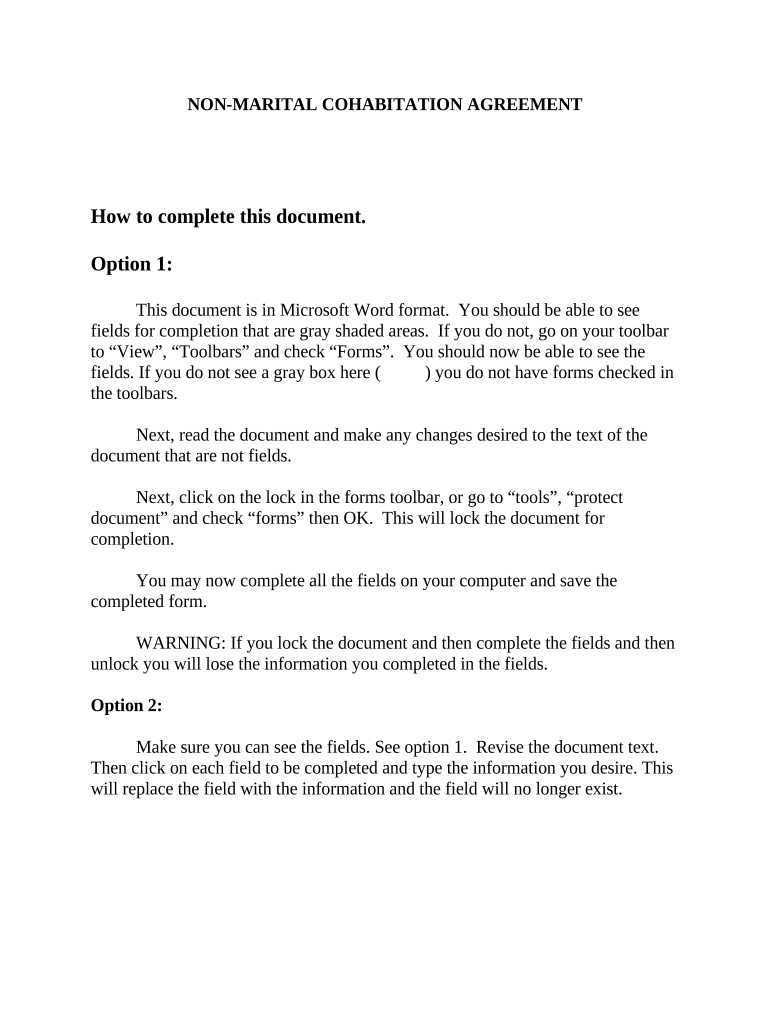
nonmarital cohabitation agreement Preview on Page 1

Here's how it works

01. Edit your nonmarital cohabitation agreement online
Type text, add images, blackout confidential details, add comments, highlights and more.
02. Sign it in a few clicks
Draw your signature, type it, upload its image, or use your mobile device as a signature pad.
03. Share your form with others
Send simple living together agreement via email, link, or fax. You can also download it, export it or print it out.

How to use or fill out Non-Marital Cohabitation Living Together Agreement - Connecticut with our platform

Form edit decoration
9.5
Ease of Setup
DocHub User Ratings on G2
9.0
Ease of Use
DocHub User Ratings on G2
  1. Click ‘Get Form’ to open the Non-Marital Cohabitation Living Together Agreement in the editor.
  2. Begin by reviewing the introductory section, which outlines the agreement's purpose and importance. Ensure both parties understand their rights and obligations.
  3. Fill in the names and addresses of both parties in the designated fields at the beginning of the document.
  4. Proceed to complete sections regarding previously owned property, debts, and financial disclosures. Clearly indicate any joint responsibilities or individual liabilities as required.
  5. Review sections on health insurance, life insurance, and health care decisions. Make selections that reflect your mutual agreements.
  6. Finalize by signing the document in front of a notary public as indicated at the end of the agreement. Ensure all necessary exhibits are attached.

Start using our platform today for free to streamline your document editing and signing process!

be ready to get more

Complete this form in 5 minutes or less

Get form

Got questions?

We have answers to the most popular questions from our customers. If you can't find an answer to your question, please contact us.
Contact us
Although other jurisdictions may recognize common-law marriage or legal consequences to informal marriage relationships, Connecticut definitely does not. . . . It follows that although two persons cohabit and conduct themselves as a married couple, our law neither grants to nor imposes upon them marital status.
Domestic Partnerships Connecticuts Domestic Partnership Ordinance allows persons in committed relationships who meet the criteria established by the Ordinance as constituting domestic partners to register for domestic partnership status.
You can use things like: a marriage certificate or civil partnership certificate. a tenancy agreement, utility bills or Council Tax bills confirming that you live at the same address or pay bills together. a bank statement from a joint bank account, or confirming that you live at the same address.
Determining whether someone is cohabiting requires proof that meets a courts criteria. Proof generally requires evidence of a spouse-like relationship between the recipient and their partner which may involve showing that the couple shares a home, is romantically involved, and combines financial responsibilities.
Key evidence to prove cohabitation includes elements like a shared residence, joint utility bills, combined financial responsibilities, shared household expenses, and testimonies from acquaintances confirming co-living.

Security and compliance

At DocHub, your data security is our priority. We follow HIPAA, SOC2, GDPR, and other standards, so you can work on your documents with confidence.

Learn more
ccpa2
pci-dss
gdpr-compliance
hipaa
soc-compliance
be ready to get more

Complete this form in 5 minutes or less

Get form

People also ask

Items that can be used as proof of a common-law relationship include: shared ownership of residential property. joint leases or rental agreements. bills for shared utility accounts, such as: gas. electricity. important documents for both of you showing the same address, such as: drivers licenses. identification documents.
Casper and Bianchi (2002) proposed four cohabitation types, essentially introducing one more distinction within the prelude to marriage type: (a) alternative to marriage, (b) precursor to marriage, (c) trial marriage, and (d) coresidential dating.

cohabitation agreement