Connecticut letter tenant 2026

Get Form
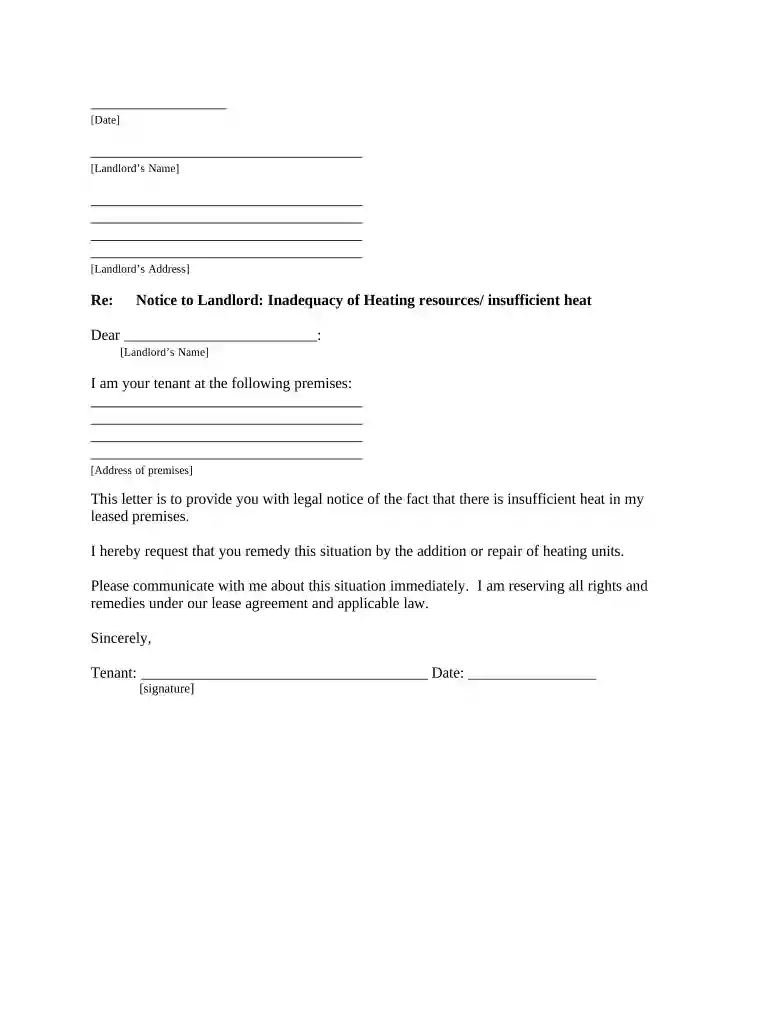
connecticut letter tenant Preview on Page 1

Here's how it works

01. Edit your form online
Type text, add images, blackout confidential details, add comments, highlights and more.

02. Sign it in a few clicks
Draw your signature, type it, upload its image, or use your mobile device as a signature pad.

03. Share your form with others
Send it via email, link, or fax. You can also download it, export it or print it out.

How to use or fill out connecticut letter tenant with our platform

Form edit decoration
9.5
Ease of Setup
DocHub User Ratings on G2
9.0
Ease of Use
DocHub User Ratings on G2
  1. Click ‘Get Form’ to open the connecticut letter tenant in the editor.
  2. Begin by entering the date at the top of the form. This is essential for record-keeping.
  3. Fill in the landlord’s name and address in the designated fields to ensure proper delivery.
  4. In the greeting section, address your landlord directly by entering their name.
  5. Provide your address as a tenant in the specified area to clarify your location.
  6. Clearly state your concern regarding insufficient heating resources, ensuring you articulate your request for remedying this issue.
  7. Sign and date the document at the bottom, confirming your identity as the tenant.
  8. Select how you will deliver this notice to your landlord by checking one of the options provided under 'Proof of Delivery.'

Start using our platform today to easily complete and manage your documents online for free!

be ready to get more

Complete this form in 5 minutes or less

Get form

Got questions?

We have answers to the most popular questions from our customers. If you can't find an answer to your question, please contact us.
Contact us
Sample Letter for Addressing Disputes or Unresponsive Landlords. Dear [Landlords Name], I am writing to address the ongoing issue of [briefly describe the problem] in my rental unit at [Your Address]. Despite my previous attempts to communicate with you about this matter, I have not received a satisfactory response.
Landlords use reference letters to screen potential tenants. Information like timely rent payments and good communication is crucial. A well-written letter can help former tenants find new homes. Positive recommendations increase their chances of approval. Writing a good tenant letter shows professionalism.
Letters are the most common form of written communication between a landlord and tenant. They provide a formal record of the correspondence and can serve as evidence in case of any disputes or legal issues. They are also a more professional way of communicating compared to phone calls or text messages.
After verifying that what they are doing is against Connecticut law, the landlord is required to give a 15-day notice to quit. Next, the landlord can start a formal eviction process if the tenant refuses to comply with the lease agreement and the eviction notice to quit possession.
Your landlord only needs to give reasonable notice to quit. Usually this means the length of the rental payment period so if you pay rent monthly, youll get one months notice. The notice does not have to be in writing.

Security and compliance

At DocHub, your data security is our priority. We follow HIPAA, SOC2, GDPR, and other standards, so you can work on your documents with confidence.

Learn more
ccpa2
pci-dss
gdpr-compliance
hipaa
soc-compliance

People also ask

Follow These Steps for Tenant Letters Keep letters consistent by including the following elements: Tenants name and full address. The date. A subject line that summarizes the information. The landlords expectations (pay the rent, stop breaking a rule, etc.)
I am the tenant at the above address and I am writing to give you [insert number of days/weeks notice required by your tenancy agreement] notice that I wish to end my tenancy. The last day of my tenancy will therefore be [Insert last day of tenancy]. Please contact me if you would like to discuss this.
(l) Tenant means the lessee, sublessee or person entitled under a rental agreement to occupy a dwelling unit or premises to the exclusion of others or as is otherwise defined by law.

Related links