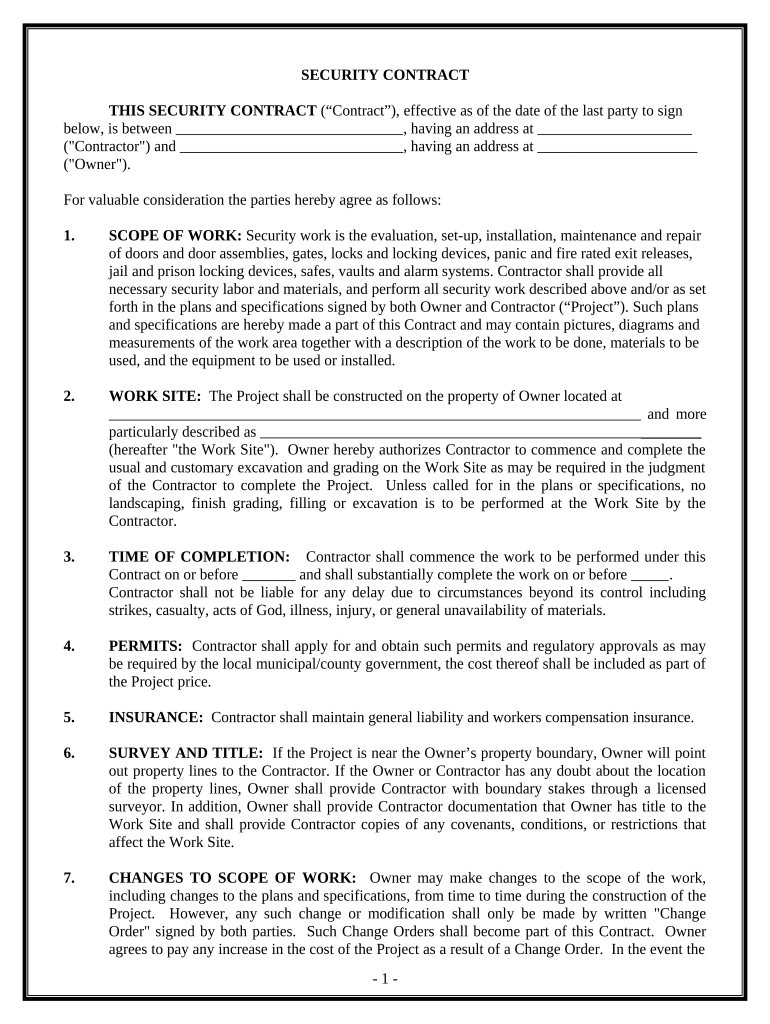
Security Contract for Contractor - Connecticut 2026

Get Form
Security Contract for Contractor - Connecticut Preview on Page 1

Here's how it works

01. Edit your form online
Type text, add images, blackout confidential details, add comments, highlights and more.
02. Sign it in a few clicks
Draw your signature, type it, upload its image, or use your mobile device as a signature pad.
03. Share your form with others
Send it via email, link, or fax. You can also download it, export it or print it out.

How to use or fill out Security Contract for Contractor - Connecticut with our platform

Form edit decoration
9.5
Ease of Setup
DocHub User Ratings on G2
9.0
Ease of Use
DocHub User Ratings on G2
  1. Click ‘Get Form’ to open the Security Contract for Contractor - Connecticut in the editor.
  2. Begin by entering the names and addresses of both the Contractor and Owner in the designated fields at the top of the form.
  3. In the 'SCOPE OF WORK' section, clearly outline the security services to be provided, ensuring all necessary details are included.
  4. Specify the 'WORK SITE' by providing the address and any additional descriptions required for clarity.
  5. Fill in the 'TIME OF COMPLETION' section with start and completion dates, noting any potential delays that may arise.
  6. Complete sections on 'PERMITS', 'INSURANCE', and 'CHANGES TO SCOPE OF WORK' as applicable, ensuring compliance with local regulations.
  7. Determine and enter either a cost-plus or fixed fee in the 'CONTRACT PRICE' section, detailing payment terms.
  8. Review all sections for accuracy before signing. Use our platform’s features to save your progress or share it for collaboration.

Start using our platform today to streamline your document editing and signing process!

be ready to get more

Complete this form in 5 minutes or less

Get form

Got questions?

We have answers to the most popular questions from our customers. If you can't find an answer to your question, please contact us.
Contact us
Following these will increase your chances of winning security sector contracts in this highly competitive sector: Know Your Competition. Understand Your Market. Engage with the Buyer Early. Write a Submission that Stands Out. Health Safety. Quality Control. Added Value.
An independent contractor agreement is a contract that lays out the terms of the independent contractors work. It covers the contractual obligations, scope, and deadlines of the work to be performed. It affirms that the client and contractor are not in an employer-employee relationship.
Best Contract Types for Different Project Owners Government Owners: Lump Sum (Fixed-Price Contract) Private Developers: Cost-Plus with Guaranteed Maximum Price (GMP) Corporate Institutional Owners: Cost-Plus with Incentives. First-Time Owners: Lump Sum or Unit Price.
A comprehensive security guard contract template should include the following elements: Parties involved. Names and addresses of the client and the security service provider. Scope of services. Duration of the contract. Payment terms. Responsibilities. Liability and insurance. Termination clause. Confidentiality.
It outlines the terms of the working relationship, including project scope, payment details, and responsibilities. This agreement ensures both parties understand their obligations, mitigating potential disputes and clarifying the contractors non-employee status.

Security and compliance

At DocHub, your data security is our priority. We follow HIPAA, SOC2, GDPR, and other standards, so you can work on your documents with confidence.

Learn more
ccpa2
pci-dss
gdpr-compliance
hipaa
soc-compliance

People also ask

It explains the rights, roles, and responsibilities of both the company and the contractor. It limits both parties expectations regarding the work to be performed. It evidences the intent of the company to create an independent contractor relationship.
The general rule is that an individual is an independent contractor if the person for whom the services are performed has the right to control or direct only the result of the work and not what will be done and how it will be done. If you are an independent contractor, then you are self-employed.
Independent contractors provide goods or services according to the terms of a contract they have negotiated with an employer. Independent contractors are not employees, and therefore they are not covered under most federal employment statutes.

Related links