Legal Last Will and Testament for Married person with Minor Children from Prior Marriage - Colorado 2026

Get Form
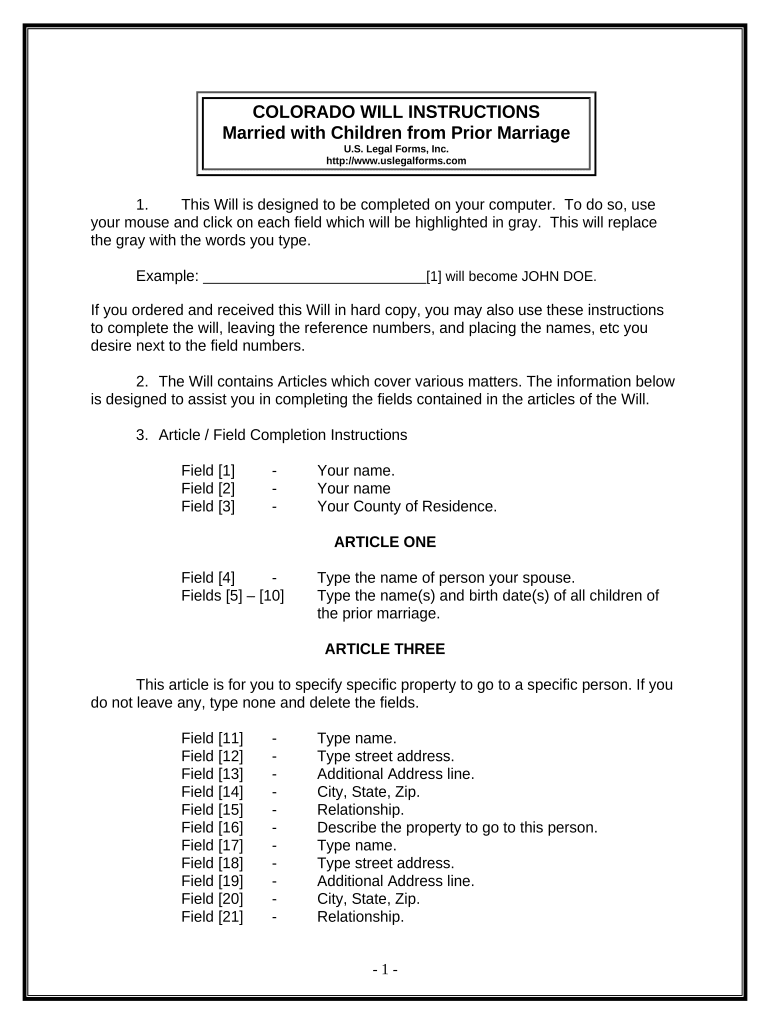
Legal Last Will and Testament for Married person with Minor Children from Prior Marriage - Colorado Preview on Page 1

Here's how it works

01. Edit your form online
Type text, add images, blackout confidential details, add comments, highlights and more.
02. Sign it in a few clicks
Draw your signature, type it, upload its image, or use your mobile device as a signature pad.
03. Share your form with others
Send it via email, link, or fax. You can also download it, export it or print it out.

How to use or fill out Legal Last Will and Testament for Married person with Minor Children from Prior Marriage - Colorado

Form edit decoration
9.5
Ease of Setup
DocHub User Ratings on G2
9.0
Ease of Use
DocHub User Ratings on G2
  1. Click ‘Get Form’ to open it in the editor.
  2. Begin by entering your name and county of residence in the designated fields. This establishes your identity and jurisdiction.
  3. In Article One, specify your spouse's name and list all children from prior marriages along with their birth dates. This is crucial for ensuring proper inheritance.
  4. Proceed to Article Three to detail any specific bequests of property. Fill in the names, addresses, relationships, and descriptions of the property you wish to bequeath.
  5. In Article Four, indicate whether your homestead will go to your spouse or children. Make sure to check the appropriate box based on your choice.
  6. Continue through Articles Five to Eleven, filling out details about remaining property distribution, appointing a trustee, guardian for minor children, and personal representative as needed.
  7. Review all entries carefully before printing. Ensure that you sign in front of two witnesses and a notary public if required.

Start using our platform today to easily complete your Legal Last Will and Testament for free!

be ready to get more

Complete this form in 5 minutes or less

Get form

Got questions?

We have answers to the most popular questions from our customers. If you can't find an answer to your question, please contact us.
Contact us
Here are some common grounds for contesting a will in Colorado: Improper Execution: The will wasnt signed or witnessed correctly. Lack of Mental Capacity: The decedent wasnt of sound mind when they made the will. Fraud: Someone lied to the decedent to get them to change the will.
The will must be in writing, signed by the testator or by someone else at the testators direction and in their presence. It must also be signed by at least two witnesses. The will must be notarized.
The basic requirements for a Colorado will include the following: Age: The testator must be at least 18 years old. Capacity: The testator must be of sound mind. Signature: The will must be signed by one of the following: Testator.
A testator must generally know: what his assets are, who his family members are, how his will affects who will inherit from him, and his will must represent his wishes. In addition, a testator must sign a will voluntarily and not be under any constraint or undue influence by another person.
But marriage changes that. While you are under no legal obligation to update your will after you get married, its something you must do if you want to make sure your will is effective. This is because spouses in Colorado automatically earn the right to inherit from one another upon the others death.
be ready to get more

Complete this form in 5 minutes or less

Get form

People also ask

A will may be deemed invalid if it is the product of undue influence. In Colorado, this occurs when another persons actions take away the free will of the testator, such as in cases of coercion or duress.
A will that was executed under undue influence, coercion or fraud will be invalidated by a court.
In most, if not every, state, the marriage does not invalidate the existing will. His existing will is still valid. In most states, a surviving spouse has rights to elect against a will, meaning that if he dies with that will in place, you would have some rights to his estate even though you arent in the will.

Related links