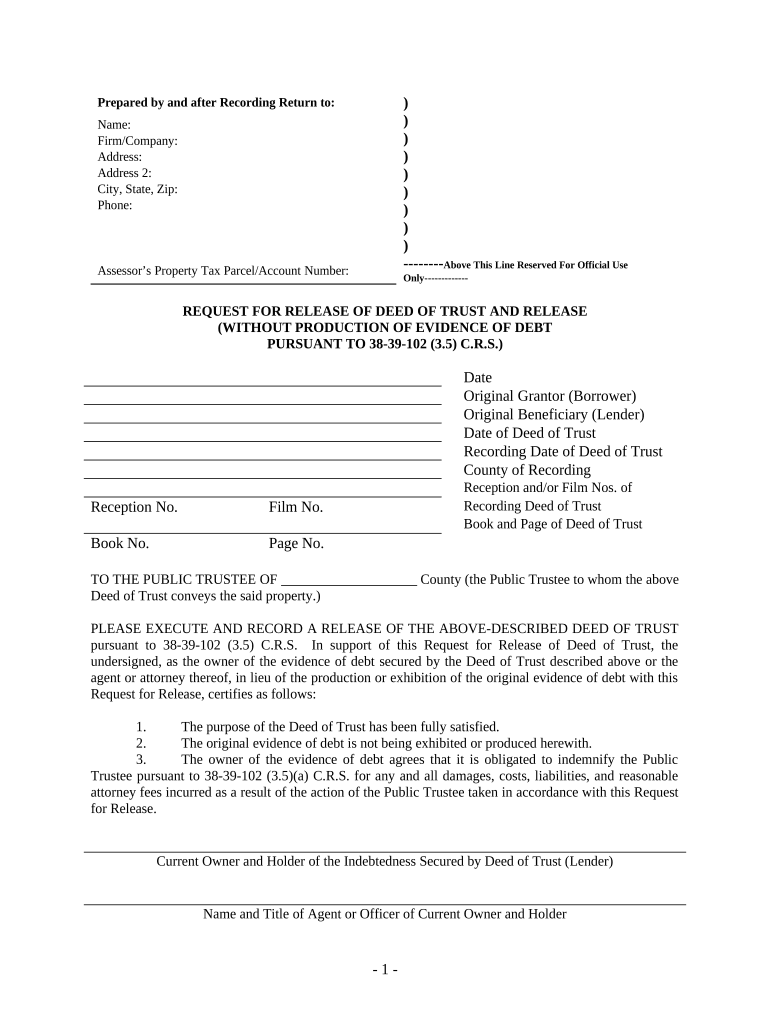
Satisfaction, Release or Cancellation of Deed of Trust by Corporation - Colorado 2026

Get Form
Satisfaction, Release or Cancellation of Deed of Trust by Corporation - Colorado Preview on Page 1

Here's how it works

01. Edit your form online
Type text, add images, blackout confidential details, add comments, highlights and more.
02. Sign it in a few clicks
Draw your signature, type it, upload its image, or use your mobile device as a signature pad.
03. Share your form with others
Send it via email, link, or fax. You can also download it, export it or print it out.

How to use or fill out Satisfaction, Release or Cancellation of Deed of Trust by Corporation - Colorado

Form edit decoration
9.5
Ease of Setup
DocHub User Ratings on G2
9.0
Ease of Use
DocHub User Ratings on G2
  1. Click ‘Get Form’ to open it in the editor.
  2. Begin by filling in the 'Prepared by and after Recording Return to' section with your name, firm/company, address, and contact information.
  3. Enter the Assessor’s Property Tax Parcel/Account Number for accurate identification of the property.
  4. In the 'REQUEST FOR RELEASE OF DEED OF TRUST AND RELEASE' section, provide details such as the date, original grantor (borrower), original beneficiary (lender), and relevant deed information including recording dates and numbers.
  5. Complete the certification statements confirming that the purpose of the Deed of Trust has been satisfied and that you are not producing original evidence of debt.
  6. Fill in the current owner and holder's information along with signatures from authorized agents or officers.
  7. Ensure all necessary acknowledgments are completed by a notary public to validate your document before submission.

Start using our platform today to streamline your document editing and signing process for free!

be ready to get more

Complete this form in 5 minutes or less

Get form

Got questions?

We have answers to the most popular questions from our customers. If you can't find an answer to your question, please contact us.
Contact us
Closing a Family Trust on Its Vesting Date determine all the assets of the trust; determine how to deal with each asset (for example, transferring an asset to a beneficiary or selling it and distributing the net proceeds to beneficiaries); discharge all the liabilities of the trust, including tax liabilities;
Except as provided in sections 38-39-202 and 38-39-204, any lien upon property created by a mortgage or deed of trust shall cease to be a lien fifteen years after the date on which the final payment or performance of the obligation secured thereby is due as shown by such mortgage or deed of trust recorded in the office
A Release of Deed of Trust is a document signed and executed by the current beneficiary of a Deed of Trust. The release form is submitted to the Public Trustees Office in the county in which the property is located.
In most circumstances, the lender will provide the borrower with a copy of the Deed of Trust, while the originals are mailed to the grantee after recording. Many county clerk and recorder offices will provide copies of this document for a small search and print fee.
Processing a Release of Deed of Trust Execution: The lender or authorized agent signs the release, and it is docHubd as required. Recording: The release is submitted to the county recorders office for official recording, making it part of the public record.

Security and compliance

At DocHub, your data security is our priority. We follow HIPAA, SOC2, GDPR, and other standards, so you can work on your documents with confidence.

Learn more
ccpa2
pci-dss
gdpr-compliance
hipaa
soc-compliance

People also ask

A deed of trust, also called a trust deed, is the functional equivalent of a mortgage. It does not transfer the ownership of real property, as the typical deed does. Like a mortgage, a trust deed makes a piece of real property security (collateral) for a loan.
What Are the Disadvantages of a Trust? Loss of Control. Setting up the trust necessitates you giving up some amount of control of the assets you place within the trust. Loss of Asset Access. Cost. Recordkeeping Complexity. High Need for Competency.

Related links