Mediation / Alternate Dispute Resolution Order - Domestic Relations Case - Colorado 2026

Get Form
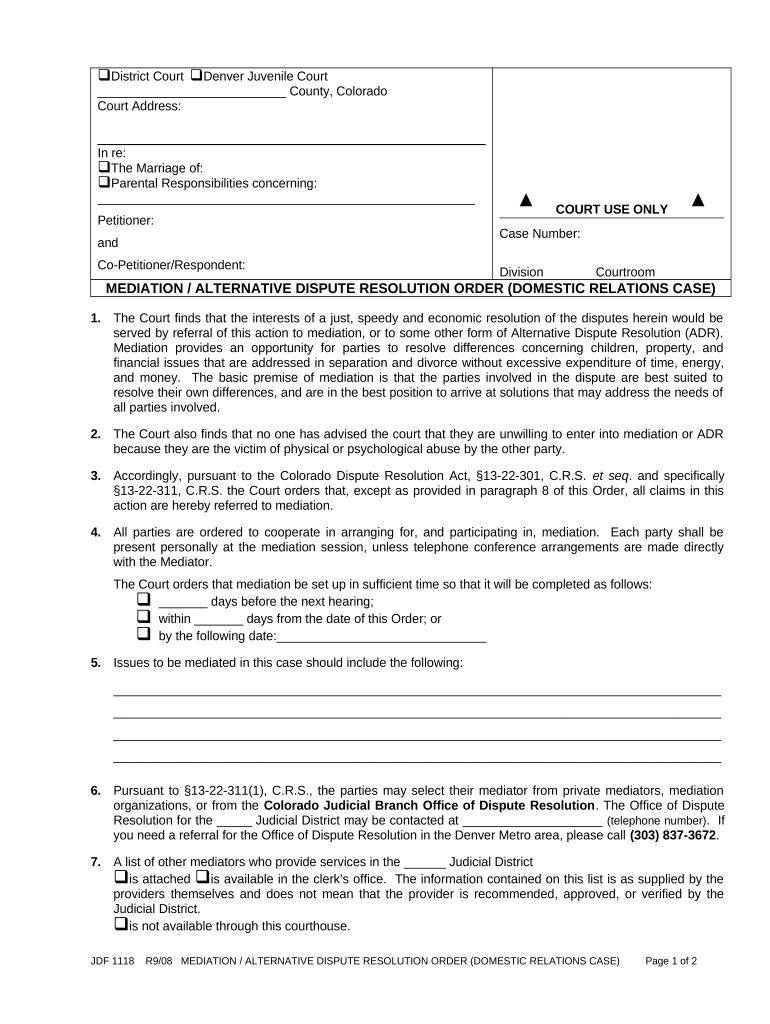
Mediation / Alternate Dispute Resolution Order - Domestic Relations Case - Colorado Preview on Page 1

Here's how it works

01. Edit your form online
Type text, add images, blackout confidential details, add comments, highlights and more.
02. Sign it in a few clicks
Draw your signature, type it, upload its image, or use your mobile device as a signature pad.
03. Share your form with others
Send it via email, link, or fax. You can also download it, export it or print it out.

How to use or fill out Mediation / Alternate Dispute Resolution Order - Domestic Relations Case - Colorado

Form edit decoration
9.5
Ease of Setup
DocHub User Ratings on G2
9.0
Ease of Use
DocHub User Ratings on G2
  1. Click ‘Get Form’ to open it in the editor.
  2. Begin by filling in the court address and case details, including the names of the Petitioner and Co-Petitioner/Respondent. Ensure accuracy as this information is crucial for identification.
  3. In section 4, specify the timeline for mediation completion. Choose from the options provided or write a specific date that suits your case.
  4. List the issues to be mediated in section 5. Clearly outline all relevant topics to ensure comprehensive discussion during mediation.
  5. Select a mediator in section 6. You can choose from private mediators or organizations listed, ensuring they are suitable for your needs.
  6. Review sections 10 and 11 regarding costs and responsibilities associated with mediation. Make sure you understand how expenses will be shared.
  7. Finally, complete the Certificate of Compliance within five days post-mediation as instructed in section 13, ensuring all parties receive a copy.

Start using our platform today to streamline your document editing and signing process for free!

be ready to get more

Complete this form in 5 minutes or less

Get form

Got questions?

We have answers to the most popular questions from our customers. If you can't find an answer to your question, please contact us.
Contact us
8 Essential Tips on What Not to Say During Mediation Avoid Being Disrespectful. Dont Lie. Dont Make Threats or Ultimatums. Dont Refuse to Participate. Dont Use Always or Never Statements. Dont Introduce New Evidence or Information. Dont Ask for More Money. Dont Discuss Irrelevant Issues.
Berger, (Ret.), senior mediator and arbitrator at ADR Systems, highlights the Four Cs of mediation cost-effectiveness, confidentiality, control and creativity and explains why these principles make mediation an effective alternative to litigation.
Mediation is an opportunity for the parties to participate in a confidential process facilitated by a neutral third party to help resolve their conflict. In the mediation process, parties enjoy control and confidentiality, while having the opportunity to explore creative solutions to civil rights complaints.
The Golden Rule of mediation is to treat others the way you want to be treated. It is important in mediation as it promotes mutual understanding, cooperation, and effective communication. To apply the Golden Rule, listen actively, stay calm, be open-minded, seek to understand, and communicate clearly.
There are a few things that you, the client, can do to increase your chances of a successful outcome to a mediation. Attitude adjustment. Prepare, prepare, prepare. State your case clearly and keep the emotion out. Be flexible. Be patient.

Security and compliance

At DocHub, your data security is our priority. We follow HIPAA, SOC2, GDPR, and other standards, so you can work on your documents with confidence.

Learn more
ccpa2
pci-dss
gdpr-compliance
hipaa
soc-compliance

People also ask

Mediation is a process through which a neutral and knowledgeable person, called the mediator, trained in conflict resolution, assists you in resolving your dispute. The disputing parties meet with the mediator, present their sides of the conflict, and are guided by the mediator to develop their own resolution.
In most ADR schemes, a decision will be made based on the paper evidence you and the other party send in. You wont always have to attend a hearing. Some ADR schemes are legally binding. This means that you wont be able to take your case to court if you accept the decision from ADR but later change your mind.
Avoid Making Accusatory Statements Focusing on the past and assigning fault can derail the process and prevent parties from docHubing a mutually agreeable settlement. It is essential to remember that the goal of mediation is to find solutions, not to determine who is right or wrong.

Related links