Letter from Landlord to Tenant as Notice to remove unauthorized inhabitants - Delaware 2026

Get Form
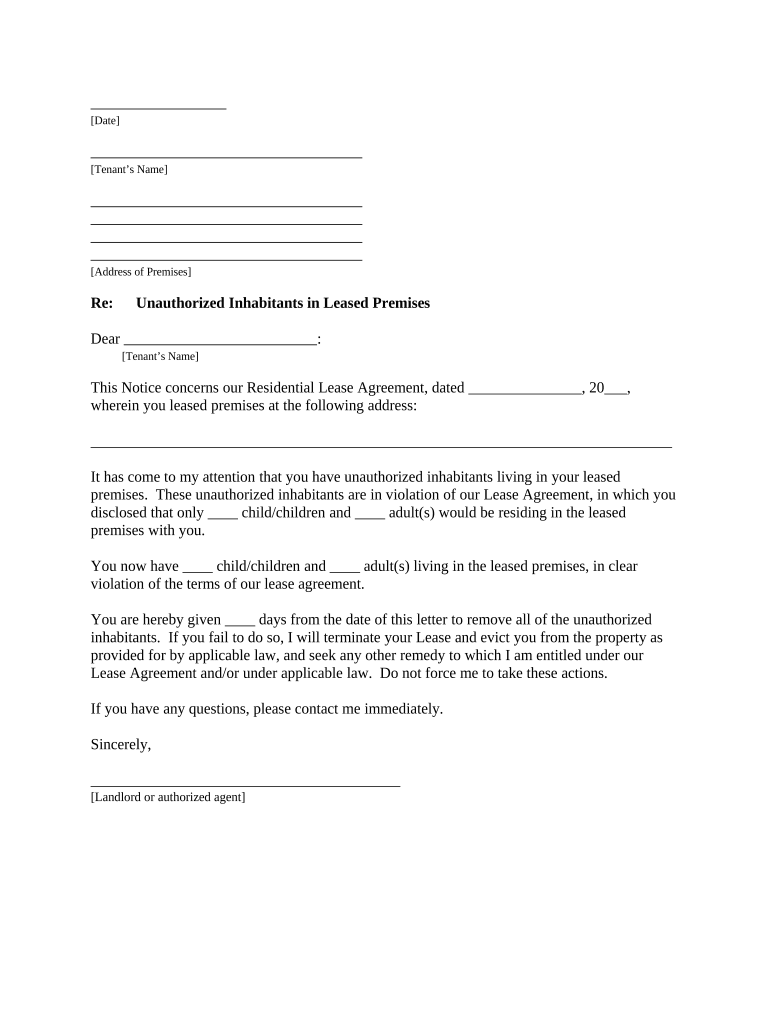
Letter from Landlord to Tenant as Notice to remove unauthorized inhabitants - Delaware Preview on Page 1

Here's how it works

01. Edit your form online
Type text, add images, blackout confidential details, add comments, highlights and more.
02. Sign it in a few clicks
Draw your signature, type it, upload its image, or use your mobile device as a signature pad.
03. Share your form with others
Send it via email, link, or fax. You can also download it, export it or print it out.

How to use or fill out Letter from Landlord to Tenant as Notice to remove unauthorized inhabitants - Delaware

Form edit decoration
9.5
Ease of Setup
DocHub User Ratings on G2
9.0
Ease of Use
DocHub User Ratings on G2
  1. Click ‘Get Form’ to open it in the editor.
  2. Begin by entering the date at the top of the document. This sets the official timeline for your notice.
  3. Fill in the tenant’s name and address of the premises where they reside. Ensure accuracy to avoid any confusion.
  4. In the body of the letter, specify the details of your Residential Lease Agreement, including its date and address. This establishes context for your notice.
  5. Clearly state the issue regarding unauthorized inhabitants, specifying how many children and adults were originally disclosed versus how many are currently residing there.
  6. Indicate a specific number of days you are allowing for compliance before further action is taken. This is crucial for legal clarity.
  7. Conclude with your signature and printed name as the landlord or authorized agent, ensuring that all parties know who issued this notice.
  8. Finally, select how you will deliver this notice (personal delivery, certified mail, etc.) and sign off on that section as well.

Start using our platform today to streamline your document editing and ensure effective communication with tenants!

be ready to get more

Complete this form in 5 minutes or less

Get form

Got questions?

We have answers to the most popular questions from our customers. If you can't find an answer to your question, please contact us.
Contact us
Photographic Evidence. Whenever possible, landlords should gather photographic evidence of the unauthorized occupants and their living conditions within the rental property. These photos can serve as visual documentation of the situation and may be used as evidence in court if legal action becomes necessary.
If you decide you want the unauthorized person out of your rental property, asking them to leave is the first step. Let your legal tenants know that the unauthorized person cannot stay there, then make sure the person leaves. If the person will not simply leave, eviction may be a necessary step.
Eviction is a legal process a landlord uses to make you move out. To evict you, your landlord must give you a 3, 30, 60 or 90-day notice. If you get one of these, its important that you take action, like pay the rent you owe, move out, or get legal help.
In Delaware, the eviction process starts with a written notice from the landlord. For late rental payments, landlords issue a 5-Day Notice to Pay. If the tenant doesnt pay within this period, eviction proceedings can start. For month-to-month tenancy, a 60-day notice is required to end the lease agreement.
Wilmington AREA, Delaware If a landlord chooses to file an eviction, they need to provide their tenants with at least five days notice (in some cases more) and pay a $45 filing fee to the courts. Data on renter population and median rent drawn from the American Community Survey (ACS).

Security and compliance

At DocHub, your data security is our priority. We follow HIPAA, SOC2, GDPR, and other standards, so you can work on your documents with confidence.

Learn more
ccpa2
pci-dss
gdpr-compliance
hipaa
soc-compliance

People also ask

Eviction Process in Delaware: Step-by-Step Guide (2025) Non-payment of rent: 5-day notice to pay or quit. Lease violations: 7-day notice to cure or quit. Illegal activity or property damage: 7-day notice to quit (no cure). Month-to-month tenancy or non-renewal: 60-day notice. Foreclosure-related: 90-day notice.
If youve asked them to leave your home or a rental property, and they wont budge, an evictiontaking legal action to remove a tenantis your final option.
In Delaware, if someone lives in your home without a lease, they may be considered a tenant by law. You cannot forcibly remove them or call police for a civil matter. Instead, you must file an eviction action through the Justice of the Peace Court.

Related links