Plaintiff default judgment 2026

Get Form
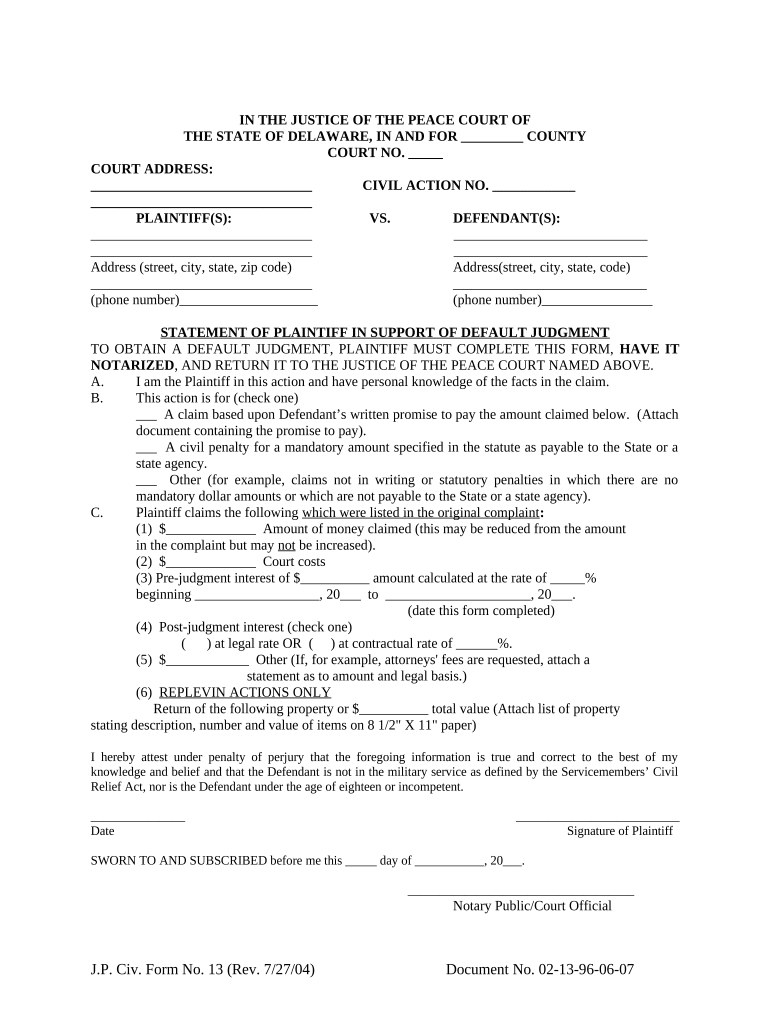
plaintiff default judgment Preview on Page 1

Here's how it works

01. Edit your form online
Type text, add images, blackout confidential details, add comments, highlights and more.
02. Sign it in a few clicks
Draw your signature, type it, upload its image, or use your mobile device as a signature pad.
03. Share your form with others
Send it via email, link, or fax. You can also download it, export it or print it out.

How to use or fill out plaintiff default judgment with our platform

Form edit decoration
9.5
Ease of Setup
DocHub User Ratings on G2
9.0
Ease of Use
DocHub User Ratings on G2
  1. Click ‘Get Form’ to open the plaintiff default judgment in the editor.
  2. Begin by entering the court information, including the court address and civil action number at the top of the form.
  3. Fill in your name as the Plaintiff and provide your contact details, including your address and phone number.
  4. In section B, check the appropriate box that describes your claim type—whether it’s based on a written promise, a civil penalty, or other claims.
  5. Complete section C by detailing the amount claimed, court costs, pre-judgment interest, post-judgment interest options, and any additional claims such as attorney's fees.
  6. Ensure you sign and date the form at the bottom. Remember that this document must be notarized before submission.

Start using our platform today to easily complete your plaintiff default judgment form for free!

be ready to get more

Complete this form in 5 minutes or less

Get form

Got questions?

We have answers to the most popular questions from our customers. If you can't find an answer to your question, please contact us.
Contact us
If youre sued, you can choose to do nothing. This means that you do not file any response by the deadline. The Plaintiff then can ask the judge to decide the case without your input. This is called a default or a default judgment.
Default Judgment is a judgment entered against a party who has failed to defend an action which has been brought against them.
Plaintiffs default refers to a scenario in which the plaintiff bears responsibility for their own harm or injury, thereby intending to file a lawsuit against the defendant to seek damages. This situation arises when the plaintiffs actions directly contribute to the incident for which they seek legal recourse.
Instances in which Default Judgment may be sought or granted: The Defendant failed to serve and file Notice of Intention to Defend. The Defendant delivered the Notice of Intention to Defend but failed to serve and file a Plea. The Defendant has entered into a defective entry of Notice of Intention to Defend.
A default judgment (also known as judgment by default) is a ruling granted by a judge or court in favor of a plaintiff in the event that the defendant in a legal case fails to respond to a court summons or does not appear in court.

Security and compliance

At DocHub, your data security is our priority. We follow HIPAA, SOC2, GDPR, and other standards, so you can work on your documents with confidence.

Learn more
ccpa2
pci-dss
gdpr-compliance
hipaa
soc-compliance

People also ask

After a default judgment, the Plaintiff will try to collect the money you owe. The Plaintiff may be able to take money from your paycheck or bank account and put a lien on your property. If you dont have any assets to pay the debt, you can let the Plaintiff. They may give up or try to collect in the future.

Related links