Type text, add images, blackout confidential details, add comments, highlights and more.
02. Sign it in a few clicks
Draw your signature, type it, upload its image, or use your mobile device as a signature pad.
03. Share your form with others
Send it via email, link, or fax. You can also download it, export it or print it out.
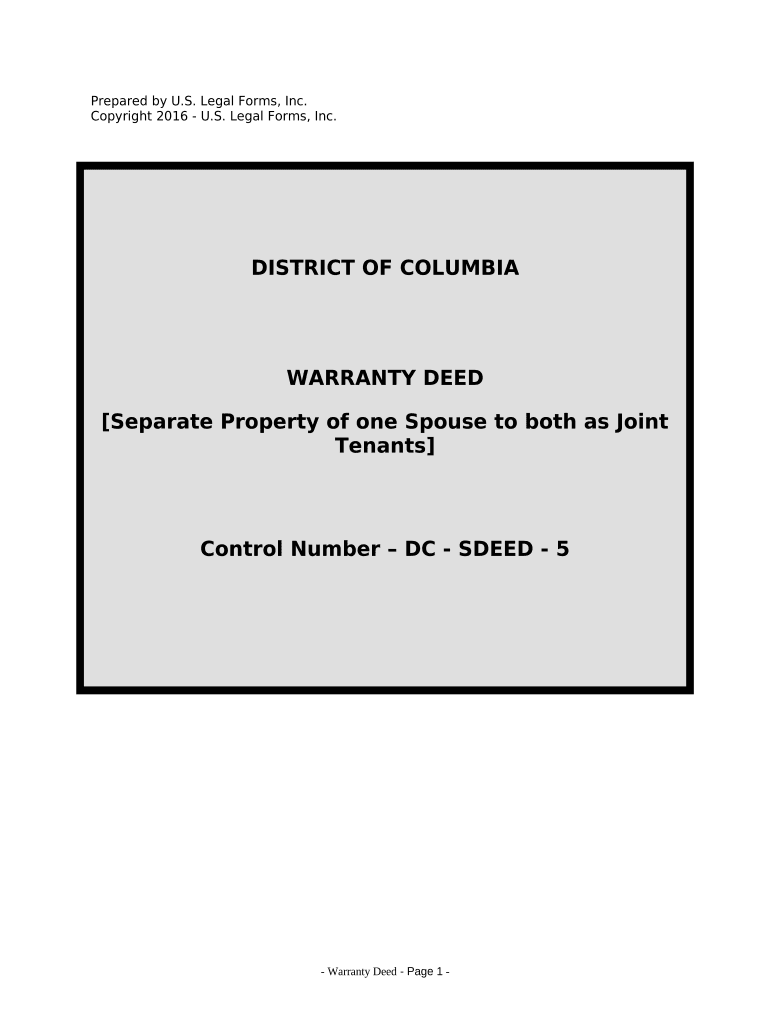
How to use or fill out Warranty Deed to Separate Property of one Spouse to both as Joint Tenants - District of Columbia
Ease of Setup
DocHub User Ratings on G2
Ease of Use
DocHub User Ratings on G2
Click ‘Get Form’ to open it in the editor.
Begin by entering the date at the top of the form where indicated. This is essential for legal documentation.
Fill in the names of the parties involved, ensuring that you accurately represent the party of the first part and both parties of the second part as Joint Tenants.
In the section regarding consideration, specify the amount being exchanged for the property transfer.
Describe the property being transferred. If there is an attachment with a detailed description, refer to it accordingly.
Ensure that all signatures are collected in front of witnesses as required. Each witness must sign and print their name.
Finally, have a Notary Public certify your document by filling out their information and affixing their seal.
Start using our platform today to easily complete your Warranty Deed online for free!
Fill out Warranty Deed to Separate Property of one Spouse to both as Joint Tenants - District of Columbia online It's free
Special warranty deedMarital signature requirements by stateNon titled spouse joinder conveyancesDoes a non borrowing spouse have to sign the Closing DisclosureNon title spouse signing requirementsCommunity property statesSpousal Joinder Agreement
Security and compliance
At DocHub, your data security is our priority. We follow HIPAA, SOC2, GDPR, and other standards, so you can work on your documents with confidence.
by JW McKnight 2002 Cited by 10 3.003(b) (Vernon 1998). 67. If separate property of one spouse is used to pay for property to which title is taken in the name of the other, there is aRead more
42516. Tenancies in common, tenancies by the entireties,
An interest in property, whether held in tenancy in common, joint tenancy, or tenancy by the entirety, may be granted by 1 or more persons, as grantor orRead more
Cookie consent notice
This site uses cookies to enhance site navigation and personalize your experience.
By using this site you agree to our use of cookies as described in our Privacy Notice.
You can modify your selections by visiting our Cookie and Advertising Notice.