




01. Edit your fir format online
Type text, add images, blackout confidential details, add comments, highlights and more.

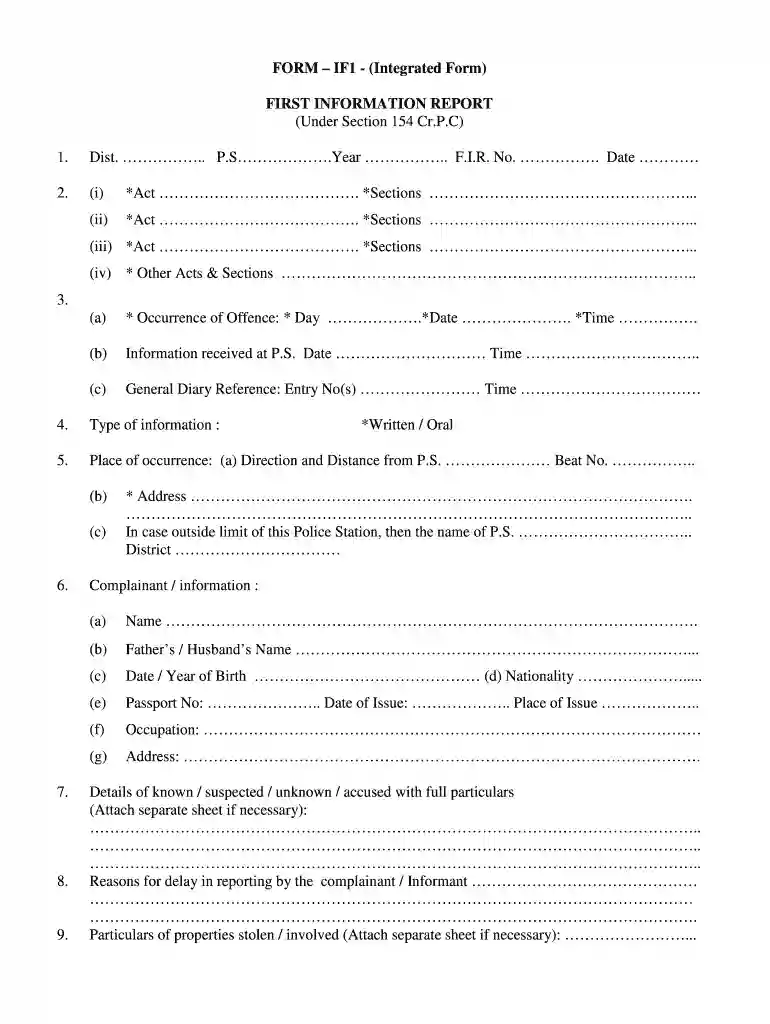
Type text, add images, blackout confidential details, add comments, highlights and more.

Draw your signature, type it, upload its image, or use your mobile device as a signature pad.

Send fir form via email, link, or fax. You can also download it, export it or print it out.
A First Information Report (FIR) is a crucial document in the process of criminal justice in the United States. It serves as the initial record of a crime made by law enforcement agencies when a complaint is lodged. The FIR outlines the essential details of an incident, such as the type of offense, the parties involved, and the circumstances surrounding the event.
An FIR typically includes several critical sections that must be accurately filled out to provide a comprehensive overview of the incident.
Writing an FIR involves a systematic approach to ensure all necessary information is included and presented clearly.
FIRs can vary in format depending on the agency or jurisdiction, but a standardized structure is commonly observed across various law enforcement bodies.
Filing an FIR is an important legal process that should be approached with care. Understanding the procedures enhances compliance and supports legal rights.
To provide clarity, consider the following example detailing an FIR scenario.
This example demonstrates how to succinctly record vital details to ensure the FIR is informative and fulfills legal requirements.
When filing an FIR, it is crucial to be aware of relevant legal implications.
Ensuring understanding of legal obligations can prevent unintentional violations and enhance the FIR's effectiveness as a significant legal document.
At DocHub, your data security is our priority. We follow HIPAA, SOC2, GDPR, and other standards, so you can work on your documents with confidence.
The arithmetic is fixed point s1x14 format (16-bit total: a sign bit, one integer bit, 14 fractional bits). After designing a filter, the program may be set toRead more
Aug 2, 2018 Name(s) of Accused: Date of Complaint : Police station: Particulars of Information sought: [1] certified copy of the FIR as detailed above.Read more
The first element of the qualifier line is the Flight Information Regions (FIR) In CONUS, FIR identifier is. ARTCC identifier. This example uses KZAU as the FIRRead more


