Grant of Communications System Easement to Operate Cable System - Indiana 2026

Get Form
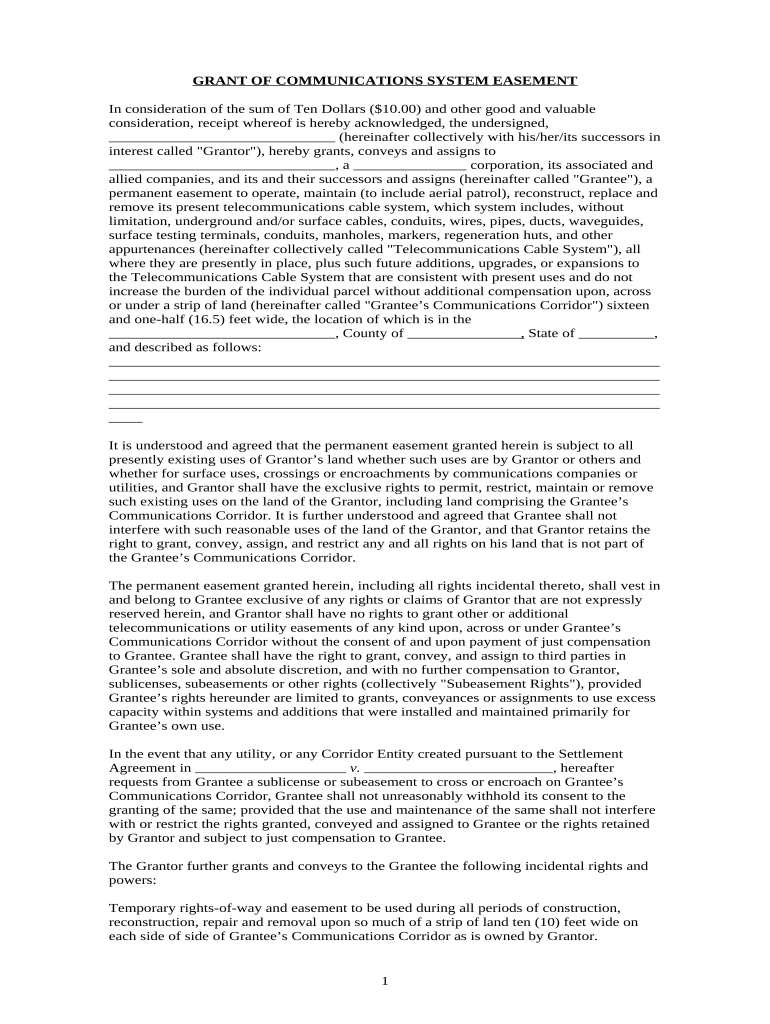
Grant of Communications System Easement to Operate Cable System - Indiana Preview on Page 1

Here's how it works

01. Edit your form online
Type text, add images, blackout confidential details, add comments, highlights and more.
02. Sign it in a few clicks
Draw your signature, type it, upload its image, or use your mobile device as a signature pad.
03. Share your form with others
Send it via email, link, or fax. You can also download it, export it or print it out.

How to use or fill out Grant of Communications System Easement to Operate Cable System - Indiana

Form edit decoration
9.5
Ease of Setup
DocHub User Ratings on G2
9.0
Ease of Use
DocHub User Ratings on G2
  1. Click ‘Get Form’ to open it in the editor.
  2. Begin by entering the name of the Grantor in the designated field. This is typically the individual or entity granting the easement.
  3. Next, specify the Grantee's name, which is the corporation or entity receiving the easement rights.
  4. Fill in the location details of the Grantee’s Communications Corridor, including county and state information.
  5. In the section regarding existing uses, ensure you acknowledge any current uses of Grantor’s land that may affect this easement.
  6. Review and complete any additional sections related to rights granted, temporary easements, and indemnification clauses as necessary.
  7. Finally, sign and date the document where indicated. Ensure all parties involved have their signatures recorded appropriately.

Start using our platform today for free to streamline your document editing and signing process!

be ready to get more

Complete this form in 5 minutes or less

Get form

Got questions?

We have answers to the most popular questions from our customers. If you can't find an answer to your question, please contact us.
Contact us
When termed as a utility easement, it means a utility companys right to access and control the portion of another persons land that is located near utility facilities and structures (i.e. utility poles, transformers, overhead or underground electrical lines).
Public utility easements: These easements allow utilities like water, power or fiber-optic networks to be installed and maintained on private property. Rights-of-way: This type of easement grants access to a designated path where utility lines can be placed, usually along roads or sidewalks.
Utility easements grant utility companies the right to access private property to maintain lines or infrastructure. The utility company does not take ownership of the property, but it does grant them access.
Utility easements give other entities the right to access and use your property. They restrict the use of your property, can damage your land and ultimately lower the value of your property. If a utility company is seeking an easement on your property, the future value and use of your land are at stake.
Refusing to grant a utility easement can lead to a series of complex legal and financial issues. Utility companies may respond by initiating legal action, such as seeking a court injunction or even invoking eminent domain, a process that allows them to use private land for public benefit with compensation.

Security and compliance

At DocHub, your data security is our priority. We follow HIPAA, SOC2, GDPR, and other standards, so you can work on your documents with confidence.

Learn more
ccpa2
pci-dss
gdpr-compliance
hipaa
soc-compliance

People also ask

As a homeowner, you cant stop a utility company from accessing the easement. You cant build on top of an easement: Although its your property, you dont have the right to build on an easement. This might mean skipping plans to put in a pool, a fence, or build an accessory dwelling unit (ADU).
A utility easement is a legal right that allows utility companies or other entities to use a portion of private property for activities like installing, maintaining, or accessing utility lines. These easements are typically recorded in the property deed and remain tied to the property, even if it changes ownership.

Related links