Bill of Sale with Warranty for Corporate Seller - Illinois 2026

Get Form
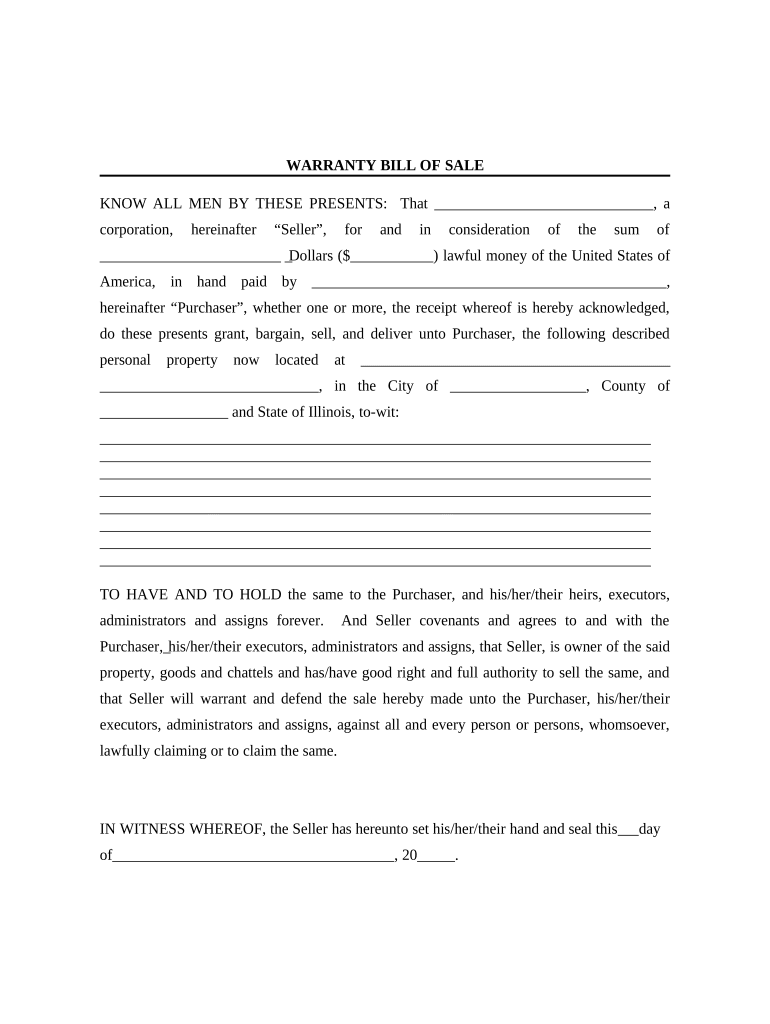
Bill of Sale with Warranty for Corporate Seller - Illinois Preview on Page 1

Here's how it works

01. Edit your form online
Type text, add images, blackout confidential details, add comments, highlights and more.
02. Sign it in a few clicks
Draw your signature, type it, upload its image, or use your mobile device as a signature pad.
03. Share your form with others
Send it via email, link, or fax. You can also download it, export it or print it out.

How to use or fill out Bill of Sale with Warranty for Corporate Seller - Illinois

Form edit decoration
9.5
Ease of Setup
DocHub User Ratings on G2
9.0
Ease of Use
DocHub User Ratings on G2
  1. Click ‘Get Form’ to open it in the editor.
  2. Begin by entering the Seller's name, which is the corporation selling the property. This should be filled in at the top of the document.
  3. Next, specify the purchase amount in dollars where indicated. Ensure this reflects the agreed price between Seller and Purchaser.
  4. Fill in the Purchaser's name(s) next, ensuring accuracy as this identifies who will receive ownership of the property.
  5. Describe the personal property being sold in detail. Include specifics such as make, model, and any identifying features to avoid ambiguity.
  6. Complete the location details where the property is currently situated, including city and county information.
  7. The Seller must sign and date the document at the bottom, along with their title within the corporation.
  8. Finally, ensure a notary public acknowledges the document by filling out their section to validate it legally.

Start using our platform today to easily complete your Bill of Sale with Warranty for Corporate Seller - Illinois for free!

be ready to get more

Complete this form in 5 minutes or less

Get form

Got questions?

We have answers to the most popular questions from our customers. If you can't find an answer to your question, please contact us.
Contact us
The template includes practical guidance, drafting notes, and alternate and optional clauses. A warranty bill of sale is usually used to transfer title to personal property, such as equipment, and includes representations and warranties from the seller that favor the buyer.
A warranty bill of sale is a formal document that serves as evidence of the transfer of ownership of personal property from a seller to a buyer. What sets it apart from a conventional bill of sale is its inclusion of warranty terms and assurances regarding the condition of the sold item.
This Standard Document is a form of absolute bill of sale that parties to a sale of goods agreement use to transfer title or evidence title transfer concerning the purchase of tangible goods. It includes representations and warranties and discusses indemnification provisions.
Warranties are meant to guarantee the condition of products and services as they are when they are purchased. This means that they typically only apply to products that have not been altered or modified after they were purchased.
The purpose of a bill of sales is to be a record of the transfer of ownership. It clearly states who the owner of the item is after the sale. This will prevent future disputes. It also protects both parties by providing the buyer with a legal document and relieving the seller of liability after the transfer.

Security and compliance

At DocHub, your data security is our priority. We follow HIPAA, SOC2, GDPR, and other standards, so you can work on your documents with confidence.

Learn more
ccpa2
pci-dss
gdpr-compliance
hipaa
soc-compliance

People also ask

The short answer is that both the buyer and seller should retain the bill of sale for their records. This document protects everyone involved should any disagreements arise in the future. Typically, the buyer should keep the original and the seller should keep a copy.
Its important to understand that a Bill of Sale is different from a warranty deed, which is used to transfer ownership of real property like land or buildings. Instead, a Bill of Sale typically pertains to tangible personal property, which can include items like vehicles, furniture, or electronics.

Related links