Joint tenant tenancy 2026

Get Form
joint tenant tenancy Preview on Page 1

Here's how it works

01. Edit your form online
Type text, add images, blackout confidential details, add comments, highlights and more.
02. Sign it in a few clicks
Draw your signature, type it, upload its image, or use your mobile device as a signature pad.
03. Share your form with others
Send it via email, link, or fax. You can also download it, export it or print it out.

How to use or fill out joint tenant tenancy with our platform

Form edit decoration
9.5
Ease of Setup
DocHub User Ratings on G2
9.0
Ease of Use
DocHub User Ratings on G2
  1. Click ‘Get Form’ to open the joint tenant tenancy document in the editor.
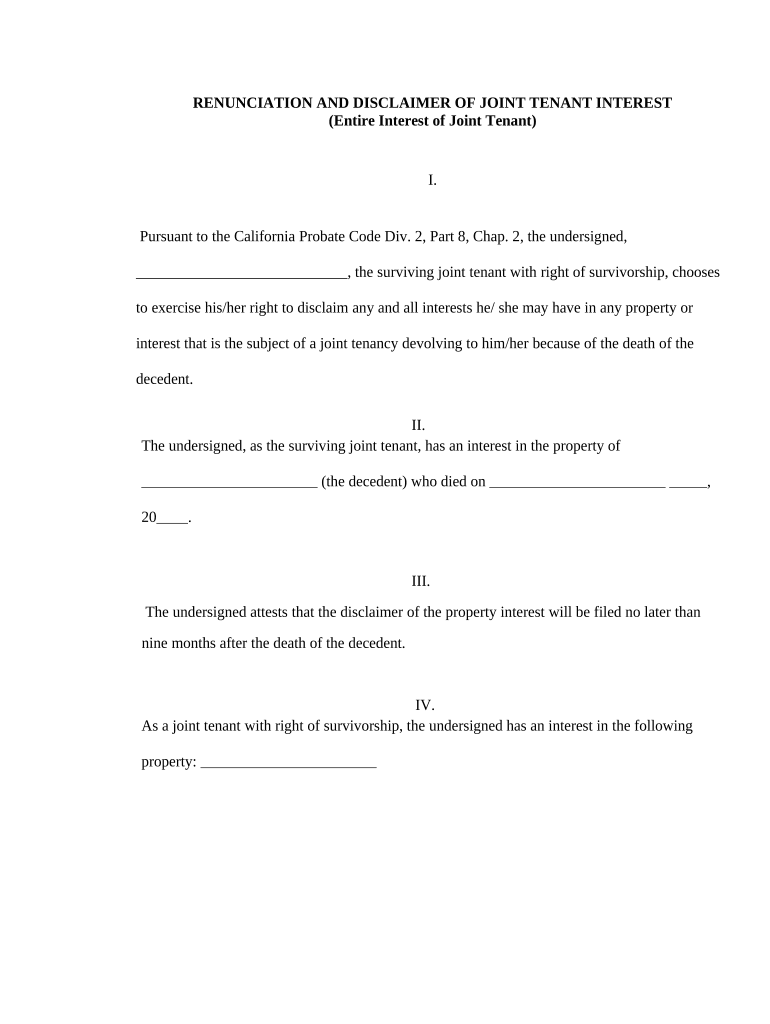
  2. In Section I, enter your name as the surviving joint tenant who is disclaiming interest. This establishes your identity in relation to the property.
  3. Proceed to Section II and fill in the name of the decedent along with their date of death. This information is crucial for legal clarity.
  4. In Section III, ensure you acknowledge that the disclaimer will be filed within nine months after the decedent's death. This is a legal requirement.
  5. Section IV requires you to specify the property in question. Clearly describe it to avoid any ambiguity.
  6. In Section V, list any individuals who will inherit the property as a result of your disclaimer. This ensures proper distribution according to your wishes.
  7. Complete Sections VI and VII by confirming that this renunciation relates back to the date of death and sign where indicated. Make sure all signatures are clear and legible.

Start using our platform today for free to streamline your document editing and signing process!

be ready to get more

Complete this form in 5 minutes or less

Get form

Got questions?

We have answers to the most popular questions from our customers. If you can't find an answer to your question, please contact us.
Contact us
The drawbacks of a joint family are a lack of personal privacy, constant quarrels, economic burdens, and minimal professional growth. Individual freedom is also restricted because of interference by elders.
Joint tenants have the same rights and responsibilities even if they no longer live at the property. For example, each joint tenant is responsible for making sure the whole of the rent is paid, and not just their share of it. If a court order was sought for unpaid rent, it would be against all the joint tenants.
Some of the main benefits of joint tenancy include avoiding probate courts, sharing responsibility, and maintaining continuity. The primary pitfalls are the need for agreement, the potential for assets to be frozen, and loss of control over the distribution of assets after death.
After all, you might be contributing equal shares, and you might be happy for the property to be passed into your partners sole name, should you die first. However, if you are making unequal contributions and you would like this to be formally recognised, then buying as tenants in common could be a better option.
Downsides of Joint Tenancy If a couple or business partners disagree, neither party can sell or encumber the asset without the consent of all parties. This restriction is intended to prevent abuses. However, the need to get agreement from all parties can make it difficult to take necessary actions.

Security and compliance

At DocHub, your data security is our priority. We follow HIPAA, SOC2, GDPR, and other standards, so you can work on your documents with confidence.

Learn more
ccpa2
pci-dss
gdpr-compliance
hipaa
soc-compliance

People also ask

If your co-owner is married, there is a risk of the property being subject to divorce proceedings. With something like a bank account, there is the risk that the co-owner could go on a spending spree and drain the account. In some situations, creating a joint ownership can also create gift tax or income tax problems.
Owning a property together as joint tenants is what married/cohabiting couples typically opt for. One reason is because joint tenants have an equal right to the whole property, regardless of whether one of you: Contributes more towards the deposit for the property. Pays more towards the mortgage.
Joint tenancy is a type of joint ownership of property in the field of property law, where each owner has an undivided interest in the property. This type of ownership creates a right of survivorship, which means that when one owner dies, the other owners absorb the deceased owners interest.

Related links