Interrogatories to Defendant for Motor Vehicle Accident - Idaho 2026

Get Form
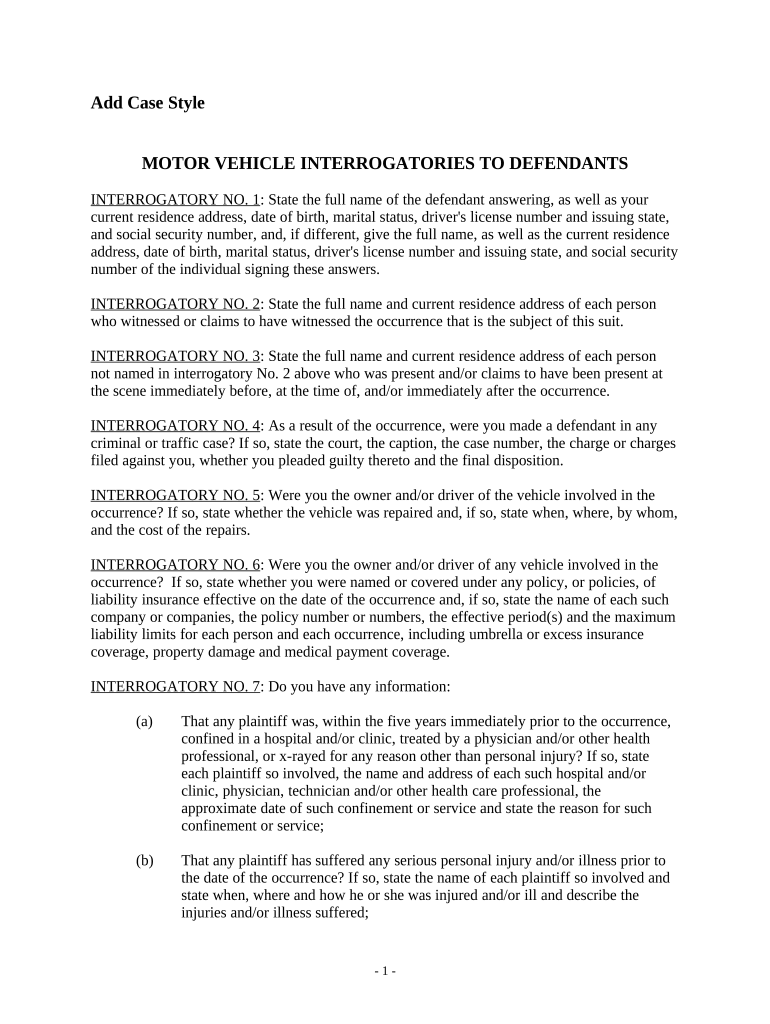
Interrogatories to Defendant for Motor Vehicle Accident - Idaho Preview on Page 1

Here's how it works

01. Edit your form online
Type text, add images, blackout confidential details, add comments, highlights and more.
02. Sign it in a few clicks
Draw your signature, type it, upload its image, or use your mobile device as a signature pad.
03. Share your form with others
Send it via email, link, or fax. You can also download it, export it or print it out.

How to use or fill out Interrogatories to Defendant for Motor Vehicle Accident - Idaho

Form edit decoration
9.5
Ease of Setup
DocHub User Ratings on G2
9.0
Ease of Use
DocHub User Ratings on G2
  1. Click ‘Get Form’ to open it in the editor.
  2. Begin with INTERROGATORY NO. 1, providing your full name, current residence address, date of birth, marital status, driver's license number and issuing state, and social security number. If someone else is signing the answers, include their details as well.
  3. Proceed to INTERROGATORY NO. 2 by listing the names and addresses of any witnesses to the incident.
  4. For INTERROGATORY NO. 3, identify additional individuals present at the scene who were not mentioned previously.
  5. Continue through each interrogatory systematically, ensuring you provide accurate information regarding any criminal cases (NO. 4), vehicle ownership (NO. 5), insurance policies (NO. 6), and medical history related to the incident (NO. 7).
  6. Complete all remaining interrogatories by detailing any evidence such as photographs (NO. 8) or conversations regarding the accident (NO. 9).
  7. Finally, review your responses for accuracy before signing at the end of the document.

Start using our platform today for free to streamline your document editing and form completion!

be ready to get more

Complete this form in 5 minutes or less

Get form

Got questions?

We have answers to the most popular questions from our customers. If you can't find an answer to your question, please contact us.
Contact us
Interrogatories are written questions sent by one party in a lawsuit to another party in that same suit, which the responding party must answer under penalty of perjury. Interrogatories allow the parties to ask who, what, when, where and why questions, making them a good method for obtaining new information.
Some of the deposition questions that you can expect during this more benign stage of the proceedings include: What is your full name? What is your date of birth? What is your address? What is your Social Security number? What is your place of birth? Where did you go to school? What is your level of education?
A deposition is an interview with witnesses to the incident that takes place out of court. Witnesses provide sworn testimony, which becomes part of a written transcript. Once transcribed, personal injury attorneys can use the information provided when building the case as well as during the trial itself.
Document Everything. Seek Medical Attention. Dont Take the First Settlement Offer. Hire an Experienced Car Accident Attorney. Promptly File Your Case. Build and Preserve a Strong Case. Avoid Discussing the Case with Insurance Companies. Make a Good Impression in Court.
Draft Interrogatories Strategically Be specific Avoid general questions that invite objections or unclear answers. Follow a logical sequence Structure questions so they build on one another. Target missing details Use interrogatories to gather facts that cant be found in available documents or witness statements.

Security and compliance

At DocHub, your data security is our priority. We follow HIPAA, SOC2, GDPR, and other standards, so you can work on your documents with confidence.

Learn more
ccpa2
pci-dss
gdpr-compliance
hipaa
soc-compliance

People also ask

Did your body strike anything inside the vehicle during the accident? What parts of your body were injured in the accident? Was there any warning of the impending accident such as horns blowing or tires screeching? Was your foot on the brake at the time of the accident? How were you sitting?
What were the causal factors of the accident? What were the injuries? What was the person doing when injured? What had the person been instructed to do?
In California, you have 30 days to respond to an interrogatory. If you do not respond within this time, the opposing side can file a motion to compel with the court. The court may require them to first consult with you about your failure to respond before officially filing a motion to compel.

Related links