Type text, add images, blackout confidential details, add comments, highlights and more.
02. Sign it in a few clicks
Draw your signature, type it, upload its image, or use your mobile device as a signature pad.
03. Share your form with others
Send it via email, link, or fax. You can also download it, export it or print it out.
How to use or fill out Mutual Wills Package of Last Wills and Testaments for Unmarried Persons living together with Adult Children - Iowa
Ease of Setup
DocHub User Ratings on G2
Ease of Use
DocHub User Ratings on G2
Click ‘Get Form’ to open it in the editor.
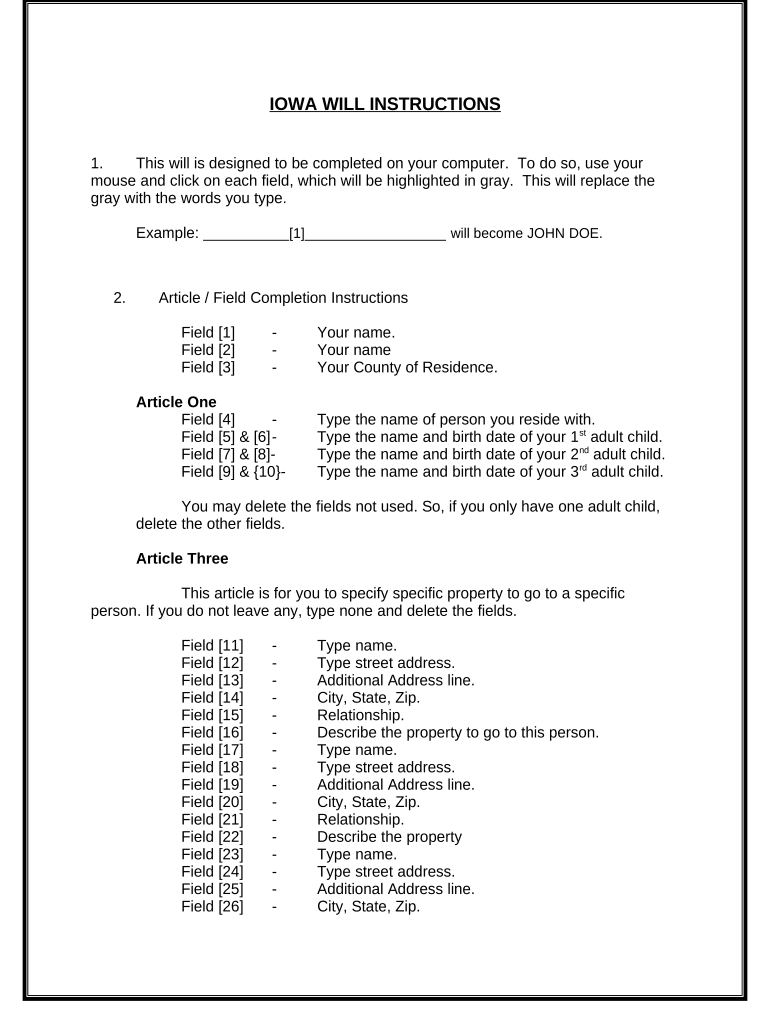
Begin by entering your name in Field [1] and your county of residence in Field [3].
In Article One, provide the name of the person you reside with in Field [4], followed by the names and birth dates of your adult children in Fields [5]-[10]. You can delete any unused fields.
For Article Three, specify any specific property bequests. Fill out Fields [11]-[28] as needed, detailing names, addresses, relationships, and descriptions of property.
In Article Four, indicate who will receive your homestead if applicable. Use Field [29] for a non-child recipient or Field [30] for children.
Complete Articles Five and Six regarding remaining property distribution. Ensure all selections are made clearly.
Designate a Personal Representative in Article Seven using Fields [34] and [35].
Review all entries carefully before printing. Ensure signatures are obtained from two witnesses during execution.
Start filling out your Mutual Wills Package today on our platform for free!
Fill out Mutual Wills Package of Last Wills and Testaments for Unmarried Persons living together with Adult Children - Iowa online It's free
Free printable joint Will TemplateIowa last will and Testament formJoint will vs mutual willCan a surviving spouse change a joint willJoint will for married coupleMirror will templateIowa Living will and Durable power of attorney form
Security and compliance
At DocHub, your data security is our priority. We follow HIPAA, SOC2, GDPR, and other standards, so you can work on your documents with confidence.
Aug 5, 2013 The wills stated that they were mutual and contractual, and were not to be violated by the surviving spouse after the death of the first spouse.Read more
wills deposited with the clerk by living testators or by persons on their behalf, and wills of deceased testators not accompanied by petitions for theRead more
Cookie consent notice
This site uses cookies to enhance site navigation and personalize your experience.
By using this site you agree to our use of cookies as described in our Privacy Notice.
You can modify your selections by visiting our Cookie and Advertising Notice.