




01. Edit your sat bubble sheet online
Type text, add images, blackout confidential details, add comments, highlights and more.

Type text, add images, blackout confidential details, add comments, highlights and more.

Draw your signature, type it, upload its image, or use your mobile device as a signature pad.

Send sat bubble sheet png via email, link, or fax. You can also download it, export it or print it out.
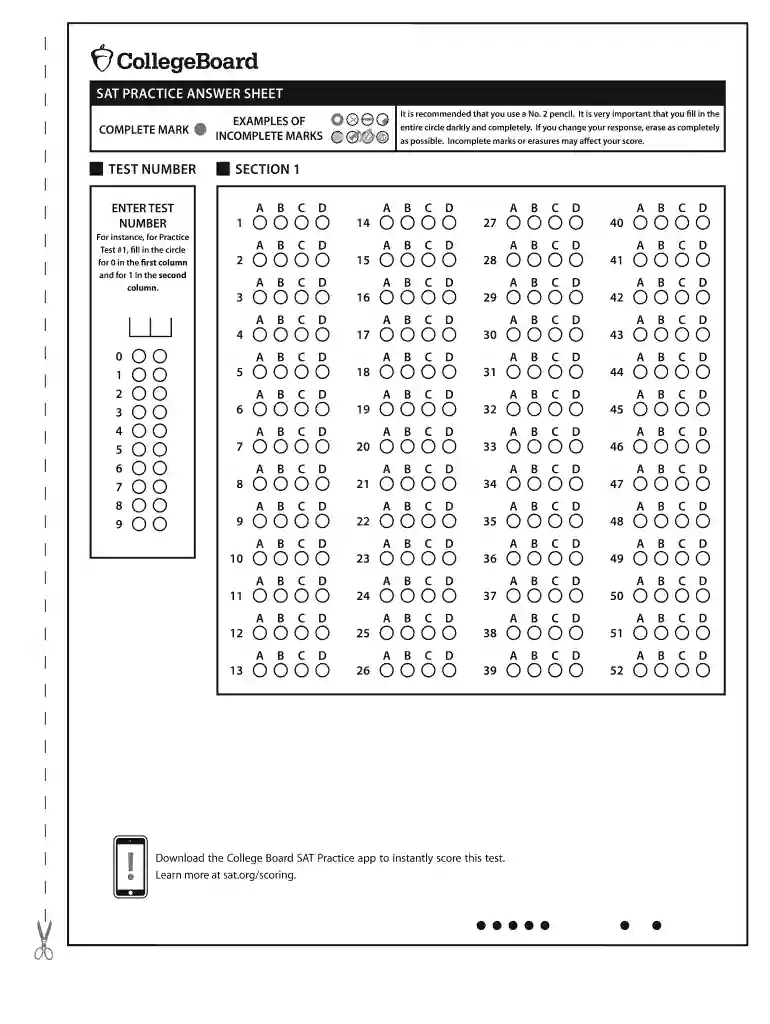
The SAT bubble sheet is a standardized answer sheet used in the SAT (Scholastic Aptitude Test) exam, primarily administered to high school students in the United States. This sheet serves as a recording instrument for test-takers to mark their answers to multiple-choice questions in various subjects, including Math, Reading, and Writing.
The format generally consists of a grid layout where students fill in circles corresponding to their chosen answers using a No. 2 pencil. Ensuring that the marks are completely filled in is essential, as incomplete markings can lead to scanning errors and affect the scoring of the exam.
There are several types of SAT bubble sheets, including the standard test answer sheet, the practice test version, and editable formats for digital use. Each variant serves a specific purpose, ranging from official test situations to self-practice environments.
Using the SAT bubble sheet properly is crucial for ensuring accurate scoring. Here are essential guidelines for effective use:
Filling in Responses:
Sections:
Practice:
Double-Check Your Work:
Filling out the SAT bubble sheet follows a systematic process. Here are detailed steps to ensure accuracy:
Read Instructions:
Mark Questions:
Check for Changes:
Several practical scenarios illustrate the use of the SAT bubble sheet effectively:
Understanding specific terminology related to the SAT bubble sheet can enhance clarity for test-takers:
The SAT bubble sheet is a legally accepted document in standardized testing. It adheres to guidelines set by the College Board, the organization that administers the SAT. Legal considerations around its use focus on ensuring authenticity and proper scoring.
With advancements in technology, a digital variant of the SAT bubble sheet has emerged alongside its traditional paper format. Here are distinctions between the two:
Students may choose to practice with both formats to become familiar with the differences and develop a strategy that best suits their testing style.
At DocHub, your data security is our priority. We follow HIPAA, SOC2, GDPR, and other standards, so you can work on your documents with confidence.


