Type text, add images, blackout confidential details, add comments, highlights and more.
02. Sign it in a few clicks
Draw your signature, type it, upload its image, or use your mobile device as a signature pad.
03. Share your form with others
Send it via email, link, or fax. You can also download it, export it or print it out.
How to use or fill out Interrogatories to Plaintiff for Motor Vehicle Occurrence - Hawaii
Ease of Setup
DocHub User Ratings on G2
Ease of Use
DocHub User Ratings on G2
Click ‘Get Form’ to open it in the editor.
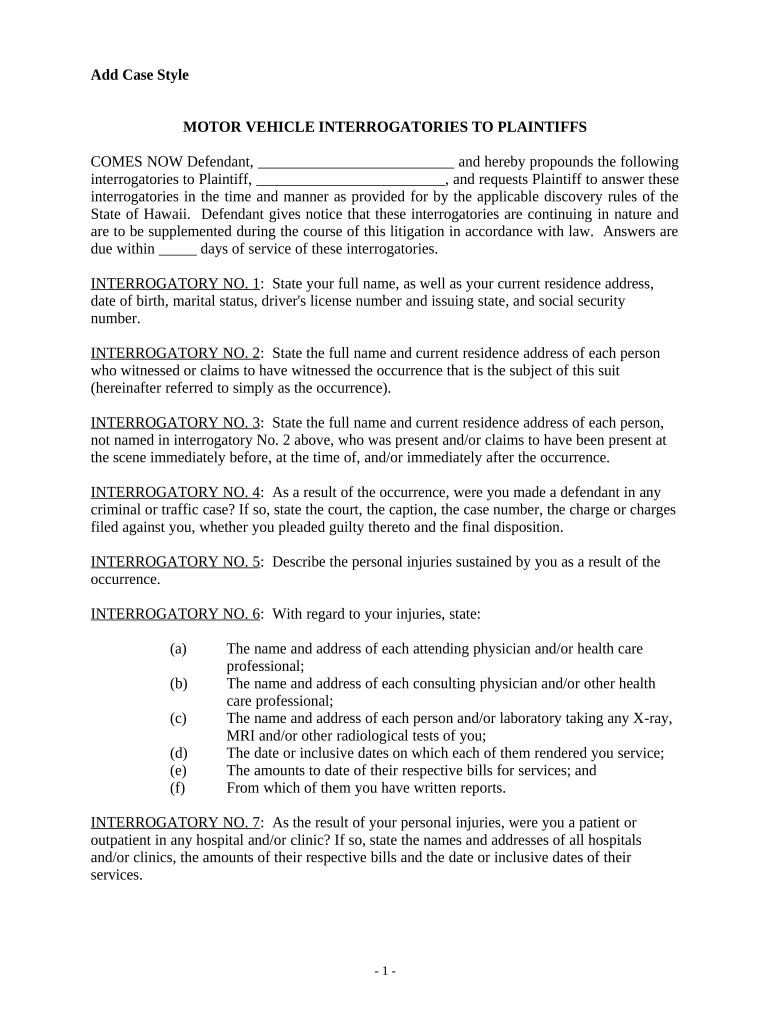
Begin by entering the case style at the top of the form, including the names of the parties involved.
In INTERROGATORY NO. 1, provide your full name, current residence address, date of birth, marital status, driver's license number and issuing state, and social security number.
Continue through each interrogatory systematically. For example, in INTERROGATORY NO. 2, list all witnesses who saw the occurrence.
For questions regarding personal injuries (INTERROGATORY NO. 5), describe your injuries in detail and include any medical professionals involved as requested in subsequent interrogatories.
Ensure you answer all questions thoroughly and accurately to comply with discovery rules.
Once completed, review your answers for clarity and completeness before submitting.
Start using our platform today to fill out your Interrogatories for free!
Fill out Interrogatories to Plaintiff for Motor Vehicle Occurrence - Hawaii online It's free
What Are The Most Common Objections To Interrogatories? The most common discovery objection our lawyers see is the objection that the interrogatories are not relevant to the litigation or are too burdensome to answer.
How to respond to plaintiffs first set of interrogatories?
In California, you have 30 days to respond to an interrogatory. If you do not respond within this time, the opposing side can file a motion to compel with the court. The court may require them to first consult with you about your failure to respond before officially filing a motion to compel.
What are the disadvantages of interrogatories?
Interrogatories are written questions sent by one party in a lawsuit to another party in that same suit, which the responding party must answer under penalty of perjury. Interrogatories allow the parties to ask who, what, when, where and why questions, making them a good method for obtaining new information.
Can interrogatories help win a case?
Fact-Finding: Interrogatories help attorneys obtain critical information from the opposing party. For example, in a car accident case, the plaintiffs attorney might ask the defendant to describe their version of the incident, list any witnesses, or detail the injuries they claim to have suffered.
What are the limitations of interrogatories?
Each party is allowed to serve 25 interrogatories upon any other party, but must secure leave of court (or a stipulation from the opposing party) to serve a larger number.
Related Searches
Sample interrogatories to Defendant car accidentCar accident Interrogatories to DefendantSample interrogatory questions to PlaintiffPremises liability Interrogatories to DefendantGeneral personal injury Negligence interrogatories to defendantSample interrogatories to plaintiff Debt CollectionSample slip and fall interrogatories to DEFENDANTDefendants FIRST SET OF INTERROGATORIES to Plaintiff
Security and compliance
At DocHub, your data security is our priority. We follow HIPAA, SOC2, GDPR, and other standards, so you can work on your documents with confidence.
Benefits of Using Interrogatories Since they are in written form, they eliminate the need for travel or in-person meetings, saving both time and expenses. Obtain Specific Details: Attorneys carefully craft interrogatories to elicit detailed information that may be difficult to obtain through other means.
Related links
Answers to Interrogatories As Limiting Proof at Trial
by FW Joyner 1962 Cited by 1 Plaintiffs counsel objected on grounds that plaintiff would be prejudiced by allowing new witnesses to testify. Defendants counsel offered to have the caseRead more
Plaintiff-Appellant Nina Dowsett (Dowsett) appeals the August 29, 2000 judgment of the circuit court of the first circuit, the Honorable Karen N. Blondin, judgeRead more
Cookie consent notice
This site uses cookies to enhance site navigation and personalize your experience.
By using this site you agree to our use of cookies as described in our Privacy Notice.
You can modify your selections by visiting our Cookie and Advertising Notice.