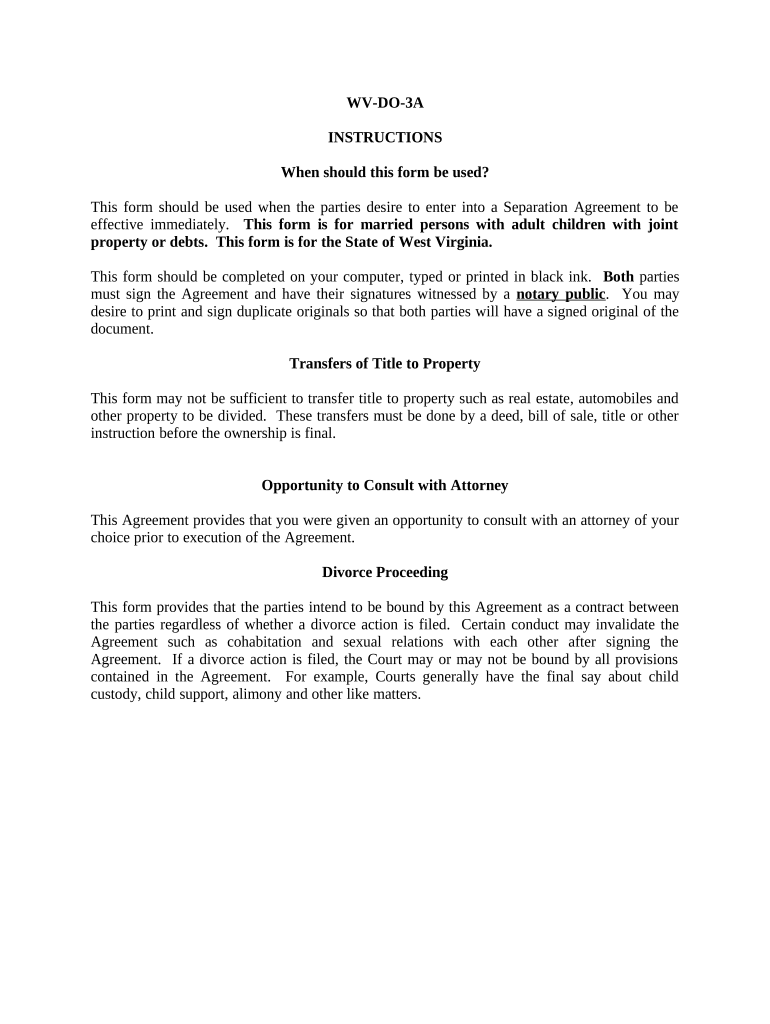
Marital Domestic Separation and Property Settlement Agreement Adult Children Parties May have Joint Property or Debts effective Immediately - West Virginia 2026

Get Form
Marital Domestic Separation and Property Settlement Agreement Adult Children Parties May have Joint Property or Debts effective Immediately - West Virginia Preview on Page 1

Here's how it works

01. Edit your form online
Type text, add images, blackout confidential details, add comments, highlights and more.
02. Sign it in a few clicks
Draw your signature, type it, upload its image, or use your mobile device as a signature pad.
03. Share your form with others
Send it via email, link, or fax. You can also download it, export it or print it out.

How to use or fill out Marital Domestic Separation and Property Settlement Agreement Adult Children Parties May have Joint Property or Debts effective Immediately - West Virginia

Form edit decoration
9.5
Ease of Setup
DocHub User Ratings on G2
9.0
Ease of Use
DocHub User Ratings on G2
  1. Click ‘Get Form’ to open it in the editor.
  2. Begin by entering the full legal names of both parties at the top of the form, ensuring accuracy for legal purposes.
  3. In Section 1, outline the separation details, including the date of separation and any relevant circumstances that led to this agreement.
  4. Proceed to Section 2 to disclose financial information. Each party should list their assets and liabilities clearly, ensuring transparency.
  5. In Section 3, detail the division of assets. Clearly describe each item being awarded to either party along with its current fair market value.
  6. Section 4 requires you to specify debts. Each party should list their respective debts and agree on who will be responsible for payment.
  7. Complete Sections 5 through 21 as applicable, ensuring all necessary provisions regarding spousal support, child arrangements, and other legal stipulations are addressed.
  8. Finally, both parties must sign the document in front of a notary public to validate the agreement legally.

Start using our platform today for free to streamline your document editing and signing process!

be ready to get more

Complete this form in 5 minutes or less

Get form

Got questions?

We have answers to the most popular questions from our customers. If you can't find an answer to your question, please contact us.
Contact us
West Virginia is an equitable distribution state, not a community property state. This means that all marital property is subject to a fair, though not necessarily equal, division. Some couples can work out property division through negotiations.
Yes, if the property was acquired prior to marriage, the general ASSUMPTION (which can be challenged) is that it belongs to the individual who made the purchase.
If the home was acquired during the marriage in a community property state, the home belongs to both spouses, whether their name is on the title or not. The spouse whose name is on the deed is considered the legal owner.
Under West Virginia law, the courts are required to divide marital property according to the principle of equitable distribution. Note that equitable does not necessarily mean equal. That is, the court is not required to simply divide all property in half, but rather to find a fair distribution.
West Virginia follows the equitable distribution rule, which means the court has to docHub a solution that is fair but not necessarily 50/50.

Security and compliance

At DocHub, your data security is our priority. We follow HIPAA, SOC2, GDPR, and other standards, so you can work on your documents with confidence.

Learn more
ccpa2
pci-dss
gdpr-compliance
hipaa
soc-compliance

People also ask

A settlement agreement differs from a separation agreement as it sets the terms for the divorce, not the separation. A settlement agreement should address all central issues of the divorce. This can include things like division of marital assets and debts, child custody, and child support, as well as spousal support.
Under community property, spouses own (and owe) everything equally, regardless of who earns or spends the income. Community property is also known as marital property.

Related links