Letter landlord tenant 2026

Get Form
letter landlord tenant Preview on Page 1

Here's how it works

01. Edit your form online
Type text, add images, blackout confidential details, add comments, highlights and more.
02. Sign it in a few clicks
Draw your signature, type it, upload its image, or use your mobile device as a signature pad.
03. Share your form with others
Send it via email, link, or fax. You can also download it, export it or print it out.

How to use or fill out letter landlord tenant with our platform

Form edit decoration
9.5
Ease of Setup
DocHub User Ratings on G2
9.0
Ease of Use
DocHub User Ratings on G2
  1. Click ‘Get Form’ to open the letter landlord tenant in the editor.
  2. Begin by entering the date at the top of the document. This is crucial for record-keeping and establishes when the notice was issued.
  3. Fill in the tenant’s name and address of the premises where they reside. Ensure accuracy to avoid any confusion regarding the notice.
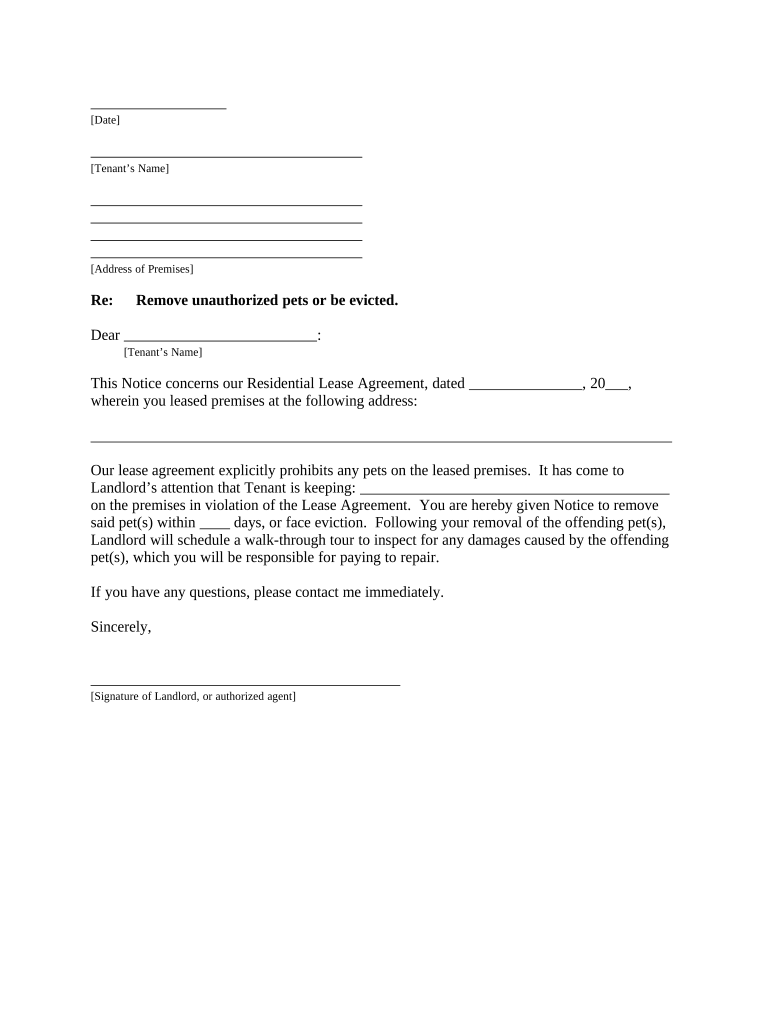
  4. In the body of the letter, specify the lease agreement date and address. Clearly state that unauthorized pets are present, violating the lease terms.
  5. Indicate a deadline for pet removal, ensuring it is reasonable and complies with local regulations. This section is vital for legal clarity.
  6. Include your signature or that of an authorized agent at the bottom, along with a proof of delivery section to confirm how this notice was delivered to the tenant.

Start using our platform today to streamline your document editing and ensure effective communication with tenants!

be ready to get more

Complete this form in 5 minutes or less

Get form

Got questions?

We have answers to the most popular questions from our customers. If you can't find an answer to your question, please contact us.
Contact us

Yes, you can use DocHub for signing any business and private paperwork, including your letter landlord tenant. All eSignatures you generate with our tool are legally binding and court-admissible, as DocHub complies with standards required by ESIGN and UETA. Save your accomplished form with a detailed Audit Trail if needed.

You can get and edit your letter landlord tenant online by using DocHub. Its straightforward but feature-rich design allows you to start effective work immediately after you sign up your account. Create your account and add your file, then our interface will guide you via our stress-free form completion experience.

Follow These Steps for Tenant Letters Keep letters consistent by including the following elements: Tenants name and full address. The date. A subject line that summarizes the information. The landlords expectations (pay the rent, stop breaking a rule, etc.)
Dear {TENANT NAME}, You are hereby notified to vacate the premises at {RENTAL PROPERTY ADDRESS} by {DATE} and {TIME}. The reason for this eviction notice letter is: {STATE THE REASON} which is in direct violation of your rental agreement, as noted below: {INSERT THE LEASE AGREEMENT}.
A Notice to Vacate should clearly state the tenants name, property address, and the date by which they must leave. Include the reason for the notice if required by law. Specify the exact move-out date, respecting any minimum notice period mandated by local or state law.

Security and compliance

At DocHub, your data security is our priority. We follow HIPAA, SOC2, GDPR, and other standards, so you can work on your documents with confidence.

Learn more
ccpa2
pci-dss
gdpr-compliance
hipaa
soc-compliance

People also ask

I am confident that I would be an ideal tenant and would take great care of your property. I understand the importance of timely rent payments and would make sure to pay my rent on time every month. I would also respect the property and your rules, and do my best to maintain a harmonious relationship with my neighbors.
To create a notice to leave, youll need the following information: your name. your tenants name. the propertys address. the reasons you want to end the tenancy, called the eviction grounds the end of the notice period the date the tenant must move out by.
Letters are the most common form of written communication between a landlord and tenant. They provide a formal record of the correspondence and can serve as evidence in case of any disputes or legal issues. They are also a more professional way of communicating compared to phone calls or text messages.

Related links