Mutual Wills or Last Will and Testaments for Man and Woman living together, not Married with Minor Children - Wisconsin 2026

Get Form
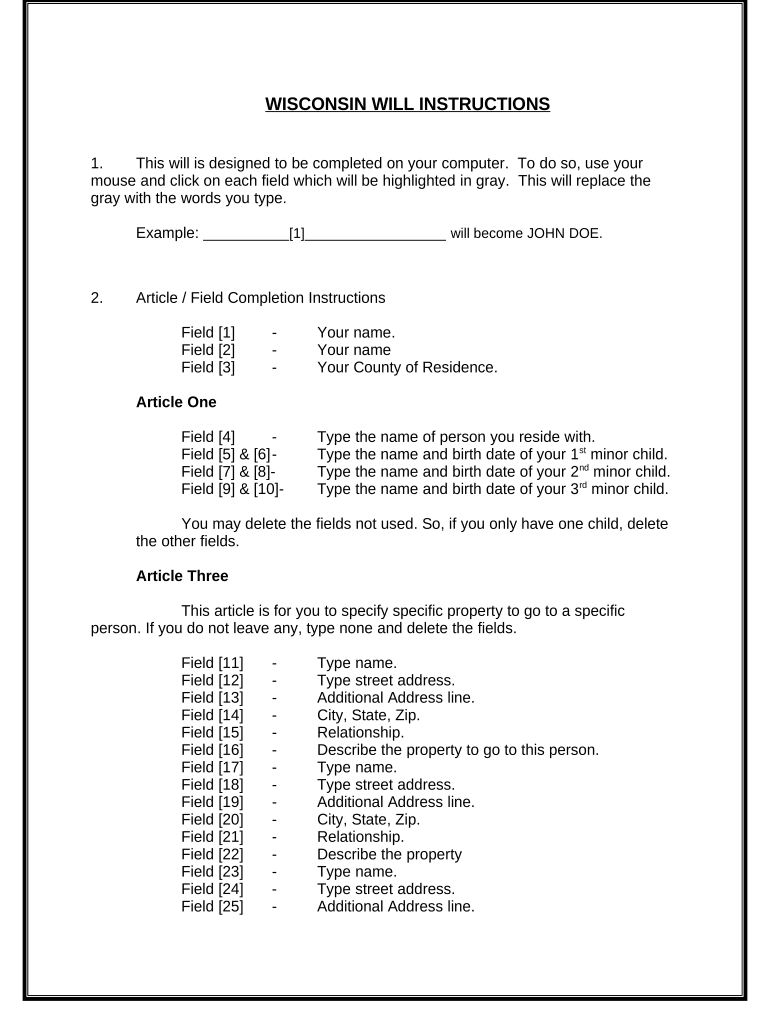
Mutual Wills or Last Will and Testaments for Man and Woman living together, not Married with Minor Children - Wisconsin Preview on Page 1

Here's how it works

01. Edit your form online
Type text, add images, blackout confidential details, add comments, highlights and more.
02. Sign it in a few clicks
Draw your signature, type it, upload its image, or use your mobile device as a signature pad.
03. Share your form with others
Send it via email, link, or fax. You can also download it, export it or print it out.

How to use or fill out Mutual Wills or Last Will and Testaments for Man and Woman living together, not Married with Minor Children - Wisconsin

Form edit decoration
9.5
Ease of Setup
DocHub User Ratings on G2
9.0
Ease of Use
DocHub User Ratings on G2
  1. Click ‘Get Form’ to open it in the editor.
  2. Begin by entering your name in Field [1] and your county of residence in Field [3].
  3. In Article One, specify the name of the person you reside with in Field [4] and list your minor children's names and birth dates in Fields [5]-[10].
  4. For Article Three, detail any specific property bequests by filling out Fields [11]-[24], including names, addresses, relationships, and descriptions of the property.
  5. In Article Four, indicate who will receive your homestead by completing Field [29] if it's someone other than your children.
  6. Complete Articles Five through Eleven by specifying how remaining property should be distributed, naming a Trustee, Guardian for minor children, and Personal Representative.
  7. Review all entries for accuracy before printing. Ensure to sign in front of two witnesses.

Start using our platform today to create your Mutual Wills or Last Will and Testament effortlessly!

be ready to get more

Complete this form in 5 minutes or less

Get form

Got questions?

We have answers to the most popular questions from our customers. If you can't find an answer to your question, please contact us.
Contact us
Important note* Wisconsin does not allow joint wills. Illinois does allow joint wills. If a joint will is presented at a Wisconsin probate court, the court will try to separate the document into two separate wills.
If neither community property nor the right of election applies, a surviving spouse may be disinherited completely. They can choose to contest the validity of the will itself, but otherwise they have no recourse.
A joint will is essentially a single will that two people, usually spouses, create together, agreeing on how their assets should be distributed upon their deaths. This approach to estate planning can simplify decision-making and provide clarity and security for the future.
The Drawbacks of Joint Wills Lack of Flexibility: One of the main issues with joint wills is their inflexibility. Once one spouse passes away, the surviving spouse cannot alter the will. This could pose challenges if circumstances change, such as the birth of new grandchildren or changes in financial status.
One of the primary issues with joint wills is their inflexibility. Its important to understand that a joint will is irrevocable once one of the signees passes away; the terms of the will cannot be changed after that. This means the surviving spouse cannot alter the will if circumstances change.

Security and compliance

At DocHub, your data security is our priority. We follow HIPAA, SOC2, GDPR, and other standards, so you can work on your documents with confidence.

Learn more
ccpa2
pci-dss
gdpr-compliance
hipaa
soc-compliance

People also ask

Wisconsin-specific Will Requirements In Wisconsin, a will must be written. In Wisconsin, a will must be signed and dated in the presence of two disinterested witnesses. In Wisconsin, your will must be proven after your death in order to be deemed valid by the court.
Grounds for Contesting a Will in Wisconsin Ambiguous provisions exist. The Will was revoked. A new Will exists. Undue influence, fraud, or duress altered the testators decisions in the Will.

Related links