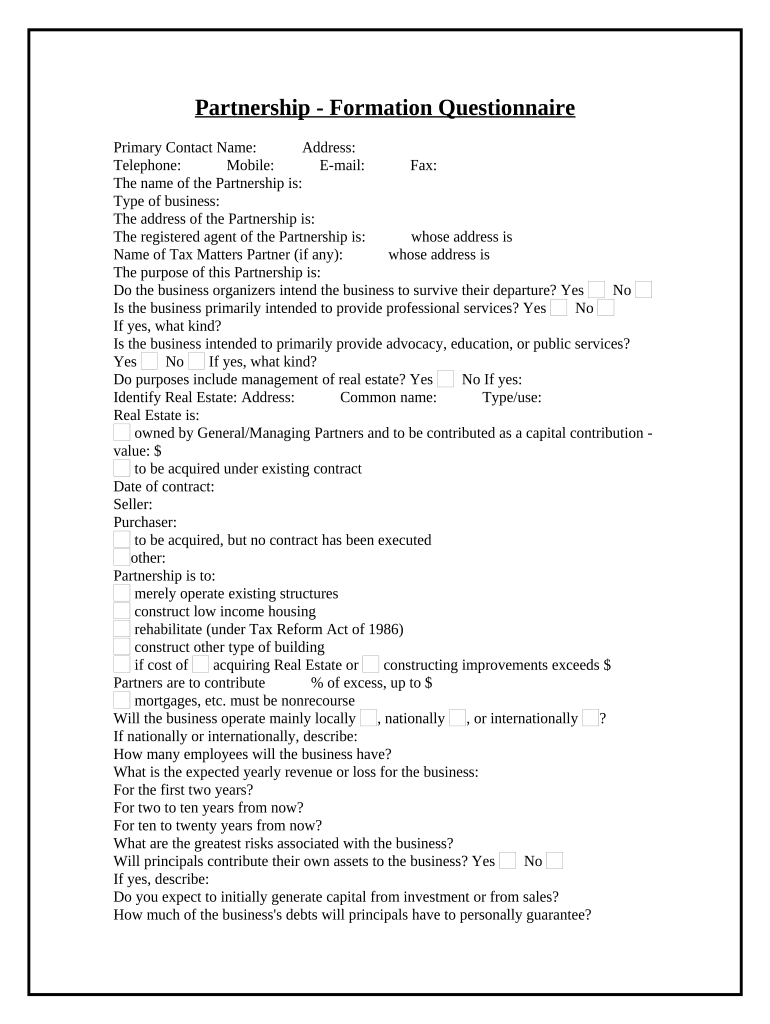
Partnership Formation Questionnaire 2026

Get Form
partnership formation questions and answers Preview on Page 1

Here's how it works

01. Edit your partnership formation questions and answers online
Type text, add images, blackout confidential details, add comments, highlights and more.
02. Sign it in a few clicks
Draw your signature, type it, upload its image, or use your mobile device as a signature pad.
03. Share your form with others
Send partnership questionnaire via email, link, or fax. You can also download it, export it or print it out.

How to use or fill out Partnership Formation Questionnaire with our platform

Form edit decoration
9.5
Ease of Setup
DocHub User Ratings on G2
9.0
Ease of Use
DocHub User Ratings on G2
  1. Click ‘Get Form’ to open the Partnership Formation Questionnaire in the editor.
  2. Begin by entering the Primary Contact Name, Address, Telephone, Mobile, E-mail, and Fax. This information is crucial for communication.
  3. Fill in the name of the Partnership and its type of business. Ensure that you provide a clear description of the business purpose.
  4. Complete sections regarding real estate management if applicable. Specify details such as address, common name, and type/use of real estate.
  5. Address questions about capital contributions and profit sharing among partners. Clearly indicate percentages and amounts where required.
  6. Review operational details including decision-making processes and requirements for signing documents on behalf of the partnership.
  7. Finalize by ensuring all partners' information is accurately entered in the designated sections before submitting your completed form.

Start using our platform today to easily complete your Partnership Formation Questionnaire for free!

be ready to get more

Complete this form in 5 minutes or less

Get form

Got questions?

We have answers to the most popular questions from our customers. If you can't find an answer to your question, please contact us.
Contact us
Over the years, we have found it useful to talk about the four Ds: divorce, death, disagreement and disability. This is a handy way of reminding business people about some of the most crucial issues they face in their relationships with other business people.
There are three relatively common partnership types: general partnership (GP), limited partnership (LP) and limited liability partnership (LLP). A fourth, the limited liability limited partnership (LLLP), is not recognized in all states.
We return to the definition of a partnership: the association of two or more persons to carry on as co-owners a business for profit[.] The three elements are (1) the association of persons, (2) as co-owners, (3) for profit.
There are four types of business partnerships: LLC partnership (also known as a multi-member LLC) Limited liability partnership (LLP) Limited partnership (LP) General partnership (GP)
How to start a partnership business in 10 steps Find the right partner(s) Decide on the partnership type. Draft a partnership agreement. Register your business. Set up your finances. Secure funding. Define roles and responsibilities. Create a business plan.

Security and compliance

At DocHub, your data security is our priority. We follow HIPAA, SOC2, GDPR, and other standards, so you can work on your documents with confidence.

Learn more
ccpa2
pci-dss
gdpr-compliance
hipaa
soc-compliance

People also ask

You dont have to file paperwork to form a partnershipyou create a partnership when you agree to go into business with another person. While you can form a partnership without formally filing or registering the entity, partnerships must comply with licensing and tax requirements that apply to all businesses.
Types of Partners Browse more Topics under The Indian Partnership Act. True Test of Partnership. 1] Active Partner/Managing Partner. An active partner is also known as Ostensible Partner. 2] Dormant/Sleeping Partner. 3] Nominal Partner. 4] Partner by Estoppel. 5] Partner in Profits Only. 6] Minor Partner.
4 Big Types of Business Partners Type 1: Strategic Alliance Partnerships. Type 2: Coopetition Partnerships. Type 3: Joint Venture Relationships. Type 4: Buyer-Supplier Relationships. Making Stuff Cheaper or Better. Having Less Risk. Getting What They Need. Talking About What You Expect.

Related links