Parent child domestic 2026

Get Form
parent child domestic Preview on Page 1

Here's how it works

01. Edit your form online
Type text, add images, blackout confidential details, add comments, highlights and more.
02. Sign it in a few clicks
Draw your signature, type it, upload its image, or use your mobile device as a signature pad.
03. Share your form with others
Send it via email, link, or fax. You can also download it, export it or print it out.

How to use or fill out parent child domestic with our platform

Form edit decoration
9.5
Ease of Setup
DocHub User Ratings on G2
9.0
Ease of Use
DocHub User Ratings on G2
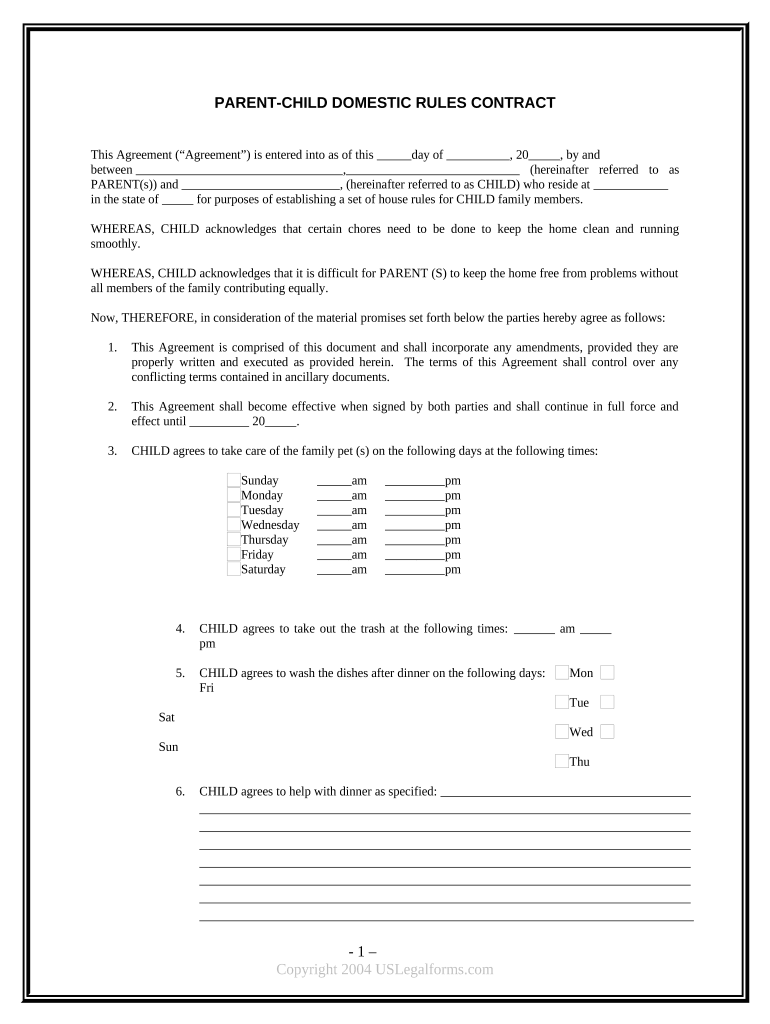
  1. Click ‘Get Form’ to open the parent-child domestic agreement in the editor.
  2. Begin by entering the date at the top of the form, followed by the names of both the PARENT(s) and CHILD. Ensure all parties are clearly identified.
  3. In Section 3, specify the days and times that CHILD agrees to take care of family pets. Use checkboxes or text fields for clarity.
  4. Fill in Section 4 with specific times for taking out the trash. This helps establish clear expectations.
  5. For Section 5, indicate which days CHILD will wash dishes after dinner. You can list these days directly in the provided space.
  6. Continue through each section, detailing responsibilities such as yard work, curfews, and communication protocols as outlined in Sections 7 to 12.
  7. Finally, review all entries for accuracy before signing. Both PARENT(s) and CHILD should sign and date at the end of the document to finalize the agreement.

Start using our platform today to easily fill out your parent-child domestic agreement for free!

be ready to get more

Complete this form in 5 minutes or less

Get form

Got questions?

We have answers to the most popular questions from our customers. If you can't find an answer to your question, please contact us.
Contact us
If you are experiencing violence or abuse at home, please tell a trustworthy adult (an adult who knows what to do to stay safe, like a school counsellor or a police officer) about whats going on. Tell more than one trustworthy adult and keep talking to them until well and truly after the abuse has stopped.
Domestic abuse is any incident of controlling, coercive or threatening behaviour, violence or abuse, between people in a domestic setting (such as marriages or cohabitation). Witnessing domestic abuse can seriously harm children and young people.
Domestic abuse is typically manifested as a pattern of abusive behavior toward an intimate partner in a dating or family relationship, where the abuser exerts power and control over the victim. Domestic abuse can be mental, physical, economic or sexual in nature.
Exposure of a child or adolescent to any incident of violent or threatening behaviour or abuse between adults who are, or have been, intimate partners or family members is defined as a form of child maltreatment (1), and is associated with increased risk of psychological, social, emotional and behavioural problems.
# Take the lead and talk to them ask them what they saw or heard or already know about what happened. Expect it to be more than you think, no matter how young they are. It can be difficult but it will help your child to understand rather than fill in the gaps with their imaginations.

Security and compliance

At DocHub, your data security is our priority. We follow HIPAA, SOC2, GDPR, and other standards, so you can work on your documents with confidence.

Learn more
ccpa2
pci-dss
gdpr-compliance
hipaa
soc-compliance

People also ask

Childhood abuse is commonly associated with becoming a perpetrator of domestic violence as an adult. Perpetrators of domestic violence commonly repeat acts of violence with new partners. Drug and alcohol abuse greatly increases the incidence of domestic violence.
Domestic abuse can include: coercive control such as being told where to go and what to wear or being isolated from friends and family. physical abuse such as being punched, kicked, cut, or being hit with an object.

Related links