Framing Contract for Contractor - Vermont 2026

Get Form
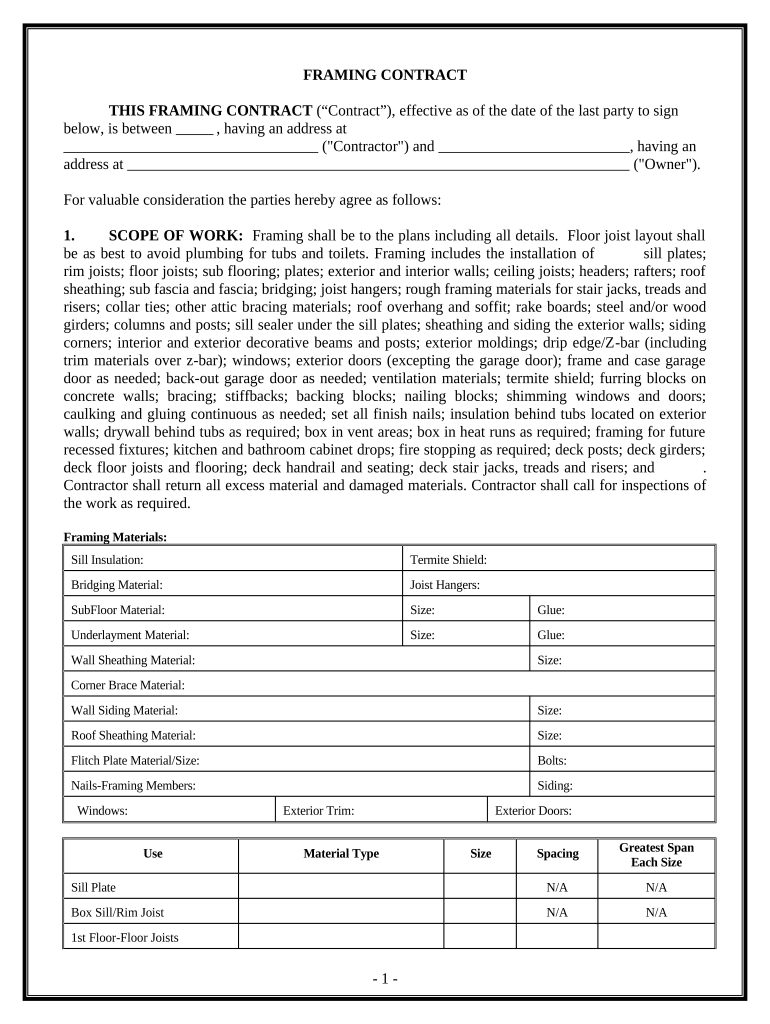
Framing Contract for Contractor - Vermont Preview on Page 1

Here's how it works

01. Edit your form online
Type text, add images, blackout confidential details, add comments, highlights and more.
02. Sign it in a few clicks
Draw your signature, type it, upload its image, or use your mobile device as a signature pad.
03. Share your form with others
Send it via email, link, or fax. You can also download it, export it or print it out.

How to use or fill out Framing Contract for Contractor - Vermont with our platform

Form edit decoration
9.5
Ease of Setup
DocHub User Ratings on G2
9.0
Ease of Use
DocHub User Ratings on G2
  1. Click ‘Get Form’ to open the Framing Contract for Contractor - Vermont in the editor.
  2. Begin by filling in the Contractor's name and address at the top of the form. This identifies who will be performing the work.
  3. Next, enter the Owner's name and address. This section specifies who is hiring the contractor.
  4. In the 'SCOPE OF WORK' section, detail all framing tasks as outlined in your project plans. Ensure you include specifics about materials and installation requirements.
  5. Fill out the 'WORK SITE' section with the property location where the project will take place.
  6. Specify start and completion dates in the 'TIME OF COMPLETION' section to set clear expectations.
  7. Complete sections on permits, insurance, and any changes to scope as necessary, ensuring compliance with local regulations.
  8. Finally, review all entries for accuracy before signing. Use our platform’s features to save or share your completed contract easily.

Start using our platform today to streamline your document editing and signing process for free!

be ready to get more

Complete this form in 5 minutes or less

Get form

Got questions?

We have answers to the most popular questions from our customers. If you can't find an answer to your question, please contact us.
Contact us
The contract should describe, in detail, the products to be used and how the work will be performed, i.e., size, color, who will be doing what work, amounts of materials provided, manufacturer model number, etc. There must be a detailed, written payment schedule in the contract.
Components often included in a design-build contract include insurance requirements, payment terms, expectations of the contractor, and project requirements. Each of these components is detailed further below.
In the construction industry, the average profit margin is approximately 6%. However, some businesses may have a much higher margin (upwards to 10%) or significantly less (2-3%) depending on many project factors from overhead to regional labor costs.
Design-build contracts are structured as a single agreement between the owner and the design-builder, encompassing both design and construction phases. This streamlined approach facilitates coordination, simplifies communication, and allows for integrated project delivery.
Is it worth it? That depends! If you would rather pay the contractor fee and not have to worry about the stress or responsibility that comes along with building, then self-contracting is probably not for you. And there is absolutely nothing wrong with that! A good general contractor is worth his weight in gold.

Security and compliance

At DocHub, your data security is our priority. We follow HIPAA, SOC2, GDPR, and other standards, so you can work on your documents with confidence.

Learn more
ccpa2
pci-dss
gdpr-compliance
hipaa
soc-compliance

People also ask

How To Write A Construction Contract With 7 Steps Step 1: Define the Parties Involved. Step 2: Outline the Scope of Work. Step 3: Establish the Timeline. Step 4: Determine the Payment Terms. Step 5: Include Necessary Legal Clauses. Step 6: Address Change Orders and Modifications. Step 7: Sign and Execute the Contract.

Related links