Warranty Deed for Parents to Child with Reservation of Life Estate - Utah 2026

Get Form
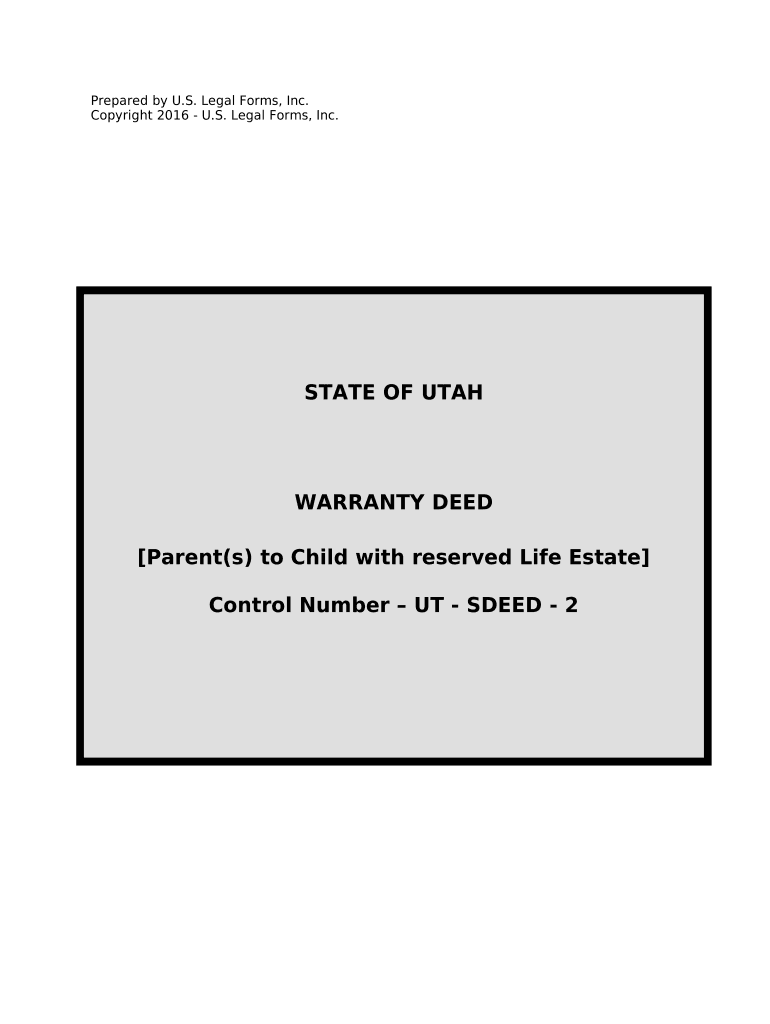
Warranty Deed for Parents to Child with Reservation of Life Estate - Utah Preview on Page 1

Here's how it works

01. Edit your form online
Type text, add images, blackout confidential details, add comments, highlights and more.
02. Sign it in a few clicks
Draw your signature, type it, upload its image, or use your mobile device as a signature pad.
03. Share your form with others
Send it via email, link, or fax. You can also download it, export it or print it out.

How to use or fill out Warranty Deed for Parents to Child with Reservation of Life Estate - Utah

Form edit decoration
9.5
Ease of Setup
DocHub User Ratings on G2
9.0
Ease of Use
DocHub User Ratings on G2
  1. Click ‘Get Form’ to open it in the editor.
  2. Begin by entering the names of the Grantors (parents) and the Grantee (child) in the designated fields. Ensure that all names are spelled correctly.
  3. Fill in the legal description of the property being transferred. This is crucial for identifying the exact location and boundaries of the property.
  4. Indicate any life estates retained by the Grantors. Specify who will hold these life estates, ensuring clarity on how they will operate consecutively.
  5. Complete any additional sections regarding easements or mineral rights as applicable, ensuring compliance with local regulations.
  6. Sign and date the document where indicated, making sure both Grantors provide their signatures.
  7. Finally, have a Notary Public witness your signatures and complete their section to finalize the deed.

Start using our platform today to easily fill out your Warranty Deed for free!

be ready to get more

Complete this form in 5 minutes or less

Get form

Got questions?

We have answers to the most popular questions from our customers. If you can't find an answer to your question, please contact us.
Contact us
A reserved life estate is when land is donated to a qualified land trust and the owners retain the right to live on the property until a trigger event (usually the owners death or moving away from the property). Also known as a remainder interest.
Most current deeds fall into one of four categories: 1) General Warranty, 2) Special Warranty, 3) Quit Claim deed, and 4) Bargain and Sale deed. General Warranty Deed The General Warranty deed is often referred to simply as a warranty deed.
A deed with a reserved life estate is used when you wish to both pass your real property to someone upon your death and also protect the property from nursing-home liens. This document may also make it possible for you to live in and maintain control of the property until your death.
The Warranty of Title clause ensures that the seller guarantees they have the legal right to transfer ownership of the goods being sold and that the title is free from any encumbrances, liens, or other claims. This clause protects the buyer from any third-party claims on the title that may arise after the purchase.
A deed is the written document that transfers title (or ownership) of a property from one person to another person. There are several ways to give others certain rights to your property, and the life estate deed is one of those options. A life estate deed is the legal document used to establish a life estate.

Security and compliance

At DocHub, your data security is our priority. We follow HIPAA, SOC2, GDPR, and other standards, so you can work on your documents with confidence.

Learn more
ccpa2
pci-dss
gdpr-compliance
hipaa
soc-compliance

People also ask

Disadvantages of Warranty Deeds Title companies will research the chain of deeds, past court judgments, and unpaid taxes before green-lighting the transfer. The grantor also remains on the hook long after the sale. If a forgotten lien surfaces, the buyer can pull the grantor into court for damages and legal fees.
A life estate deed allows you to transfer property while reserving an interest during your lifetime or during the lifetime of someone else. Once the person who holds the life estate passes away, the Grantee fully owns the property.

Related links