Right way agreement 2026

Get Form
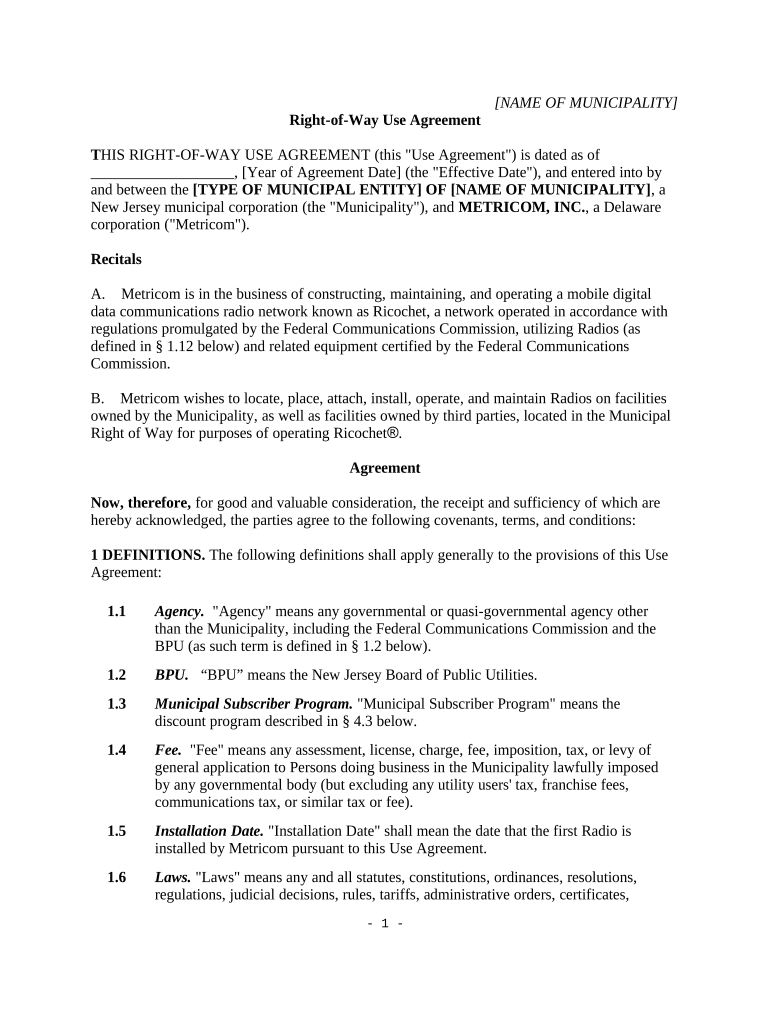
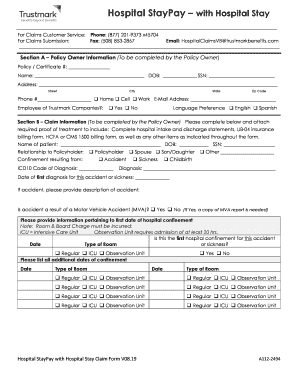
right way agreement Preview on Page 1

Here's how it works

01. Edit your form online
Type text, add images, blackout confidential details, add comments, highlights and more.
02. Sign it in a few clicks
Draw your signature, type it, upload its image, or use your mobile device as a signature pad.
03. Share your form with others
Send it via email, link, or fax. You can also download it, export it or print it out.

How to use or fill out right way agreement with our platform

Form edit decoration
9.5
Ease of Setup
DocHub User Ratings on G2
9.0
Ease of Use
DocHub User Ratings on G2
  1. Click ‘Get Form’ to open the right-of-way use agreement in the editor.
  2. Begin by entering the effective date of the agreement in the designated field. This is crucial as it marks the start of your contractual obligations.
  3. Fill in the names of both parties involved: the municipality and Metricom. Ensure that all details are accurate to avoid any legal complications.
  4. Proceed to complete the definitions section, which clarifies key terms used throughout the agreement. This will help ensure mutual understanding between both parties.
  5. In the scope section, outline how Metricom intends to utilize municipal facilities. Be specific about locations and types of equipment to be installed.
  6. Review and fill out compensation details, including annual fees and any applicable discounts or utility charges. Make sure these figures align with your financial agreements.
  7. Finally, ensure all signatures are collected from authorized representatives of both parties before submitting the completed form for processing.

Start using our platform today for free to streamline your document editing and signing process!

be ready to get more

Complete this form in 5 minutes or less

Get form

Got questions?

We have answers to the most popular questions from our customers. If you can't find an answer to your question, please contact us.
Contact us
A public right-of-way is broader than a typical easement because it allows anyone access to a defined portion of private property and doesnt tie to a specific person. Determining whether you need a right-of-way or a different type of easement will depend on what situation you find yourself in.
As a general rule, you should yield to cars that are already at the intersection. Whoever arrives at the intersection first gets to go first. And similar to stop sign etiquette, you should yield to the car on your right when in doubt.
Right of Way - A right of way is publicly owned area reserved for transportation purposes. Adjacent land from private owners may be required to construct, or reconstruct, highways or bridges within the right of way.
Right of way doesnt transfer ownership; it only grants the right to use a specific area. Easements also dont transfer ownership but provide rights to use the land for specific purposes.
A right-of-way represents a legal right to pass through or use another persons land for specific purposes. Unlike full property ownership, a right-of-way grants limited use rights while the underlying land ownership typically remains with the adjacent property owner.

Security and compliance

At DocHub, your data security is our priority. We follow HIPAA, SOC2, GDPR, and other standards, so you can work on your documents with confidence.

Learn more
ccpa2
pci-dss
gdpr-compliance
hipaa
soc-compliance

People also ask

In California, easements are subject to specific rules and regulations, and property owners generally cannot unilaterally block or obstruct established easements. Property owners should seek legal advice to navigate the complexities of easement disputes and to comply with California Law.
Whereas an easement is an agreed-upon use of land by someone other than the landowner, possibly for a utility, a right of way allows anyone to pass through a portion of property as though it was public land. Most rights of ways are acquired in fee for transportation infrastructure.
It will typically be whoever arrives first at the junction has right of way, as well as right-turning vehicles giving way to others. Drivers will often let larger vehicles go first, like lorries and buses.

Related links