Type text, add images, blackout confidential details, add comments, highlights and more.
02. Sign it in a few clicks
Draw your signature, type it, upload its image, or use your mobile device as a signature pad.
03. Share your form with others
Send excavation contract via email, link, or fax. You can also download it, export it or print it out.
How to use or fill out excavation contract with our platform
Ease of Setup
DocHub User Ratings on G2
Ease of Use
DocHub User Ratings on G2
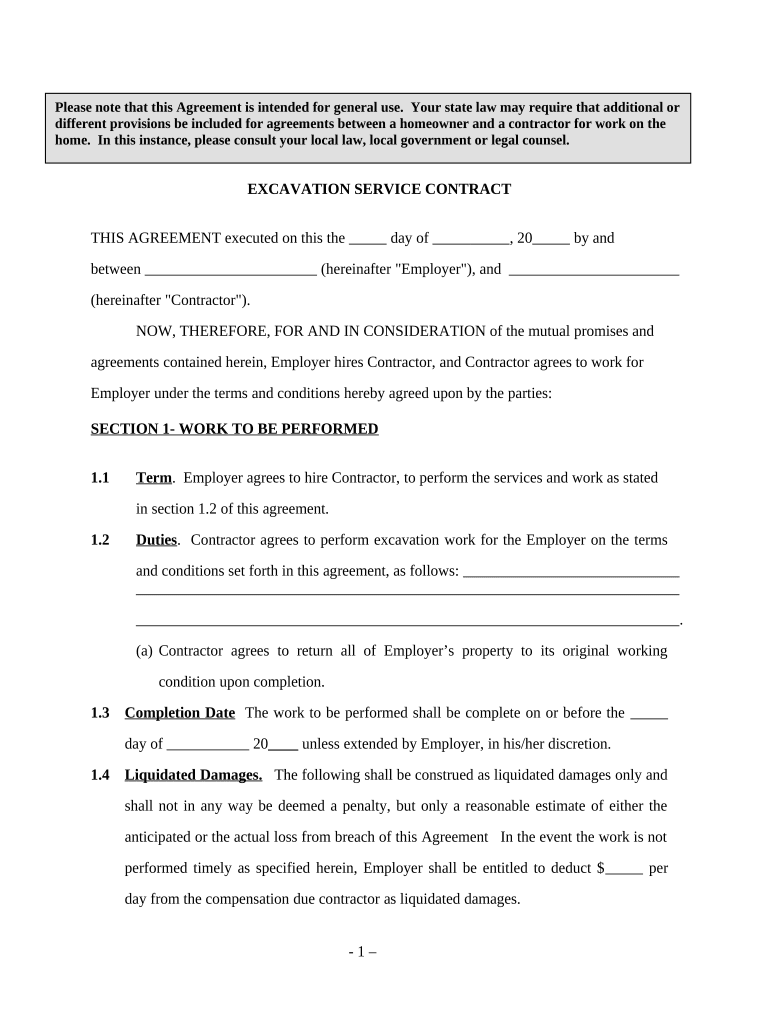
Click ‘Get Form’ to open the excavation contract in the editor.
Begin by filling in the date and names of both the Employer and Contractor at the top of the form. This establishes who is entering into the agreement.
In Section 1, outline the specific work to be performed. Clearly define duties and ensure you include a completion date to set expectations.
Move to Section 2 to specify compensation details. Indicate how much will be paid and the payment schedule (daily, weekly, monthly).
In Section 3, confirm that the Contractor understands their independent status. This clarifies their role and responsibilities.
Complete Sections 4 through 6 by providing necessary representations, insurance requirements, and any miscellaneous provisions relevant to your agreement.
Finally, ensure both parties sign at the bottom of the document to finalize the contract.
Start using our platform today for free to streamline your excavation contract process!
Cave-ins, however, pose the greatest risk and are much more likely to result in fatalities. To raise awareness of the hazards, OSHA encourages all employees exposed to excavations deeper than 5 feet (not in rock) to follow the three Ss of trenching safety: Slope It, Shore It, and Shield It!
What are the three types of excavation protection?
There are four types of protective systems used for trench safety: sloping, shoring, shielding, and benching. Sloping for Trench Safety. Shoring for Trench Safety. Shielding for Trench Safety. Benching for Trench Safety.
What are the different types of excavation?
11 Types Of Excavation Used In Construction Trench Excavation. Basement Excavation. Cut and Fill Excavation. Slope Excavation. Dredging. Footing Excavation. Pit Excavation. Rock Excavation.
What are the three phases of excavation?
There are three phases of excavation for archaeology investigations: Phase I Shovel Test Survey, Phase II Test Units and Phase III Block Excavation. Each of these phases can uncover different information for an archaeology investigation.
How do you bid excavation work?
Gather cost estimates: Determine the cost of labor, equipment, and materials that will be required to complete the job. This will include things like excavation equipment rental, fuel, and labor costs. Make sure your rates are up to date. If you are bidding with old prices, you could get burned.
The primary purpose of an excavation contract is to define the projects scope and terms, ensuring that all parties have a clear understanding of their obligations.
What are the three types of excavation?
The Top 3 Types of Excavation Topsoil Excavation Prior to most construction projects, the upper layer of soil is removed. Earth Excavation This is the removal of soil beneath the topsoil and on top of rock. Rock Excavation When it comes to removing rock beneath soil, using earthmoving equipment wont cut it.
How much money can you make an excavation?
Excavating Salary Annual SalaryHourly Wage Top Earners $63,000 $30 75th Percentile $56,000 $27 Average $49,330 $24 25th Percentile $40,500 $19
excavation contract template
Marble tablet with rental agreement found in Turkey
Oct 6, 2016 Excavations at the ancient Greek city of Teos on the west coast of Turkey, have yielded an inscribed marble tablet with a rental agreement.
This comment deals with some of the legal problems facing contractors and governmental agencies in such excavation, and suggests possible solutions to theseRead more
Cookie consent notice
This site uses cookies to enhance site navigation and personalize your experience.
By using this site you agree to our use of cookies as described in our Privacy Notice.
You can modify your selections by visiting our Cookie and Advertising Notice.