

Registration rights agreement 2026

Get Form
registration rights agreement Preview on Page 1

Here's how it works

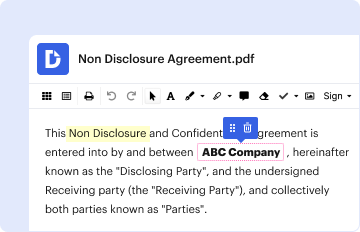
01. Edit your form online
Type text, add images, blackout confidential details, add comments, highlights and more.
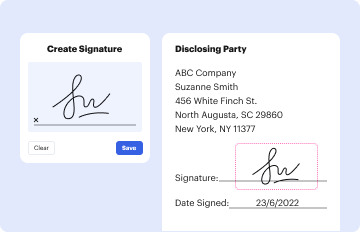
02. Sign it in a few clicks
Draw your signature, type it, upload its image, or use your mobile device as a signature pad.
03. Share your form with others
Send it via email, link, or fax. You can also download it, export it or print it out.

How to use or fill out registration rights agreement with our platform

Form edit decoration
9.5
Ease of Setup
DocHub User Ratings on G2
9.0
Ease of Use
DocHub User Ratings on G2
  1. Click ‘Get Form’ to open the registration rights agreement in the editor.
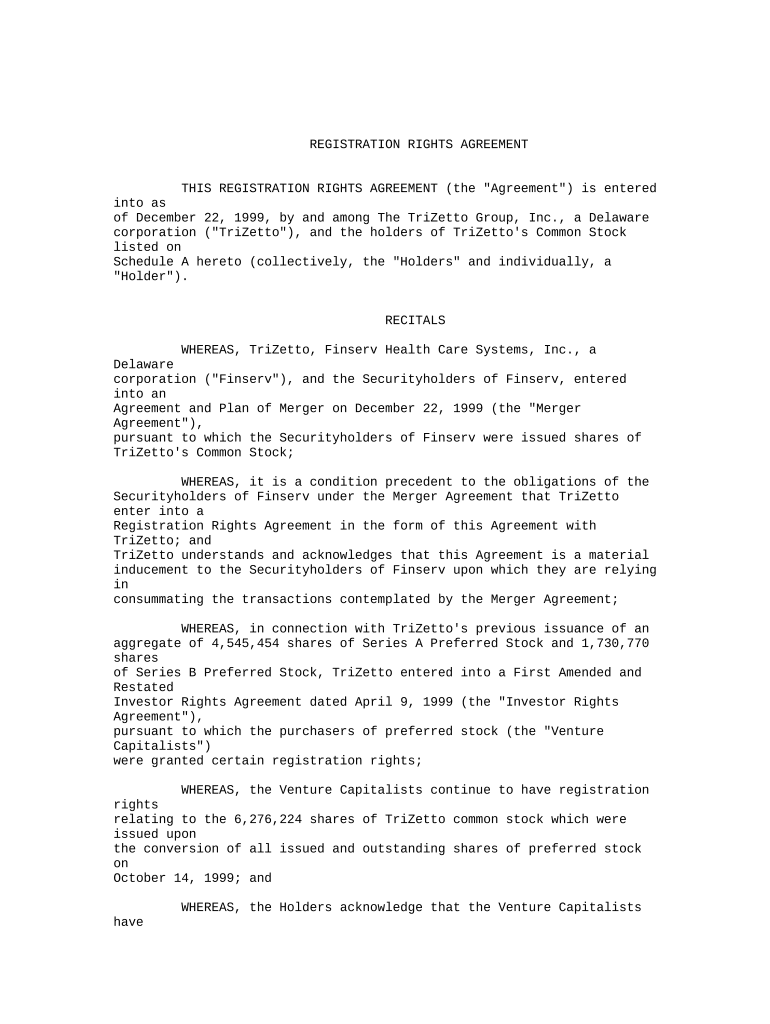
  2. Begin by reviewing the introductory section, which outlines the parties involved and the purpose of the agreement. Ensure that all names and dates are accurate.
  3. Move to Section 1, where you will find details about registration rights. Fill in any required fields regarding 'Registrable Securities' as defined in this section.
  4. In Section 1.2, provide any necessary information related to TriZetto's registration process. This may include specific requests for inclusion of securities.
  5. Complete Section 1.4 regarding expenses associated with registration. Make sure to clarify who bears these costs.
  6. Review Sections 1.6 and 1.7 for indemnification clauses and information requirements from Holders, ensuring compliance with all stipulations.
  7. Finally, navigate to the signature section at the end of the document. Ensure all parties sign and date appropriately before finalizing.

Start using our platform today for free to streamline your document editing and signing process!

be ready to get more

Complete this form in 5 minutes or less

Get form

Got questions?

We have answers to the most popular questions from our customers. If you can't find an answer to your question, please contact us.
Contact us
Common types of restricted securities include those acquired prior to an initial public offering (IPO) or issued in private placements. A Registration Rights Agreement makes restricted securities more attractive by assuring the holder that the securities will be freely tradable on the open market in the future.
Limitation on subsequent registration rights refers to restrictions placed on the ability to register securities (such as stocks or bonds) for resale in the future, usually in connection with an initial public offering (IPO) or other securities offering.
Registration rights can help investors holding private shares gain access to the broader market to sell their shares. Early investors may have shorter time horizons than company founders for a liquidity event and thus may wish to exercise these registration rights.
Rights issue can lower a stocks value and decrease trading volume, both of which have an impact on the share price. By adding more shares, stock prices become diluted and there may be a downward trend in share valuation.
There are two primary categories of registration rights: demand and piggyback rights. With demand registration rights, investors have a right to force a company to register shares with the SEC. Once registered, the shareholders can then sell their shares to outside investors and exit the company.

Security and compliance

At DocHub, your data security is our priority. We follow HIPAA, SOC2, GDPR, and other standards, so you can work on your documents with confidence.

Learn more
ccpa2
pci-dss
gdpr-compliance
hipaa
soc-compliance

People also ask

A Registration Rights Agreement is a contract between an issuer and a holder of the issuers restricted securities that grants the holder the right to have those securities registered, or to participate in a registration initiated by others, under the Securities Act of 1933 (Securities Act), 15 U.S.C.

Related links