Consent Order in Family Matter - New Jersey 2026

Get Form
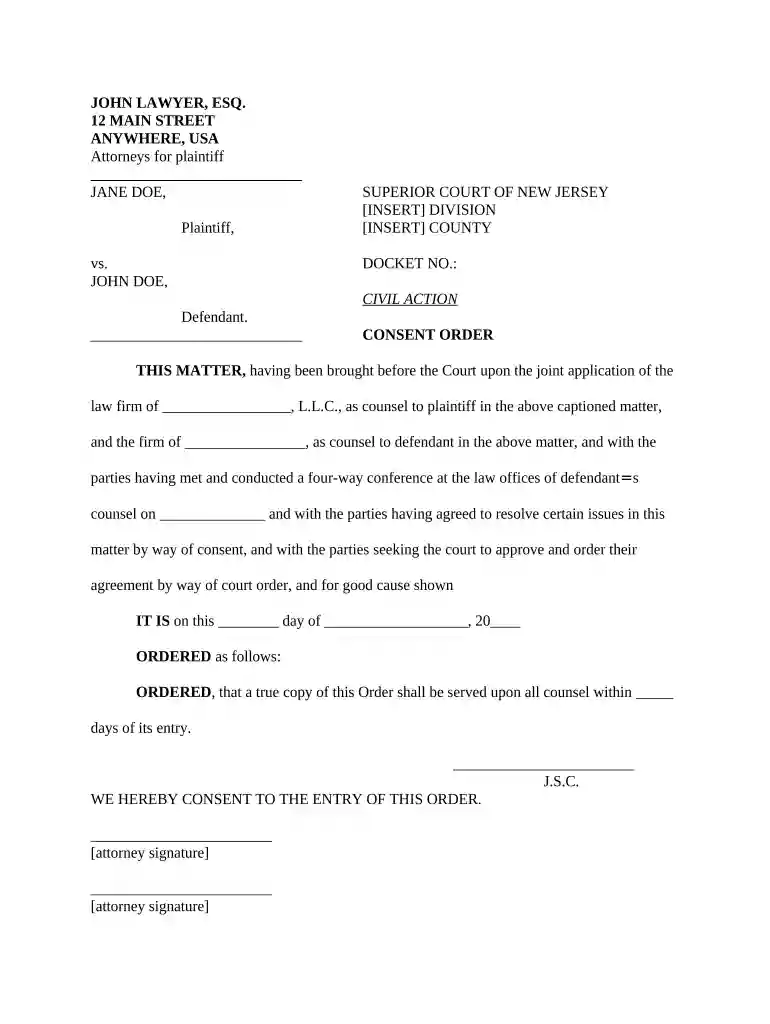
consent order nj template Preview on Page 1

Here's how it works

01. Edit your consent order nj template online
Type text, add images, blackout confidential details, add comments, highlights and more.

02. Sign it in a few clicks
Draw your signature, type it, upload its image, or use your mobile device as a signature pad.

03. Share your form with others
Send what is a consent order via email, link, or fax. You can also download it, export it or print it out.

Definition & Meaning of Consent Order in Family Matter - New Jersey

A consent order in a family matter is a legally binding agreement between parties, typically regarding child custody, child support, alimony, and property division in the context of divorce or separation. This document is created collaboratively by the involved parties, often with legal representation, to outline the terms that both parties have agreed upon. Once signed by both parties and entered by the court, it has the same enforceability as a court judgment.

Essential Components of a Consent Order

  • Parties Involved: Clearly states the names of the individuals participating in the agreement.
  • Terms of Agreement: Detailed provisions regarding the specific issues at hand, such as:
    • Child custody arrangements
    • Financial responsibilities and obligations
    • Visitation schedules
  • Court Approval: It is crucial for a consent order to be approved by a judge, which solidifies its legal standing.

Understanding these components ensures that parties can craft a comprehensive and enforceable consent order suited to their specific family circumstances.

How to Use the Consent Order in Family Matter - New Jersey

Using a consent order in family matters involves several steps that ensure the agreement is effective and meets legal standards. The parties must first identify the critical issues to be addressed and draft the terms of their agreement accordingly.

Steps to Effectively Use a Consent Order

  1. Draft the Agreement: Parties should work together, possibly with legal assistance, to outline all necessary terms and conditions relating to their family matter.
  2. Consult Legal Counsel: It is advisable to have an attorney review the proposed order to ensure that all legal obligations are met and that the document aligns with New Jersey family law.
  3. File with the Court: Submit the consent order to the appropriate family court for approval. This includes providing any necessary accompanying documents.
  4. Attend the Court Hearing: If required, appear in court for a judge to review and finalize the consent order.
  5. Implementation: Once approved, both parties must abide by the terms outlined in the order.

Understanding the proper use of a consent order aids in ensuring mutual compliance and can significantly ease the process of family law disputes.

Key Elements of the Consent Order in Family Matter - New Jersey

The effectiveness of a consent order relies on its comprehensive nature and clarity in terms. Specific elements must be addressed to create a robust legal agreement.

Important Elements to Include

  • Identification of Children: If minors are involved, the order should detail relevant information about them, including names and birth dates.
  • Custody Arrangements: Clear statements defining physical and legal custody, including decision-making authority between parents.
  • Support Financials: Terms regarding child support payments, including amounts, payment schedules, and any circumstances for adjustments.
  • Visitation Rights: Specific guidelines about visitation, including schedules, holidays, and any restrictions.
  • Dispute Resolution Methods: Provisions for resolving conflicts that may arise regarding the consent order’s terms.

Inclusion of these elements minimizes future disputes and fosters clearer expectations for both parties involved.

Important Terms Related to Consent Order in Family Matter - New Jersey

The terminology associated with consent orders can significantly impact their interpretation and enforcement. It's crucial to understand specific terms that frequently appear in such documents.

Common Terms Defined

  • Child Custody: Refers to the legal authority a parent has concerning their child’s care and welfare.
  • Visitation: Defines the non-custodial parent’s right to spend time with their child.
  • Child Support: Financial payments made by the non-custodial parent to support the child’s living expenses.
  • Legal Guardianship: A designation that may be relevant if the biological parents are unable to fulfill their roles.
  • Modification: The legal process to alter the terms of the consent order, typically requiring proof of changed circumstances.

Grasping these terms aids in better comprehension of the order’s provisions and ensures adherence to its stipulations.

Examples of Using the Consent Order in Family Matter - New Jersey

Real-life scenarios can illustrate how consent orders function within the family court system to address various circumstances.

Scenarios of Consent Orders

  • Divorce with Minor Children: A couple undergoing divorce may use a consent order to establish custody and visitation plans, ensuring both parents remain involved in their child’s life.
  • Child Support Adjustments: If a parent’s financial situation changes, a consent order can be modified to reflect new support obligations or changes in custody arrangements.
  • Dispute Over Visitation: When disagreements arise regarding visitation schedules, a court-approved consent order provides a clear roadmap that both parties must follow, reducing conflict.
  • End-of-Life Planning: In situations involving extended family and guardianship for minors, a consent order may define future caregivers should unforeseen circumstances arise.

These examples highlight the utility of consent orders in providing structured, agreeable resolutions for varied family issues, ensuring all parties have a clear understanding of rights and responsibilities.

be ready to get more

Complete this form in 5 minutes or less

Get form

Got questions?

We have answers to the most popular questions from our customers. If you can't find an answer to your question, please contact us.
Contact us
Consent orders are court orders that both parties agree upon and are often the result of collaborative divorce and successful mediation(s). They are all tools intended to resolve any issues in a divorce, including child custody, division of assets and property, and alimony or spousal support.
In essence, a court order is one that is made by a judge and not usually negotiated between parties. A Consent Order is a court Order that contains terms that the parties have agreed to or consented to themselves.
Common Mistakes to Avoid in a New Jersey Child Custody Case Failing to Keep Accurate Records of Your Communication With the Other Parent. Not Cooperating With the Other Parent During the Custody Evaluation Process. Ignoring the Advice of Your Attorney. Failing to Show Up to Scheduled Court Appearances.
A Consent Decree is the final order signed by the Judge when parties have agreed on everything required for a divorce, legal separation, or annulment.

Security and compliance

At DocHub, your data security is our priority. We follow HIPAA, SOC2, GDPR, and other standards, so you can work on your documents with confidence.

Learn more
ccpa2
pci-dss
gdpr-compliance
hipaa
soc-compliance