Legal Last Will and Testament Form for Divorced Person Not Remarried with Adult and Minor Children - Texas 2026

Get Form
Legal Last Will and Testament Form for Divorced Person Not Remarried with Adult and Minor Children - Texas Preview on Page 1

Here's how it works

01. Edit your form online
Type text, add images, blackout confidential details, add comments, highlights and more.
02. Sign it in a few clicks
Draw your signature, type it, upload its image, or use your mobile device as a signature pad.
03. Share your form with others
Send it via email, link, or fax. You can also download it, export it or print it out.

How to use or fill out Legal Last Will and Testament Form for Divorced Person Not Remarried with Adult and Minor Children - Texas

Form edit decoration
9.5
Ease of Setup
DocHub User Ratings on G2
9.0
Ease of Use
DocHub User Ratings on G2
  1. Click ‘Get Form’ to open it in the editor.
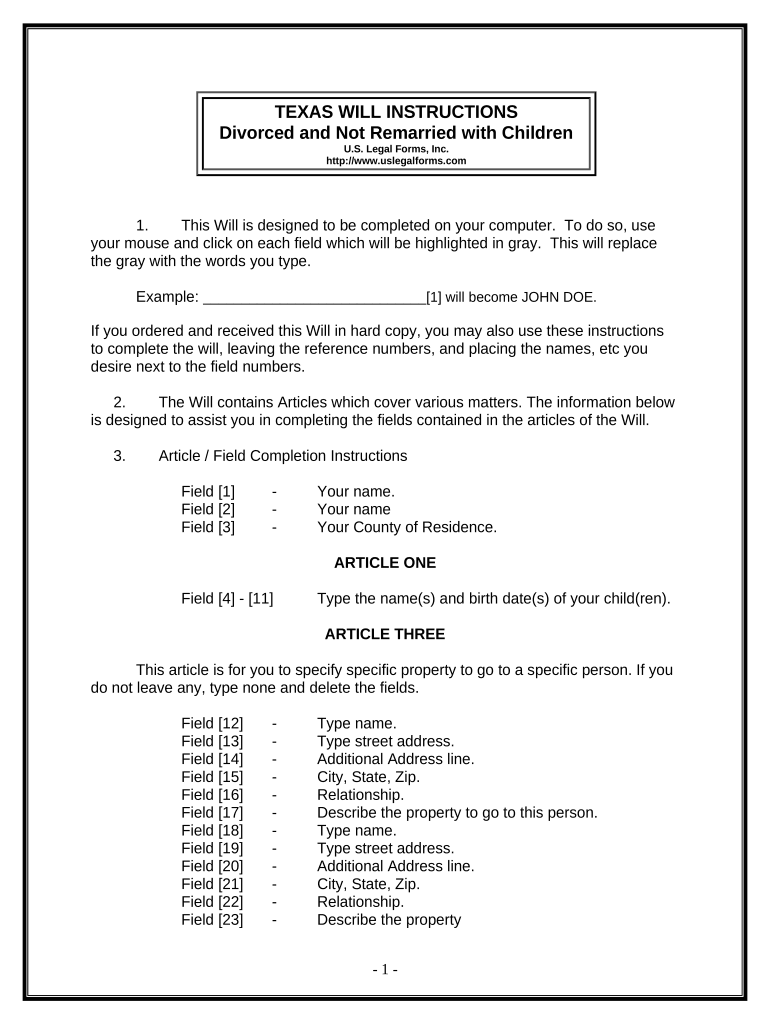
  2. Begin by entering your name in Field [1] and your county of residence in Field [3]. This establishes your identity and jurisdiction.
  3. In Article One, list the names and birth dates of your children in Fields [4] to [11]. This is crucial for ensuring they are recognized as beneficiaries.
  4. Proceed to Article Three to specify any particular property you wish to bequeath. Fill out Fields [12] to [29] with the recipient's details and a description of the property.
  5. In Article Four, designate your children as recipients of all remaining property by filling out Field [30].
  6. For minor beneficiaries, complete Article Five by entering the age at which their share will be distributed in Fields [34] to [38].
  7. Continue through Articles Six to Twelve, filling in necessary details such as appointing a trustee, guardian, and personal representative.
  8. Once completed, review all entries for accuracy before printing. Ensure you sign the document in front of two witnesses and a notary.

Start using our platform today to effortlessly complete your Legal Last Will and Testament form online for free!

be ready to get more

Complete this form in 5 minutes or less

Get form

Got questions?

We have answers to the most popular questions from our customers. If you can't find an answer to your question, please contact us.
Contact us
The divorce decree should over-ride the will, but the actual answer may depend on the language in the divorce agreement, the will and state law. Youre best off having the matter double checked by your matrimonial attorney.
Understanding the Law Information on how divorce can affect key components of your estate plan. A divorce in Texas does NOT invalidate a will executed prior to the divorce but does invalidate bequests to the former spouse thereby changing the estate plan.
In Texas yes a person can draft and execute their own will, but there are several pitfalls non-lawyers make that can severly frustrate their estate plans if the non-lawyer drafts a document that doesnt meet the strict requirements of the Texas Estates Code.
The person creating the will is referred to as the testator. A valid will in Texas requires the document to be signed by two witnesses at least 14 years old. Although notarization is not mandatory, its highly advisable. Once the will has been executed, it is prudent to: Keep the signed original in a safe location.
14 common mistakes to avoid when writing a will The will was incorrectly witnessed. Asking a child or partner to be a witness. Having an out of date will. Making changes to your will after it has been signed. Forgetting Assets. Failing to appoint guardians. Excluding any step-children. Being too specific.

People also ask

Key takeaways for a Texas last will and testament Texas recognizes holographic wills, which are entirely handwritten by the testator and do not require witness signatures, and for a will to be valid, the testator must be at least 18 years old and of sound mind. Texas does not impose estate or inheritance taxes.
These spousal rights established by intestate succession can supersede any contradictory instructions laid out in a will. Furthermore, Texas law provides a surviving spouse the option to claim an elective share of the deceased spouses estate, even if the will disinherits the surviving spouse.

Related links