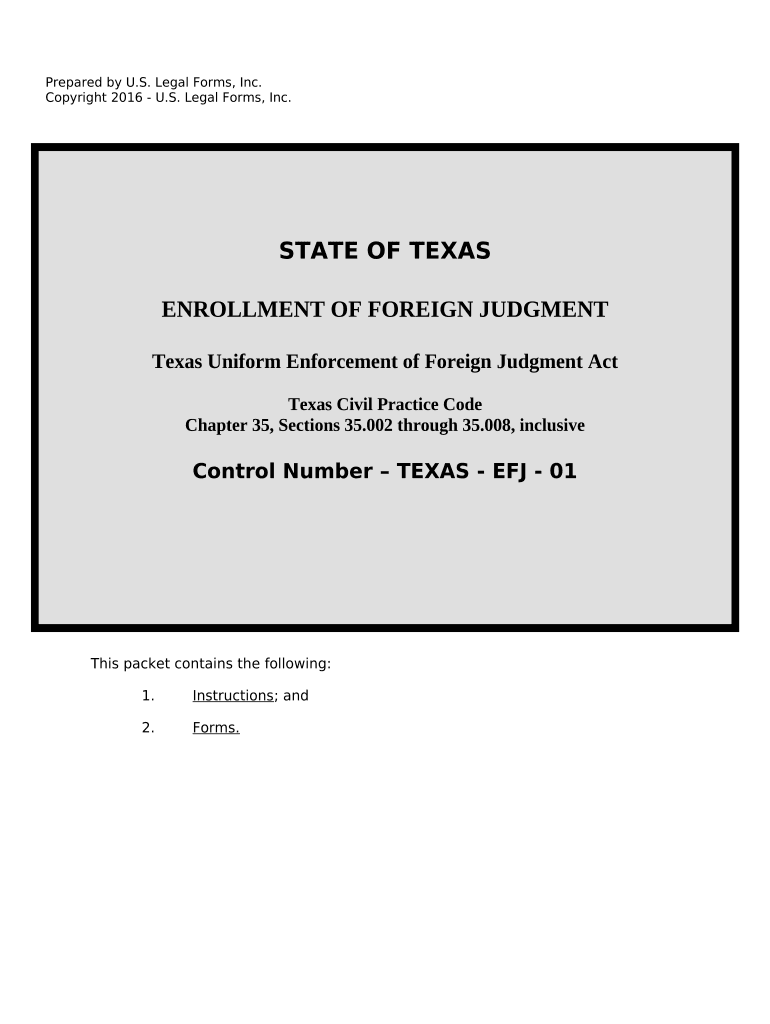
Texas Foreign Judgment Enrollment - Texas 2026

Get Form
texas foreign judgment forms Preview on Page 1

Here's how it works

01. Edit your texas foreign judgment forms online
Type text, add images, blackout confidential details, add comments, highlights and more.
02. Sign it in a few clicks
Draw your signature, type it, upload its image, or use your mobile device as a signature pad.
03. Share your form with others
Send it via email, link, or fax. You can also download it, export it or print it out.

How to use or fill out Texas Foreign Judgment Enrollment - Texas with DocHub

Form edit decoration
9.5
Ease of Setup
DocHub User Ratings on G2
9.0
Ease of Use
DocHub User Ratings on G2
  1. Click ‘Get Form’ to open the Texas Foreign Judgment Enrollment form in our editor.
  2. Begin by filling in the 'Return Name and Address' section with the Clerk of Court's details. Ensure accuracy for proper processing.
  3. In the 'Affidavit in Support of Request for Enrollment' section, provide your name, role (Plaintiff or Attorney), and the Judgment Debtor's Social Security Number if known.
  4. Complete the 'Request for Enrollment of Foreign Judgment' by entering details about the judgment, including dates, court information, and amounts owed.
  5. After filling out all necessary fields, review your entries for accuracy. Use our platform’s features to navigate easily between fields.
  6. Once satisfied, save your document and follow any additional instructions provided for submission to the court.

Start using our platform today to streamline your Texas Foreign Judgment Enrollment process for free!

be ready to get more

Complete this form in 5 minutes or less

Get form

Got questions?

We have answers to the most popular questions from our customers. If you can't find an answer to your question, please contact us.
Contact us
Checklist Steps Step 1: Get two copies of your court orders. Step 2: Determine where in Texas to register the orders. Step 3: Prepare the registration letter, orders, and affidavit. Step 4: File (turn in) the documents with the court. Step 5: Notify the other parties. Step 6: The order is confirmed.
The Foreign Judgments (Reciprocal Enforcement) Act 1933 (FJA 1933) applies to judgments from courts in Australia, Canada (except Nunavut and Quebec), Guernsey, India, the Isle of Man, Israel, Jersey and Pakistan.
The only U.S. states which have not adopted the Uniform Enforcement of Foreign Judgments Act are California and Vermont.
When a foreign nation presents an international child custody case to California, the state will first confirm if the said nation has signed The Hague Convention treaty. If the foreign country has not signed The Hague Convention treaty, the court will decide who has jurisdiction over the case.
Under U.S. law, an individual seeking to enforce a foreign judgment, decree or order in this country must file suit before a competent court. The court will determine whether to recognize and enforce the foreign judgment.

Security and compliance

At DocHub, your data security is our priority. We follow HIPAA, SOC2, GDPR, and other standards, so you can work on your documents with confidence.

Learn more
ccpa2
pci-dss
gdpr-compliance
hipaa
soc-compliance