






Understanding the Driveway Agreement
A driveway agreement is a legal contract between property owners, typically outlining the rights and responsibilities concerning the use of a driveway shared between two or more parties. This agreement serves to clarify how the driveway is to be used, maintain its condition, and protect the legal rights of all involved.
Key Components of a Driveway Agreement
The primary components outlined in a driveway agreement include:
- License Grant: Specific permissions granted to the licensee to use the driveway.
- Usage Restrictions: Guidelines on how the driveway can be used, limiting activities such as parking or loitering.
- Maintenance Responsibilities: Clear responsibilities for maintaining the driveway, including who is responsible for repairs and upkeep.
- Duration of Agreement: The time frame for which the agreement remains valid, including renewal terms.
- Indemnification Clause: Protection for parties against liabilities arising from use of the driveway.
- Termination Rights: Conditions under which the agreement can be terminated by either party.
Importance of a Driveway Agreement
Having a driveway agreement in place is crucial for several reasons:
- Legal Protection: It minimizes potential disputes between property owners by providing a clear legal framework.
- Clarity of Rights: The agreement delineates specific rights of each party, reducing misunderstandings and conflicts over driveway usage.
- Maintenance Assurance: It ensures that there are defined responsibilities for maintenance, preventing one party from neglecting the agreed-upon upkeep.
Steps to Draft a Driveway Agreement
To create an effective driveway agreement, follow these steps:
- Identify the Parties Involved: Clearly state the names and addresses of the property owners involved in the agreement.
- Specify the Driveway: Describe the location and boundaries of the shared driveway to avoid any confusion.
- Outline Usage Terms: Detail the permitted uses of the driveway, including any restrictions.
- Define Maintenance Duties: Clarify who will be responsible for maintenance, repairs, and associated costs.
- Include Legal Provisions: Incorporate clauses regarding indemnification, termination rights, and dispute resolution.
Common Scenarios Involving Driveway Agreements
Driveway agreements typically arise in various situations, including:
- Residential Properties: Neighbors sharing a common driveway often require a formal agreement to prevent disputes.
- Commercial Spaces: Businesses that share parking areas may need to outline terms for the use of a driveway for delivery vehicles or customer access.
- Easements: In cases where one party has an easement over another’s property, a driveway agreement can formalize the terms of use.
Legal Considerations for Driveway Agreements
Understanding the legal context surrounding driveway agreements is essential. Typically, these agreements:
- Must be in written form to be enforceable.
- Should comply with local zoning laws and regulations.
- May require notarization to add an extra layer of authenticity and legality.
Drafting Templates and Resources
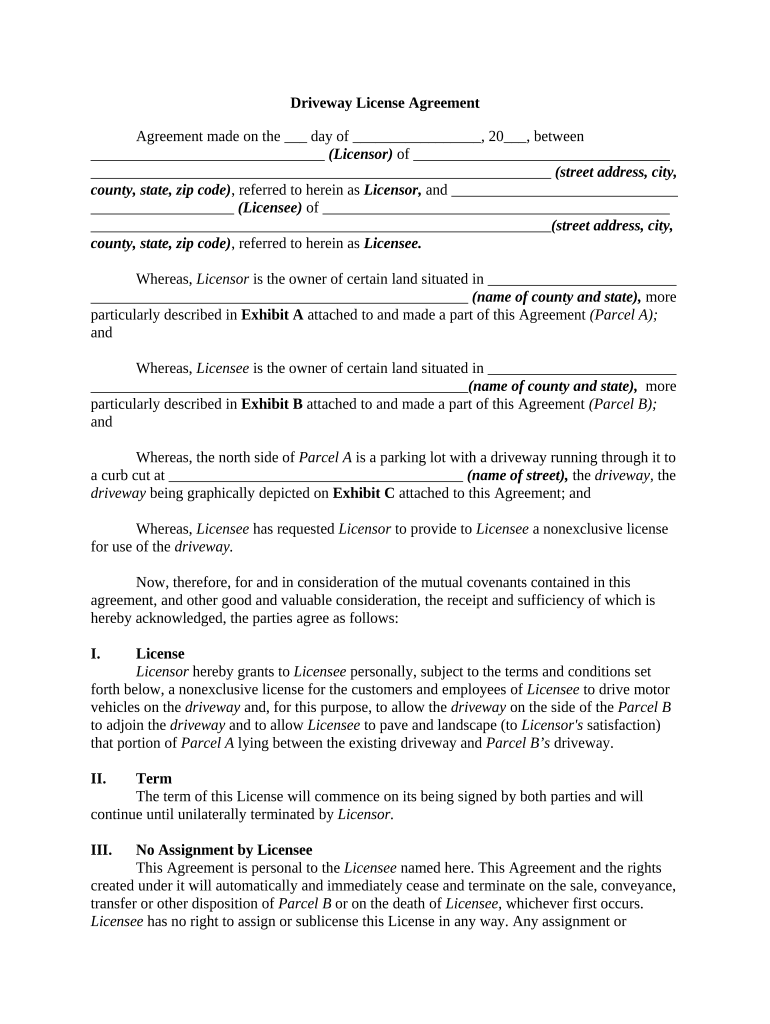
For those interested in drafting a driveway agreement, templates are available online. A shared driveway agreement template can aid in the proper formatting and inclusion of necessary clauses. When using templates, ensure they are adapted to your specific circumstances and local laws.
Potential Disputes Related to Driveway Agreements
Disputes may arise from:
- Misinterpretation of agreement terms.
- Failure to maintain the driveway properly.
- Unauthorized use of driveway space.
To mitigate disputes, it is advisable to include a clause specifying the process for addressing conflicts, such as mediation or arbitration.
Conclusion on Driveway Agreement Significance
The driveway agreement is an essential legal tool for property owners sharing a driveway. By formalizing terms of use and maintenance, it can help prevent misunderstandings and conflicts, ensuring a harmonious relationship between neighboring property owners.