Standard Terms and Conditions for Merchandise Warehouses 2026

Get Form
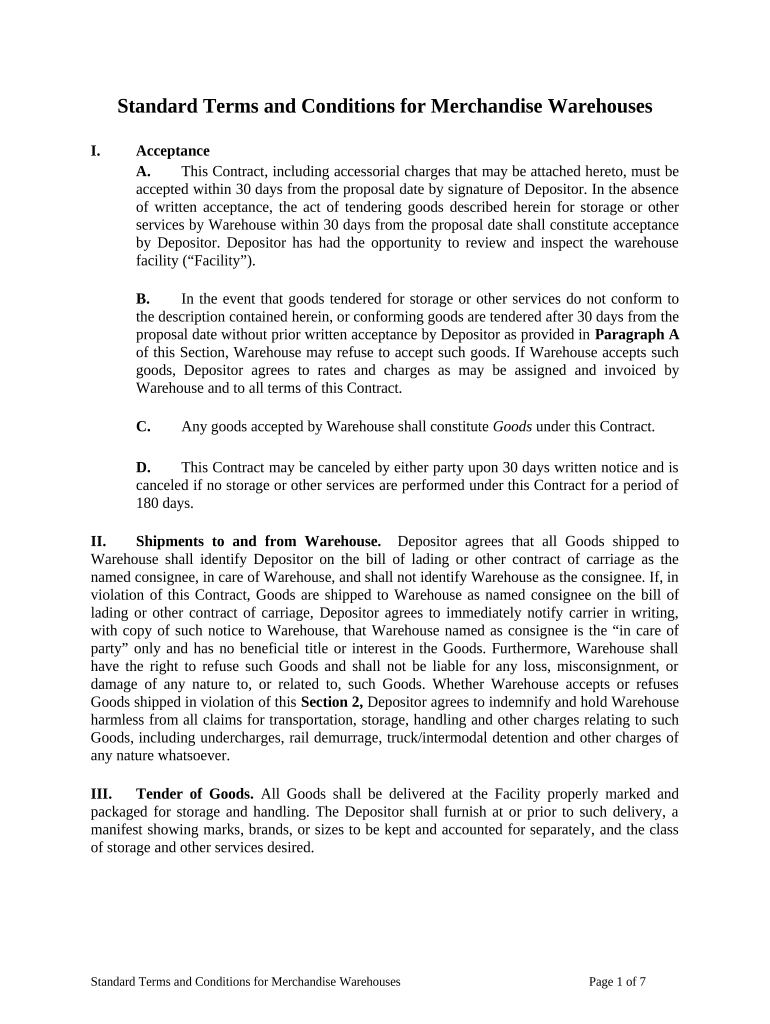
Standard Terms and Conditions for Merchandise Warehouses Preview on Page 1

Here's how it works

01. Edit your form online
Type text, add images, blackout confidential details, add comments, highlights and more.
02. Sign it in a few clicks
Draw your signature, type it, upload its image, or use your mobile device as a signature pad.
03. Share your form with others
Send it via email, link, or fax. You can also download it, export it or print it out.

How to use or fill out Standard Terms and Conditions for Merchandise Warehouses

Form edit decoration
9.5
Ease of Setup
DocHub User Ratings on G2
9.0
Ease of Use
DocHub User Ratings on G2
  1. Click ‘Get Form’ to open it in the editor.
  2. Begin with the 'Acceptance' section. Ensure you understand the acceptance terms, including the 30-day window for signing. Fill in your name as the Depositor and provide a signature if accepting within this timeframe.
  3. Move to 'Shipments to and from Warehouse.' Clearly indicate your name on all shipping documents as required, ensuring compliance with the contract terms.
  4. In 'Storage Period and Charges,' input details regarding your goods, including expected storage duration. Familiarize yourself with the charge structure based on your delivery dates.
  5. Complete the 'Handling' section by specifying any additional services needed beyond ordinary handling, noting that these may incur extra charges.
  6. Finally, review all sections for accuracy before submitting. Ensure that all necessary signatures are included at the end of the document.

Start using our platform today to easily fill out your Standard Terms and Conditions for Merchandise Warehouses for free!

be ready to get more

Complete this form in 5 minutes or less

Get form

Got questions?

We have answers to the most popular questions from our customers. If you can't find an answer to your question, please contact us.
Contact us

Yes, a typed name is accepted as a legitimate electronic signature when you create it on your form using a compliant solution like DocHub. Simply upload your Standard Terms and Conditions for Merchandise Warehouses to our editor, click Sign in the top tool pane → Create your signature → Type your name in the appropriate tab, and decide how it will look on your document.

If you are searching for a state-specific Standard Terms and Conditions for Merchandise Warehouses sample, you will find it in our DocHub Forms & Templates catalog. Use the search field, enter your form’s name, and search through the results for your state. You may also filter out irrelevant results while searching our catalog by categories.

A warehousing agreement for the storage of goods for a business customer. A professional warehousing provider agrees to store the customers goods on a long-term or regular basis. The agreement is drafted to be broadly neutral between the parties.
Important tips for Warehouse Construction: Should have a plinth height of 2.5 feet to 3 feet. RCC floor should be of minimum 5 tons / Sq. It should have a clear height of minimum 22 Feet. It should have ample docking bays so that material can be easily moved and total area of warehouse is utilized.
With the four pillars of Labor Planning, Inventory Flow Management, Human/Robotic Task Handoffs, and Space and Constraint Optimization, you can ensure your warehouse doesnt just survive the demands of todays environmentit thrives.

Security and compliance

At DocHub, your data security is our priority. We follow HIPAA, SOC2, GDPR, and other standards, so you can work on your documents with confidence.

Learn more
ccpa2
pci-dss
gdpr-compliance
hipaa
soc-compliance

People also ask

Warehousing is the process of storing goods until theyre ready for transport to retailers, distributors or customers. Businesses can benefit from warehousing in several ways, including more efficiently managing inventory and optimizing the shipment process.
General OSHA Safety Guidelines for Warehouses Ensure your warehouse is well ventilated. Implement proper lockout/tag-out procedures. Block off exposed or open loading dock doors and any area where an employee could fall more than four feet.
The ISO 9001 standard enhances operational performance and quality management in a warehouse. Key requirements include setting up an effective QMS; managing resources; ensuring proper storage and preservation; controlling processes like receiving, inspecting, and dispatching goods; and maintaining accurate records.
5S is a Japanese lean concept of warehouse organization and improvement based on 5 principles sort, set, shine, standardize, and sustain to create a clean and organized workplace/warehouse. The concepts help create a more organized and clean workspace for efficiency.

Related links