Financial services agreement 2026

Get Form
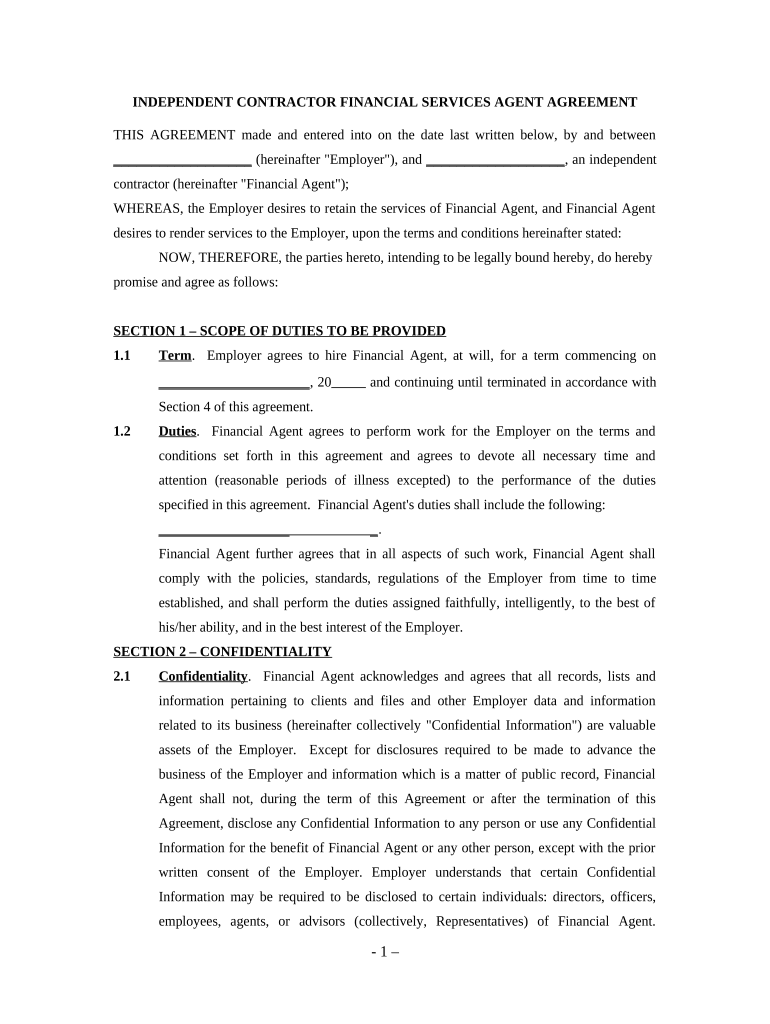
financial services agreement Preview on Page 1

Here's how it works

01. Edit your financial services agreement online
Type text, add images, blackout confidential details, add comments, highlights and more.
02. Sign it in a few clicks
Draw your signature, type it, upload its image, or use your mobile device as a signature pad.
03. Share your form with others
Send financial services agreement template via email, link, or fax. You can also download it, export it or print it out.

How to use or fill out financial services agreement with our platform

Form edit decoration
9.5
Ease of Setup
DocHub User Ratings on G2
9.0
Ease of Use
DocHub User Ratings on G2
  1. Click ‘Get Form’ to open the financial services agreement in the editor.
  2. Begin by filling in the names of both parties at the top of the document. Ensure that you accurately represent the Employer and Financial Agent.
  3. In Section 1, specify the term of employment by entering the start date and any relevant details about duties expected from the Financial Agent.
  4. Proceed to Section 2 and outline any confidentiality agreements. Make sure to clarify what constitutes Confidential Information.
  5. In Section 3, detail the compensation structure, including payment frequency and amount. This ensures clarity on financial expectations.
  6. Review Section 4 for termination conditions. Fill in any required notice periods or mutual agreement terms.
  7. Complete Sections 5 through 7 by confirming independent contractor status, representations, and miscellaneous provisions as necessary.
  8. Finally, ensure all signatures are included at the bottom before saving your completed document.

Start using our platform today to streamline your financial services agreement process for free!

be ready to get more

Complete this form in 5 minutes or less

Get form

Got questions?

We have answers to the most popular questions from our customers. If you can't find an answer to your question, please contact us.
Contact us
4 Common Types of Contracts Non-Disclosure Agreement. Companies often request or provide a Non-Disclosure Agreement (NDA) when they have sensitive or confidential information to disclose. Master Services Agreement. Order Form. Buy-Side Contracts.
Financial Agreements or Binding Financial Agreements are private agreements between either a de facto or married couples with the intended purpose of providing a clear understanding of how assets are to be divided upon the breakdown of the relationship.
A financial services agreement (FSA) is a contract between a business and its customer that allows for an ongoing relationship. This document contains the terms of the agreement, including what a business will provide to its customers and how much the customers will pay for the goods or services.
How binding are they on the Courts? The short answer is that they are binding, provided they have been set up correctly. To be binding, there are certain requirements that BFAs need to meet. If these requirements are not met, then the agreement can be void or set aside by a Court.
A loan is an example of a type of financing agreement. Financing agreements are often used by businesses that need capital for expansion or new equipment but dont have enough cash on hand or cant get traditional loans from banks because they are not credit-worthy.

Security and compliance

At DocHub, your data security is our priority. We follow HIPAA, SOC2, GDPR, and other standards, so you can work on your documents with confidence.

Learn more
ccpa2
pci-dss
gdpr-compliance
hipaa
soc-compliance

People also ask

A service agreement is a contract that outlines the terms and conditions governing the provision of services between a service provider and a client. It serves to clearly define expectations, protect both parties interests, and provide a framework for a successful working relationship.
Accept deposits and repayable funds and make loans: Providers pay those who give them money, which they in turn lend or invest with the goal of making a profit on the difference between what they pay depositors and the amount they receive from borrowers.

Related links