Motion amend complaint form 2026

Get Form
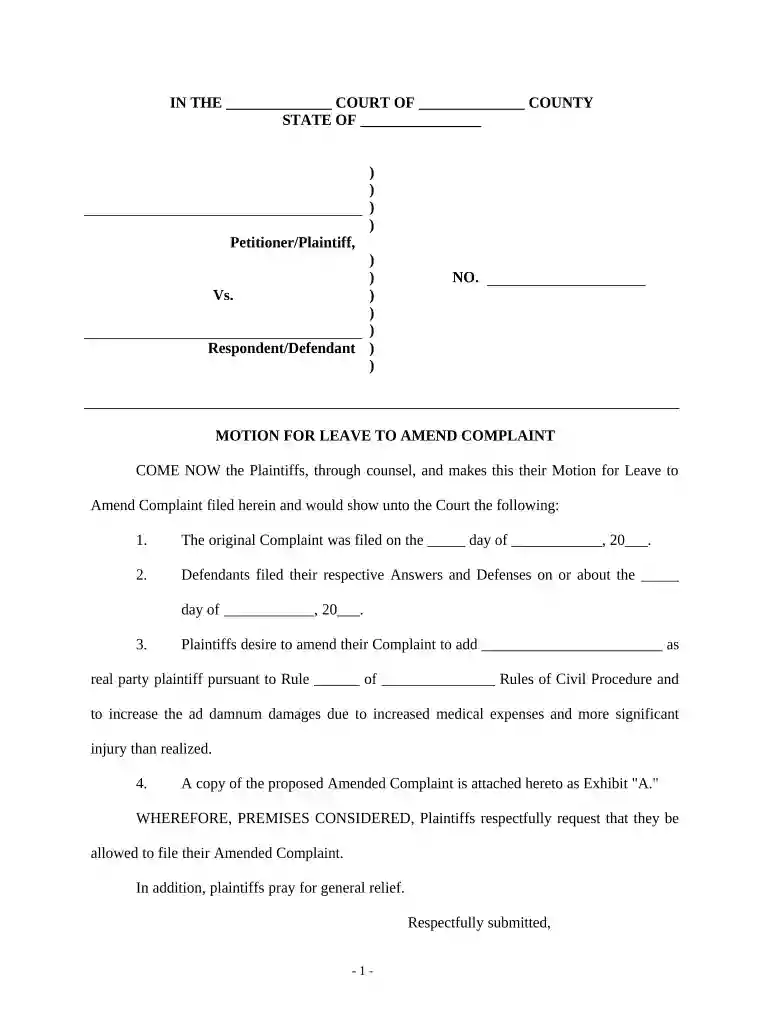
motion for leave Preview on Page 1

Here's how it works

01. Edit your motion for leave online
Type text, add images, blackout confidential details, add comments, highlights and more.

02. Sign it in a few clicks
Draw your signature, type it, upload its image, or use your mobile device as a signature pad.

03. Share your form with others
Send motion for leave to amend example via email, link, or fax. You can also download it, export it or print it out.

Understanding the Motion to Amend Complaint Form

The motion to amend complaint form is a crucial legal document filed in court when a party wishes to modify their initial complaint. This form allows for the addition of new parties, claims, or substantial changes to existing allegations. Understanding its structure and requirements is essential for effective legal proceedings.

Purpose of the Motion to Amend Complaint Form

The primary purpose of this form is to seek permission from the court to alter the original complaint. Common situations necessitating an amendment include:

  • Adding new plaintiffs or defendants to the case.
  • Modifying the claims to reflect updated damages or injuries.
  • Correcting inaccuracies in the initial filing.
  • Addressing new evidence that has emerged after the original complaint was filed.

The ability to amend complaints is vital in ensuring that the case reflects the most current and relevant issues at hand.

Steps to Complete the Motion to Amend Complaint Form

Completing the motion to amend complaint form involves several critical steps, which include:

  1. Title the Document: Clearly label the form as a "Motion to Amend Complaint" along with the case number and court details.
  2. State the Request: Begin the motion by stating explicitly that you seek leave of court to amend your complaint.
  3. Details of Amendment: Provide a detailed explanation of the proposed changes, including any new allegations or parties being introduced.
  4. Attach the Amended Complaint: Submit a copy of the proposed amended complaint alongside the motion. This serves as a reference for the court.
  5. Certification of Service: Include a statement certifying that all parties involved have been given notice of the motion, typically through attorney representation or direct service.

It is important to ensure that the tone is formal and that all statements are clear and precise.

Key Elements to Include in the Motion

When drafting the motion, certain elements are mandatory:

  • Jurisdictional Statement: Indicate the court’s authority to hear the motion.
  • Factual Background: Provide background information detailing why the motion is necessary. This should be concise but informative.
  • Legal Argument: Include a discussion of relevant legal standards that support the motion, such as rules governing amendments.
  • Conclusion: Summarize the request clearly, reiterating the need for the change.

Each section should flow logically, leading the court through the rationale behind the amendment.

Legal Standards Governing Amendments

In U.S. courts, amendments to complaints are typically evaluated under specific legal standards. Key rules include:

  • Federal Rule of Civil Procedure 15(a): This rule allows parties to amend their pleadings with the court’s leave, which should be freely given when justice requires.
  • State-Specific Rules: Various states have nuanced rules concerning amendments. Understanding local rules is critical to ensure compliance.

Failing to adhere to these standards may result in denial of the motion.

Common Scenarios for Filing a Motion to Amend

Common scenarios that may prompt the filing of a motion to amend a complaint include:

  • New Evidence: The revelation of new evidence that may affect the outcome of the case.
  • Changed Circumstances: Situations such as a change in the law that impacts the claims or defenses being made.
  • Complex Cases: In complex litigation, initial complaints may need continuous updates to address evolving issues.

Each scenario requires careful consideration of how amendments may impact ongoing legal strategies.

Practical Examples of Completed Motions

A completed motion to amend might look as follows:

  • In one case, a personal injury plaintiff filed a motion to amend the complaint to include additional medical expenses after a significant change in health status was documented.
  • In family law, a motion was granted to include a new guardian after a change in the legal status of a minor involved in custody proceedings, allowing all necessary parties to be properly represented.

These examples demonstrate the flexibility of the amendment process and its role in adapting to new realities in litigation.

Important Considerations When Filing

When preparing and filing the motion to amend, consider the following:

  • Timeliness: Ensure that motions are filed promptly to avoid potential dismissal based on delays.
  • Opposition: Be prepared for any objections from opposing parties, especially regarding the merits of the amendment or potential prejudice.
  • Court Discretion: Understand that the court enjoys broad discretion in granting or denying motions to amend.

Navigating these considerations effectively can enhance the likelihood of a favorable outcome.

Conclusion on the Importance of Amending Complaints

The motion to amend complaint form serves as a vital tool in the litigation process, ensuring that legal documents reflect current and accurate information. Knowledge of the applicable rules and careful navigation of the filing process can significantly impact the effectiveness of pursuing legal remedy.

be ready to get more

Complete this form in 5 minutes or less

Get form

Got questions?

We have answers to the most popular questions from our customers. If you can't find an answer to your question, please contact us.
Contact us
An amended complaint is a written revision of an original complaint filed by a plaintiff or petitioner. Rule 15 of the federal rules of civil procedure allows the plaintiff to amend their complaint as a matter of course once within 21 days of service of the original complaint.
An amendment is a motion to change, to add words to, or to omit words from, an original motion. The change is usually to clarify or improve the wording of the original motion and must, of course, be germane to that motion.
The defendant shall answer the amendments, or the complaint as amended, within 30 days after service thereof, or such other time as the court may direct, and judgment by default may be entered upon failure to answer, as in other cases.
An amended complaint looks like any complaint, except that it is called amended complaint. It must be complete in itself and should not refer back to your previous complaints. In fact, once you file an amended complaint, it completely replaces your previous complaints.
This Court advises the parties that when a motion to dismiss is filed, the nonmoving party has a right to amend its pleading once within 21 days.

Security and compliance

At DocHub, your data security is our priority. We follow HIPAA, SOC2, GDPR, and other standards, so you can work on your documents with confidence.
Learn more
ccpa2
pci-dss
gdpr-compliance
hipaa
soc-compliance

People also ask

An amendment is a change or addition to the terms of a contract or document. An amendment is often an addition or correction that leaves the original document substantially intact. Other times an amendment can strike the original text entirely and substitute it with new language.
File a motion that explains the error and identifies what the correct language should be. Make sure the caption of the motion contains the date and docket number of the erroneous order. Attach a copy of the proposed amended order to the motion, as an exhibit to the motion..
Plaintiffs may choose to amend a complaint for numerous reasons, like adding additional claims, correcting errors, adding additional parties to the suit, including additional requests for relief, or clearing up inadequate claims.

motion for leave to amend complaint california pdf