Conversion judgment 2026

Get Form
what does conversion mean in a court case Preview on Page 1

Here's how it works

01. Edit your what does conversion mean in a court case online
Type text, add images, blackout confidential details, add comments, highlights and more.
02. Sign it in a few clicks
Draw your signature, type it, upload its image, or use your mobile device as a signature pad.
03. Share your form with others
Send what is a charge of conversion via email, link, or fax. You can also download it, export it or print it out.

How to use or fill out conversion judgment with our platform

Form edit decoration
9.5
Ease of Setup
DocHub User Ratings on G2
9.0
Ease of Use
DocHub User Ratings on G2
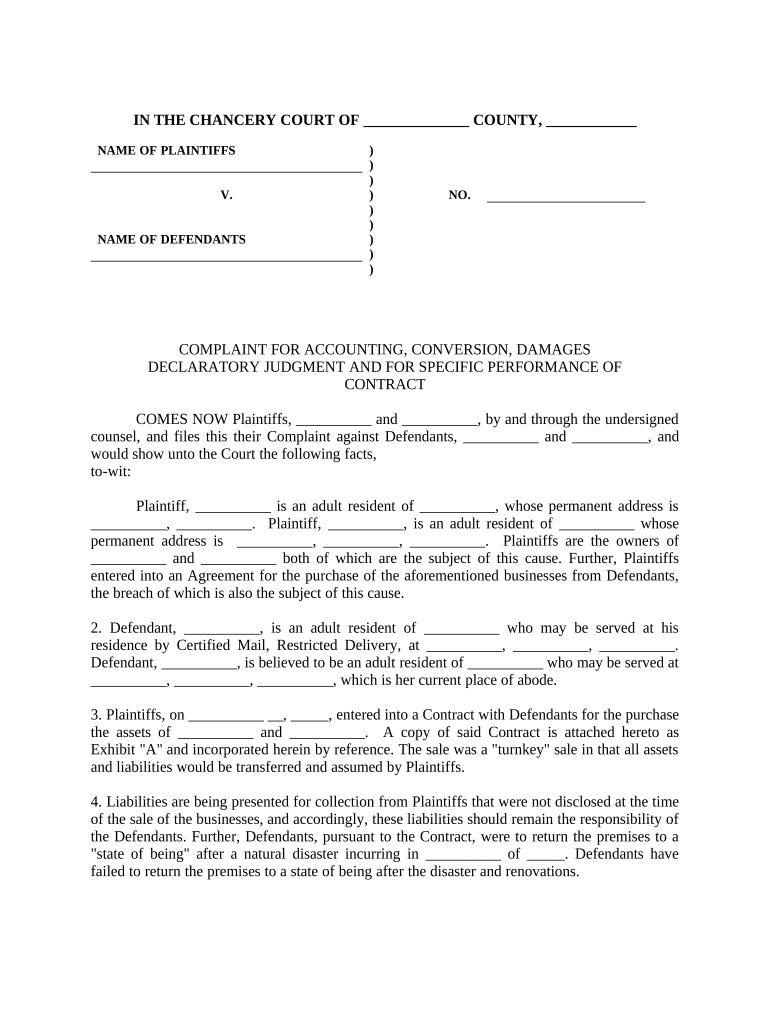
  1. Click ‘Get Form’ to open the conversion judgment document in the editor.
  2. Begin by filling in the names of the plaintiffs and defendants in the designated fields at the top of the form. Ensure that all names are spelled correctly for accuracy.
  3. In Section 1, provide the permanent addresses of each plaintiff. This information is crucial for legal notifications and should be entered carefully.
  4. Proceed to Section 2, where you will need to detail how each defendant can be served. Include their current addresses and any specific instructions for service.
  5. In Section 3, summarize the contract details between plaintiffs and defendants, including dates and key terms. Attach any relevant documents as exhibits using our platform’s upload feature.
  6. Continue through each section, ensuring that you address all counts listed, such as accounting, conversion, and damages. Use clear language to describe your claims and desired outcomes.
  7. Finally, review your entries for completeness and accuracy before submitting your form through our platform’s submission feature.

Start using our platform today to streamline your document editing and ensure a smooth completion of your conversion judgment!

be ready to get more

Complete this form in 5 minutes or less

Get form

Got questions?

We have answers to the most popular questions from our customers. If you can't find an answer to your question, please contact us.
Contact us
Conversion is an intentional tort which occurs when a party takes the chattel property of another with the intent to deprive them of it. Conversion is not applicable to real property . For the purposes of conversion, intent merely means the objective to possess the property or exert property rights over it.
An example might be tapping someones secured wireless LAN or public utility line (which could also amount to theft of services). Another example might be taking a joy ride in a car, never intending to keep it from the owner.
Traditionally, a conversion occurs when some chattel is lost, then found by another who appropriates it to his own use without legal authority to do so. It has also applied in cases where chattels were bailed for safekeeping, then misused or misappropriated by the bailee or a third party.
Under California law, conversion is a civil cause of action that applies when a person unlawfully and without permission takes or interferes with your possession of your property. You can bring a claim for. recovery of the property, or. compensation for the value of the lost property.
What is conversion under California law? Conversion, under California law, is defined as: intentional interference with the property of another with the intent to deprive the owner of the property.

Security and compliance

At DocHub, your data security is our priority. We follow HIPAA, SOC2, GDPR, and other standards, so you can work on your documents with confidence.

Learn more
ccpa2
pci-dss
gdpr-compliance
hipaa
soc-compliance

People also ask

Conversion is a legal expression that describes a civil tort (when someone does something wrong, but criminal law is not broken ) where one person converts another persons property for themselves. Basically stealing. Other ways to think about it? When someone pretends to own something that belongs to someone else.

Related links