Minnesota discovery request 2026

Get Form
minnesota discovery request Preview on Page 1

Here's how it works

01. Edit your form online
Type text, add images, blackout confidential details, add comments, highlights and more.
02. Sign it in a few clicks
Draw your signature, type it, upload its image, or use your mobile device as a signature pad.
03. Share your form with others
Send it via email, link, or fax. You can also download it, export it or print it out.

How to use or fill out Minnesota Discovery Request with Our Platform

Form edit decoration
9.5
Ease of Setup
DocHub User Ratings on G2
9.0
Ease of Use
DocHub User Ratings on G2
  1. Click ‘Get Form’ to open the Minnesota Discovery Request in the editor.
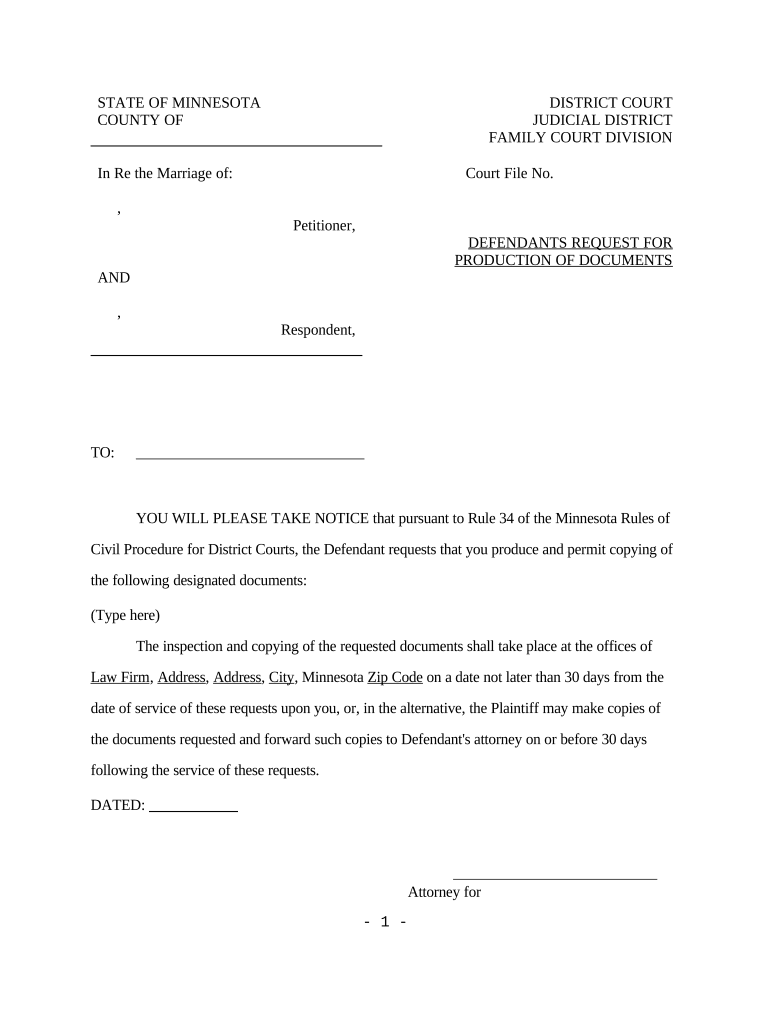
  2. Begin by entering the Court File Number at the top of the form. This is essential for identifying your case.
  3. In the section labeled 'Petitioner' and 'Respondent', fill in the names of both parties involved in the case.
  4. Next, address the recipient of the request by filling in their name under 'TO:'.
  5. In the designated area, specify the documents you are requesting from the other party. Be clear and concise to avoid confusion.
  6. Indicate where and when the inspection and copying will take place, ensuring it complies with the 30-day requirement stated in Rule 34.
  7. Finally, complete the form by signing it as 'Attorney for' and providing your contact information including address, telephone number, and attorney registration number.

Start using our platform today to easily fill out your Minnesota Discovery Request for free!

be ready to get more

Complete this form in 5 minutes or less

Get form

Got questions?

We have answers to the most popular questions from our customers. If you can't find an answer to your question, please contact us.
Contact us
The purpose of discovery is to provide parties the opportunity to gather evidence relevant to proving or defending the case. A Guide to the Discovery Process for Unrepresented Complainants Equal Employment Opportunity Commission federal-sector guide-discovery- Equal Employment Opportunity Commission federal-sector guide-discovery-
The other party might not respond, or s/he could file a motion to compel discovery. A motion to compel discovery is a written request to the judge in which the party seeking discovery asks the judge to issue an order requiring that the other party turns over the requested documents by a certain date or face certain Before the Trial: How do I object when I do not want to turn over a WomensLaw.org trial document-requests WomensLaw.org trial document-requests
The Benefits of Discovery for Both Plaintiffs and Defendants Allows attorneys on both sides to determine what facts, evidence, and other information are available. Helps plaintiffs and defendants understand the legal issues at play in the case and better prepare for trial.
No person shall hereafter carry on or conduct or transact a commercial business in this state under any designation, name, or style, which does not set forth the true name of every person interested in such business unless such person shall file in the Office of the Secretary of State, a certificate setting forth the Sec. 333.01 MN Statutes MN Revisors Office statutes cite MN Revisors Office statutes cite
Discovery is important because allows the parties to know what evidence the other side has. It was designed to prevent trial by ambush, where one side doesnt learn of the other sides evidence or witnesses until it is too late; leaving the other side scrambling trying to figure out an on-the-spot response.

Security and compliance

At DocHub, your data security is our priority. We follow HIPAA, SOC2, GDPR, and other standards, so you can work on your documents with confidence.

Learn more
ccpa2
pci-dss
gdpr-compliance
hipaa
soc-compliance

People also ask

Discovery is a process you can use before your trial to find out information from another party. The purpose of discovery is to find out the information you need to prove your case or defend against the claims being made against you.
63.03Notice to Remove A judge or judicial officer who has presided at a motion or other proceeding or who is assigned by the Chief Justice of the Minnesota Supreme Court may not be removed except upon an affirmative showing that the judge or judicial officer is disqualified under the Code of Judicial Conduct. minnesota court rules - civil procedure - MN Revisors Office MN Court Rules courtrules MN Court Rules courtrules
You typically have 30 days to respond to the request During the time you have to respond to discovery requests, you can still use mediation or work to negotiate a settlement with the other side. How you respond will depend upon what type of request youve received.

Related links