Special or Limited Power of Attorney for Real Estate Sales Transaction By Seller - California 2026

Get Form
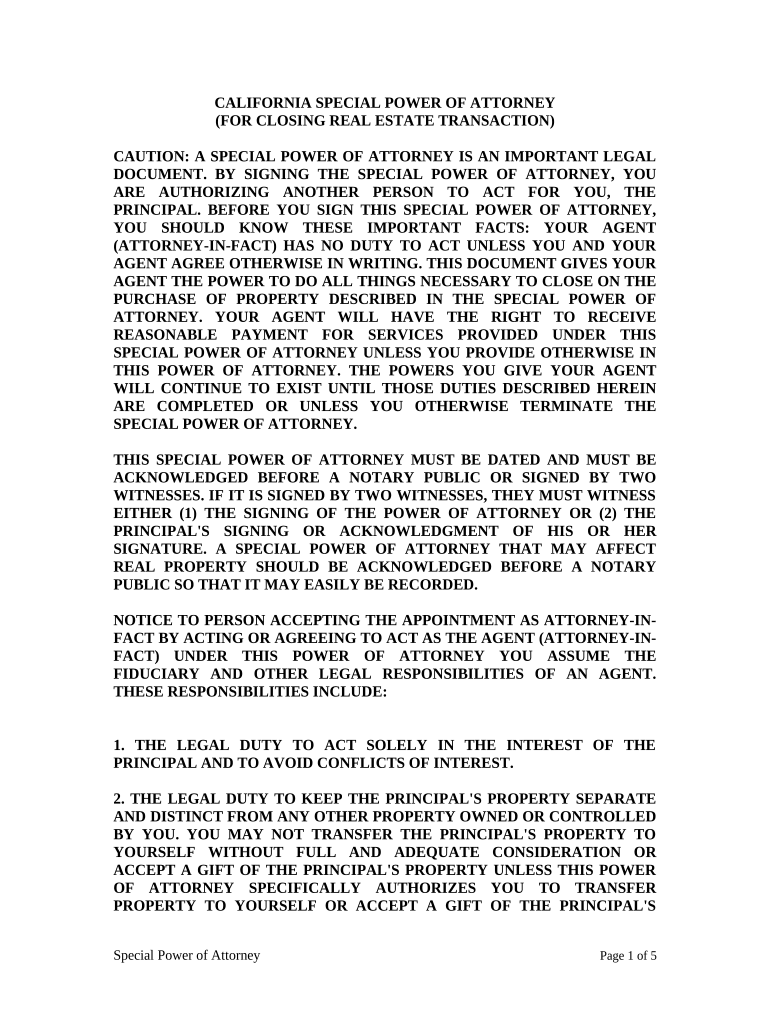
Special or Limited Power of Attorney for Real Estate Sales Transaction By Seller - California Preview on Page 1

Here's how it works

01. Edit your form online
Type text, add images, blackout confidential details, add comments, highlights and more.
02. Sign it in a few clicks
Draw your signature, type it, upload its image, or use your mobile device as a signature pad.
03. Share your form with others
Send it via email, link, or fax. You can also download it, export it or print it out.

How to use or fill out Special or Limited Power of Attorney for Real Estate Sales Transaction By Seller - California

Form edit decoration
9.5
Ease of Setup
DocHub User Ratings on G2
9.0
Ease of Use
DocHub User Ratings on G2
  1. Click ‘Get Form’ to open it in the editor.
  2. Begin by entering your name and address in the designated fields as the Principal. Ensure accuracy, as this information is crucial for legal identification.
  3. Next, appoint your Attorney-in-Fact by filling in their name and address. This person will act on your behalf in real estate transactions.
  4. In the section granting powers, specify the property details, including its common address and legal description. This ensures clarity on what property is involved.
  5. Review the powers granted to your Attorney-in-Fact, ensuring they align with your intentions for the transaction.
  6. Sign and date the document at the bottom. Remember that a notary public must acknowledge this signature for it to be valid.

Start using our platform today to complete your Special Power of Attorney form online for free!

be ready to get more

Complete this form in 5 minutes or less

Get form

Got questions?

We have answers to the most popular questions from our customers. If you can't find an answer to your question, please contact us.
Contact us
As long as the principal is alive, and the Power of Attorney (POA) does not limit the Attorney-in-facts authority to sell the home, and it can be demonstrated that selling the home serves the principals best interests, then the POA has the power to sell the home.
Creating a Limited Power of Attorney (LPOA) in California requires filling out a state-approved form, clearly stating the powers youre granting, the duration of the LPOA, and the identity of your agent. For it to be valid, the form needs to be docHubd.
A California real estate power of attorney is drafted to appoint an individual to act on behalf of the creator in real estate transactions. Once the document has been executed, the attorney-in-fact will be able to sign documents, transfer property, manage tenants, and perform other property management tasks.
Specificity is Key in Powers of Attorney These documents will remain in effect until the creator rescinds the order or the subject dies. By contrast, a limited power of attorney grants only specific powers to the holder.
What a power of attorney cant do Change a principals will. Break their fiduciary duty to act in the principals best interests. Make decisions on behalf of the principal after their death. (POA ends with the death of the principal. Change or transfer POA to someone else.

Security and compliance

At DocHub, your data security is our priority. We follow HIPAA, SOC2, GDPR, and other standards, so you can work on your documents with confidence.

Learn more
ccpa2
pci-dss
gdpr-compliance
hipaa
soc-compliance

People also ask

2:14 3:53 Terms and legal requirements. However once the principal passes. Away the power of attorney is noMoreTerms and legal requirements. However once the principal passes. Away the power of attorney is no longer valid. And any property sales must be handled through the probate. Process.
Key Takeaways: A Power of Attorney (POA) can sell property before death if explicitly authorized in the document, but authority ends immediately upon death. When selling property, POA agents must provide proper documentation, follow legal requirements, and always act in the principals best interest.
Yes, an agent may change beneficiaries on financial accounts they manage on someones behalf if the bank verifies that the POA meets legal requirements. If the POA does not explicitly grant this authority, the agents actions may be challenged and require additional documentation.

Related links