




01. Edit your engine build sheet online
Type text, add images, blackout confidential details, add comments, highlights and more.

Type text, add images, blackout confidential details, add comments, highlights and more.

Draw your signature, type it, upload its image, or use your mobile device as a signature pad.

Send engine build sheet template via email, link, or fax. You can also download it, export it or print it out.
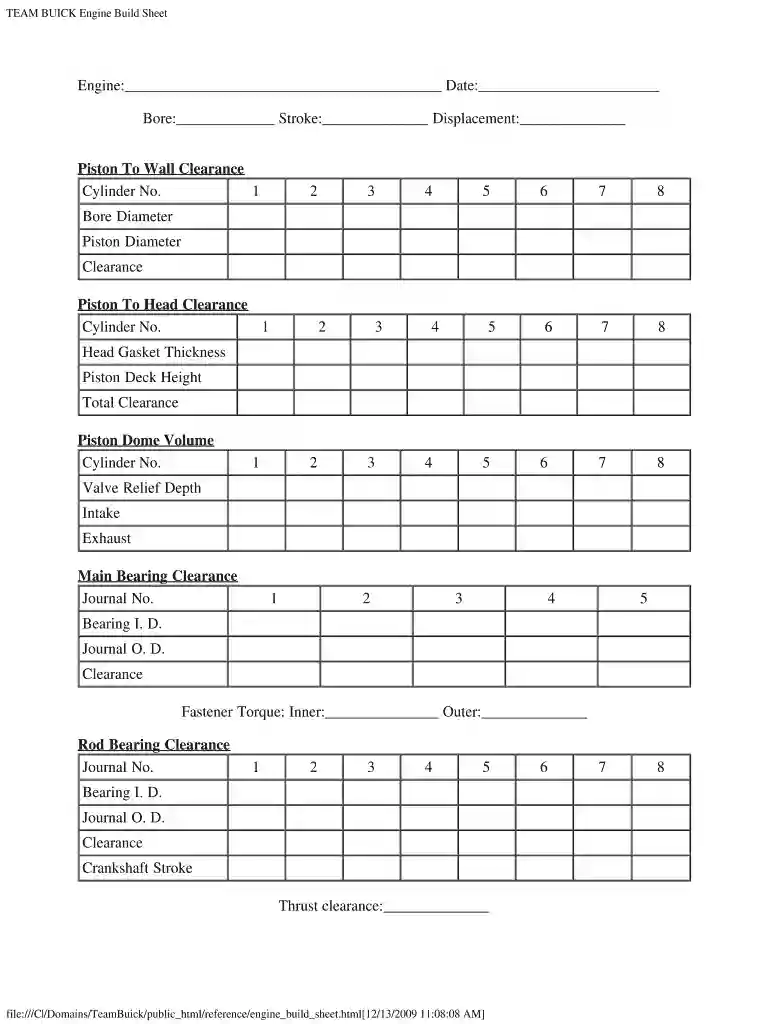
An engine build sheet is a comprehensive document that outlines the specifications and measurements for various engine components during assembly and tuning. It serves as a detailed guide for builders, providing essential information for all stages of engine construction and modification. Typically, it includes data on bore, stroke, piston clearance, valve springs, camshaft specifications, fastener torque, and more. An accurate engine build sheet ensures consistency and quality in engine performance while aiding in troubleshooting and maintenance.
Documenting measurements in an engine build sheet is crucial for several reasons:
Using an engine build sheet effectively involves several key steps. By following these steps, builders can ensure accuracy and efficiency throughout the engine assembly process.
Review Specifications: Begin by closely examining the specifications detailed in the engine build sheet. This includes understanding the intended use of the engine and any performance goals.
Gather Required Parts: Collect all parts listed in the build sheet to ensure that no components are overlooked during assembly.
Follow Assembly Instructions: Utilize the step-by-step assembly instructions provided to put together the engine components. Proper adherence to these guidelines helps avoid mistakes.
Document Adjustments: As you progress with the build, document any changes made to the original specifications. This is particularly important for custom builds.
Verify Final Assembly: After completing the assembly, double-check all measurements against the build sheet to verify that everything aligns with the documented specifications.
Understanding the specific terminology associated with engine build sheets is instrumental for builders and engineers. Below are essential terms explained:
Torque Specifications: Refers to the precise amount of force applied when tightening bolts and other components. Correct torque ensures the integrity of the engine build.
Clearance: This term indicates the space between moving parts, such as piston clearance, which is vital for engine performance and longevity.
Blueprinting: Refers to a process where engine components are machined to exact specifications outlined in an engine build sheet. This process aims to enhance performance by maximizing efficiency.
Practical applications of an engine build sheet can vary widely among different builders and engine types. Below are several scenarios:
Utilizing engine build sheets in digital or paper formats offers distinct advantages and challenges. Understanding these differences can inform a builder's choice.
In practice, many builders opt for a combination of both formats, using digital sheets for initial assembly documentation while keeping printed versions for shop records.
Completing an engine build sheet requires careful attention to detail and an understanding of the engine components involved. Follow these steps to ensure a thorough and complete build sheet.
Define Engine Type: Specify the type of engine being built (e.g., V8, inline-four).
List Components: Compile a detailed list of all engine components, including pistons, camshaft, intake and exhaust systems.
Record Measurements: Document precise measurements such as bore, stroke, and clearance to provide a clear specification reference.
Outline Assembly Sequence: Create an outline for the assembly sequence, noting any special procedures or tools required.
Review for Completeness: Once the build sheet is drafted, review it against the physical parts and assembly plan to ensure no details are overlooked.
By following these structured steps, builders can create an effective engine build sheet that supports high-quality assembly and enhances overall performance.
At DocHub, your data security is our priority. We follow HIPAA, SOC2, GDPR, and other standards, so you can work on your documents with confidence.
by HJ Lee 2016 Cited by 1 We review the history of jet engines, types of jet engines, how we built our jet engine and the engineering analysis behind it. We calculatedRead more
Feb 24, 2021 This manual provides instruction for servicing on-highway, industrial, generator set, and marine applications of the Detroit Diesel Series 92Read more


