Personal representative deed pdf 2026

Get Form
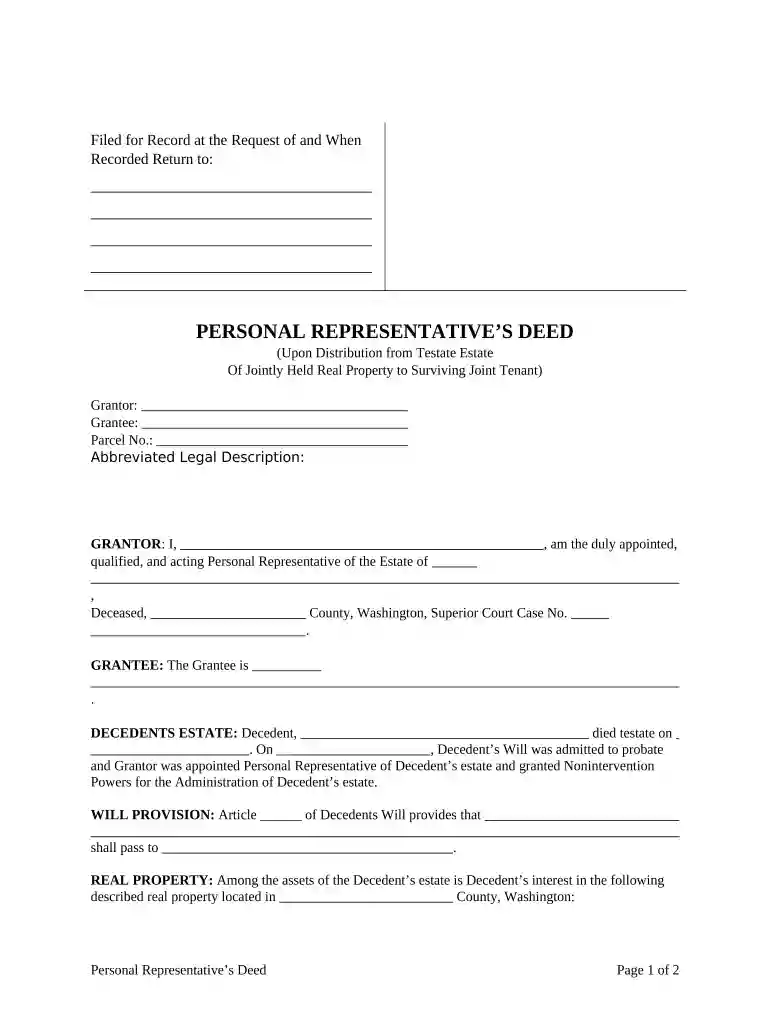
personal representative deed new mexico Preview on Page 1

Here's how it works

01. Edit your personal representative deed new mexico online
Type text, add images, blackout confidential details, add comments, highlights and more.

02. Sign it in a few clicks
Draw your signature, type it, upload its image, or use your mobile device as a signature pad.

03. Share your form with others
Send personal representative deed pdf via email, link, or fax. You can also download it, export it or print it out.

How to use or fill out personal representative deed pdf with our platform

Form edit decoration
9.5
Ease of Setup
DocHub User Ratings on G2
9.0
Ease of Use
DocHub User Ratings on G2
  1. Click ‘Get Form’ to open the personal representative deed PDF in the editor.
  2. Begin by filling in the 'Grantor' section with your name as the Personal Representative of the estate, along with the deceased's name and relevant court case number.
  3. In the 'Grantee' field, enter the name of the surviving joint tenant who will receive the property.
  4. Complete the 'Decedent's Estate' section by providing details about the decedent's death date and probate admission date.
  5. Fill in Article provisions from the decedent’s Will that specify how property is to be distributed.
  6. Describe the real property being conveyed, including its legal description and common address.
  7. Confirm consideration for this conveyance based on decedent’s intent as stated in their Will.
  8. Sign and date at the bottom of the form, ensuring all information is accurate before finalizing.

Start using our platform today to easily complete your personal representative deed PDF for free!

be ready to get more

Complete this form in 5 minutes or less

Get form

Got questions?

We have answers to the most popular questions from our customers. If you can't find an answer to your question, please contact us.
Contact us
Personal representatives can also use a power of attorney to enable another person to act on their behalf. It is usually used where a temporary issue means that the personal representative is not available to deal with a specific element of administration.
A Fiduciary Deed, also known as a trustees deed or personal representatives deed, is a legal document used to convey real property from one party (the grantor) to another (the grantee). A fiduciary is a person or entity entrusted with the responsibility to manage and act in the best interests of another party.
A power of attorney names someone to act on your behalf while youre incapacitated but still alive. A personal representative only assumes their duties after your death.
The Key Differences between a POA and a PR: Purpose: A Power of Attorney is often used for incapacity planning or to facilitate decision making during the individuals lifetime, while a PR is appointed to handle the affairs of a deceased individuals estate after their death.
A personal representative deed is executed by the personal representative of the deceased persons estate. The personal representative must have legal authority to act on behalf of the estate, which is typically granted through a court order. The deed must be signed by the personal representative and notarized.

Security and compliance

At DocHub, your data security is our priority. We follow HIPAA, SOC2, GDPR, and other standards, so you can work on your documents with confidence.
Learn more
ccpa2
pci-dss
gdpr-compliance
hipaa
soc-compliance

People also ask

Under the Uniform Probate Code , a personal representative has the same power over the title to property of the estate that an absolute owner would have. Although, the personal representative holds the property of the estate in trust for the benefit of the creditors and others interested in the estate. This power
A personal representative is the person, or it may be more than one person, who is legally entitled to administer the estate of the person who has died (referred to as the deceased). The term personal representatives, sometimes abbreviated to PR, is used because it includes both executors and administrators.

personal representative deed example