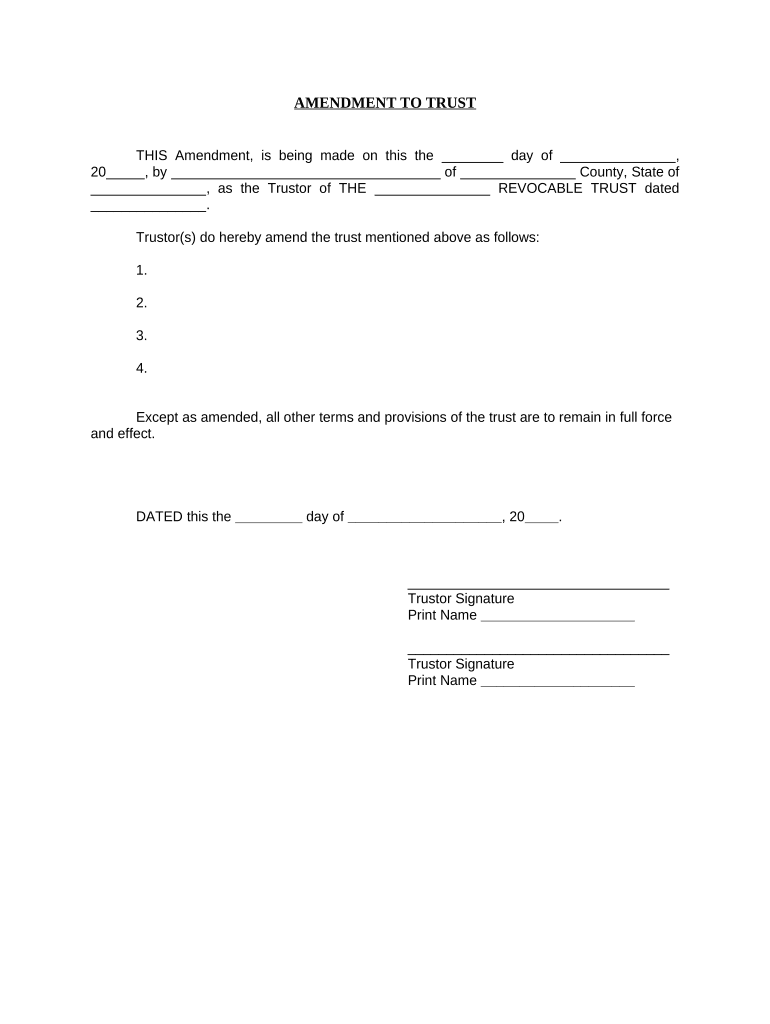
Amendment to Living Trust - Maryland 2026

Get Form
Amendment to Living Trust - Maryland Preview on Page 1

Here's how it works

01. Edit your form online
Type text, add images, blackout confidential details, add comments, highlights and more.
02. Sign it in a few clicks
Draw your signature, type it, upload its image, or use your mobile device as a signature pad.
03. Share your form with others
Send it via email, link, or fax. You can also download it, export it or print it out.

How to use or fill out Amendment to Living Trust - Maryland with our platform

Form edit decoration
9.5
Ease of Setup
DocHub User Ratings on G2
9.0
Ease of Use
DocHub User Ratings on G2
  1. Click ‘Get Form’ to open the Amendment to Living Trust - Maryland in the editor.
  2. Begin by entering the date of the amendment in the first blank field. This should reflect the day you are completing the document.
  3. Fill in your name as the Trustor, along with your county and state in the designated fields. Ensure accuracy for legal purposes.
  4. In the amendment section, clearly outline any changes you wish to make to your existing trust. Number each amendment for clarity.
  5. After detailing your amendments, confirm that all other terms of the original trust remain unchanged by noting this at the end of this section.
  6. Sign and print your name in the signature fields provided. If there are multiple Trustors, ensure all signatures are included.
  7. Finally, complete the notary section by having a Notary Public witness your signatures and fill out their information accordingly.

Start using our platform today for free to easily complete your Amendment to Living Trust - Maryland!

be ready to get more

Complete this form in 5 minutes or less

Get form

Got questions?

We have answers to the most popular questions from our customers. If you can't find an answer to your question, please contact us.
Contact us
While its possible to amend a revocable living trust on your own, its advisable to consult with an experienced estate planning attorney in California. They can provide legal guidance and ensure that your amendments comply with state laws.
A trust is a distinct legal entity, and changes to it must follow specific procedures. Codicils, in the traditional sense, apply only to wills. However, amending a trust follows a similar process, even though it is not called a codicil.
An amendment is a formal document making a change to one or multiple parts of a Revocable Living Trust. A codicil is a formal document making a change to one or multiple parts of a Last Will and Testament.
A codicil is a legal document that allows you to make changes or amendments to an existing will without revoking the entire document. Think of it as an addendum that serves to address specific alterations while keeping the original terms of the will intact.
Simple amendments, like changing a beneficiary or trustee, can range between $300 to $500. More substantial changes, such as a complete restatement of the trust to reflect docHub alterations, could exceed $2,000.

Security and compliance

At DocHub, your data security is our priority. We follow HIPAA, SOC2, GDPR, and other standards, so you can work on your documents with confidence.

Learn more
ccpa2
pci-dss
gdpr-compliance
hipaa
soc-compliance

People also ask

A revocable trust can be modified while the Grantor is alive. Revising the terms of a trust is known as amending the trust. An amendment is generally appropriate when there are only a few minor changes to make, like rewording a certain paragraph, changing the successor trustee, or modifying beneficiaries.
California law does not require notarization of trust amendments, but having your signature docHubd can provide additional proof of authenticity and may help prevent future challenges to the validity of your changes.
Potential for errors: There is a more docHub potential for errors when using a codicil than when creating a new will. A codicil might introduce conflicting terms with the original will, creating ambiguity and a lack of clarity. Limited scope: Codicils can only be used to make minor changes to your will.

Related links