Quitclaim Deed from Individual to LLC - Arizona 2026

Get Form
how to quit claim a property to an llc Preview on Page 1

Here's how it works

01. Edit your how to quit claim a property to an llc online
Type text, add images, blackout confidential details, add comments, highlights and more.
02. Sign it in a few clicks
Draw your signature, type it, upload its image, or use your mobile device as a signature pad.
03. Share your form with others
Send quitclaim deed arizona via email, link, or fax. You can also download it, export it or print it out.

How to use or fill out Quitclaim Deed from Individual to LLC - Arizona

Form edit decoration
9.5
Ease of Setup
DocHub User Ratings on G2
9.0
Ease of Use
DocHub User Ratings on G2
  1. Click ‘Get Form’ to open it in the editor.
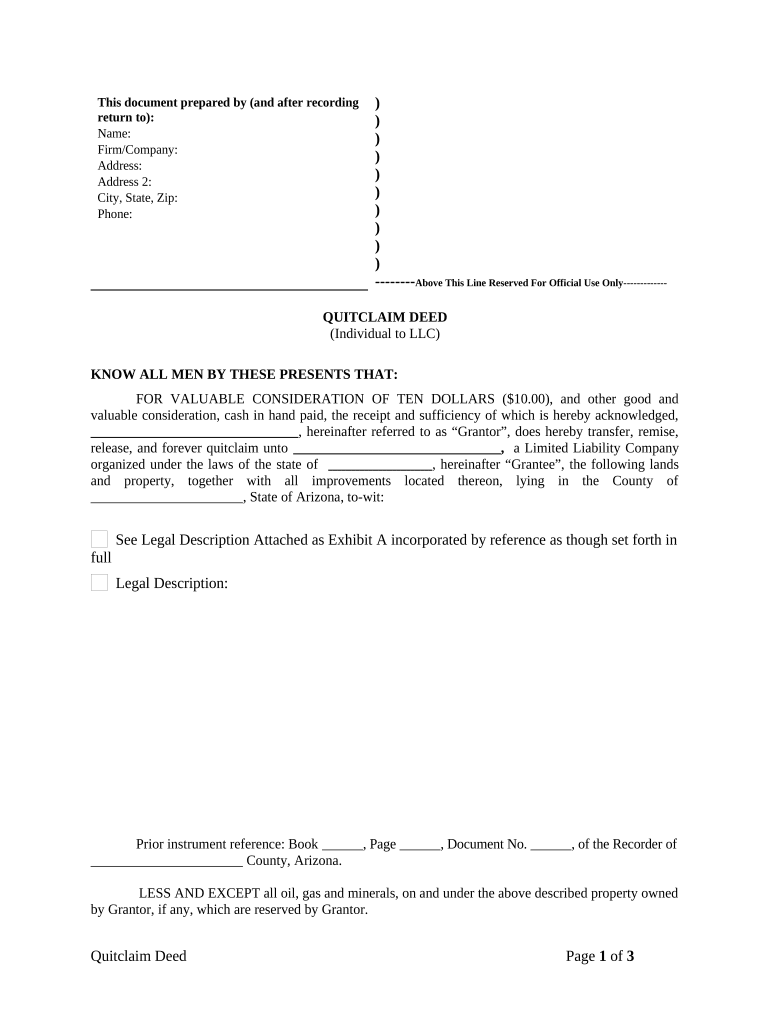
  2. Begin by entering the Grantor's name, firm/company, address, and contact information in the designated fields at the top of the form.
  3. In the main body, specify the Grantee's name (the LLC) and ensure you include its state of organization. This is crucial for legal clarity.
  4. Fill in the legal description of the property being transferred. If you have an attachment (Exhibit A), reference it appropriately.
  5. Indicate any prior instrument references if applicable, including book, page, and document numbers.
  6. Decide on tax responsibilities and select one of the options provided regarding tax payments between Grantor and Grantee.
  7. Complete the signature section by having the Grantor sign and print their name. Ensure that if married, both spouses sign if required.
  8. Finally, complete the notary section with necessary details for acknowledgment.

Start using our platform today to streamline your Quitclaim Deed process for free!

be ready to get more

Complete this form in 5 minutes or less

Get form

Got questions?

We have answers to the most popular questions from our customers. If you can't find an answer to your question, please contact us.
Contact us
So, if title is already held by both the individual and the LLC, the most straightforward method is to use a quitclaim deed so that the LLC can renounce, or quit, their ownership in the property.
Follow these steps to transfer property to LLC business structures. Make sure your LLC is registered. Review the property title and LLC operating agreement. Draft a deed of transfer. docHub and file the deed. Notify your mortgage company. Update tax records. Transfer utilities and insurance. Plan for tax complications.
Three advantages to using an LLC for rental property are pass-through of income and losses, protecting personal assets, and creating a flexible ownership structure. Drawbacks to using an LLC include possible self-employment tax, difficulty of financing, and annual fees.
A quit claim deed to LLC transfers property ownership but does not guarantee the property is free from liens or encumbrances. LLCs provide liability protection for real estate owners, but transferring property using a quit claim deed does not remove personal liability from an existing mortgage.
The quitclaim deed must identify both the grantor and the grantee or the person or entity receiving the interest in the real estate by name. Finally, one of the parties must record the quitclaim deed at the local county recorders office so that it becomes an official document.

Security and compliance

At DocHub, your data security is our priority. We follow HIPAA, SOC2, GDPR, and other standards, so you can work on your documents with confidence.

Learn more
ccpa2
pci-dss
gdpr-compliance
hipaa
soc-compliance

People also ask

Transferring Property to the LLC The deed should clearly state the LLC as the new owner of the property. File the Deed with the County Recorders Office Once the deed is prepared, file it with the county recorders office where the property is located. This officially transfers ownership of the property to your LLC.
A quitclaim deed is another type of deed that can be used to transfer property to an LLC. Unlike a warranty deed, a quitclaim deed does not provide any personal guarantee regarding the title or condition of the property. Instead, it transfers the interest or rights the seller has in the property to the buyer (the LLC).

Related links